Home / Alabama / Tuskegee & East Alabama / Tuskegee Airmen National Historic Site
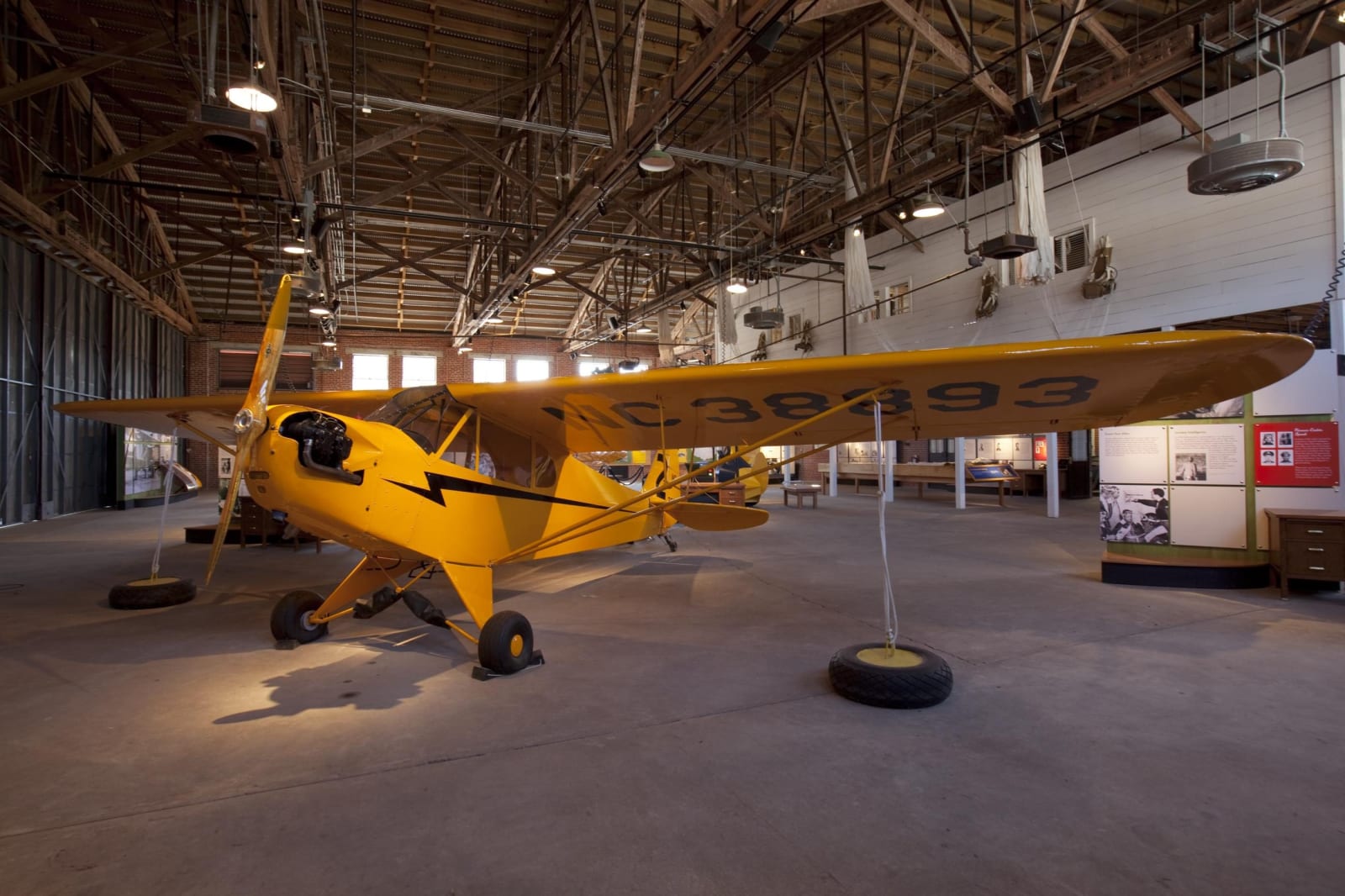
A yellow training plane on display inside a wooden-trussed hangar at Moton Field, with exhibit panels along the walls.Carol M. Highsmith / public domain via Library of Congress
🏛️Historical

Tuskegee Airmen National Historic Site

Part ofTuskegee & East Alabama

Moton Field, the Tuskegee Institute airfield where every Black military pilot of World War II began flight training, now a National Park Service site with its hangars and control tower.

⏱
Duration
One to two hours.
🎟
Admission
Free.
📅
Best Season
Year round.

The Story

Before 1940 Black Americans were not allowed to fly for the U.S. military, and the common white view held that they could not. The NAACP and the Black press pushed until the Army agreed to train Black pilots, on a segregated basis, at Tuskegee, where the institute already ran a civilian pilot program. The Rosenwald Fund paid for Moton Field, built from 1940 to 1942 and named for Robert R. Moton, the school's second president. In March 1941 Eleanor Roosevelt, a Rosenwald trustee, flew with the school's chief instructor, C. Alfred "Chief" Anderson, and her flight helped raise the rest of the money. Tuskegee was the only Black institution to own and run a military flight school.

The first class, with Benjamin O. Davis Jr., began training on July 19, 1941. Cadets went on to Tuskegee Army Air Field nearby, and almost 1,000 pilots finished, with more than 15,000 men and women supporting them. The 332nd Fighter Group, its P-51s painted with red tails, shot down 112 enemy aircraft over Europe. The old claim that it never lost a bomber is not true, but its losses were well below the average. Back home the airmen were still segregated stepping off the ship, and in 1945 101 officers were arrested for entering a whites-only club at Freeman Field, Indiana.

The site opened in 2008. The hangars, control tower and field buildings hold the story of the cadets, mechanics, parachute riggers and the women who worked the field, including a restored Link Trainer flight simulator.

Visitor Info

⏱
Time Needed
One to two hours.
🎟
Admission
Free.
📅
Best Season
Year round.
🛣️
Highway
Chappie James Avenue, off AL 81

On the Map

Nearby

The closest stops worth working into your route

historical2.5 mi away
Tuskegee Institute National Historic Site
The Tuskegee University campus that Booker T. Washington's students built by hand, with his house, The Oaks, and the George Washington Carver Museum kept by the National Park Service.
historical2.5 mi away
Tuskegee History Center
The museum Fred Gray and study survivor Herman Shaw founded in 1997 to remember the men of the Public Health Service syphilis study, and Macon County's welcome center.
natural3.3 mi away
Tuskegee National Forest
The nation's smallest national forest, replanted on worn-out Macon County cotton land by Tuskegee Institute and New Deal crews in the 1930s, with the Bartram Trail through it.
historical11 mi away
Pioneer Park and Lee County Historical Society Museum
A railroad-era trade building and a village of old buildings in Loachapoka, the Creek town Lucv-Pokv, which militia destroyed in 1836.
natural14 mi away
Chewacla State Park
A 696-acre Civilian Conservation Corps park on Auburn's south edge, where a 1930s stone dam spills over as Chewacla Falls below a 26-acre lake.
cultural15 mi away
Toomer's Corner
The corner of Magnolia Avenue and College Street where Auburn's campus meets its downtown, home of Toomer's Drugs since 1896 and of the oaks fans roll in toilet paper after a win.

Historical markers nearby

Roadside plaques and monuments within a short detour

Marker2.3 mi away
Samuel "Sammy" Leamon Younge, Jr.
Tuskegee
Marker2.3 mi away
Macon County Legal Milestone
Tuskegee
Marker2.6 mi away
Tuskegee Civic Association
Tuskegee Institute
Marker2.8 mi away
Amelia Boynton Robinson
Tuskegee Institute
Marker7.5 mi away
Birthplace of Zora Neale Hurston
Notasulga
Marker12 mi away
Tukabatchee / Tokvpvcce
Tallassee