Home / New Mexico / Albuquerque & the Middle Rio Grande / Trinity Site
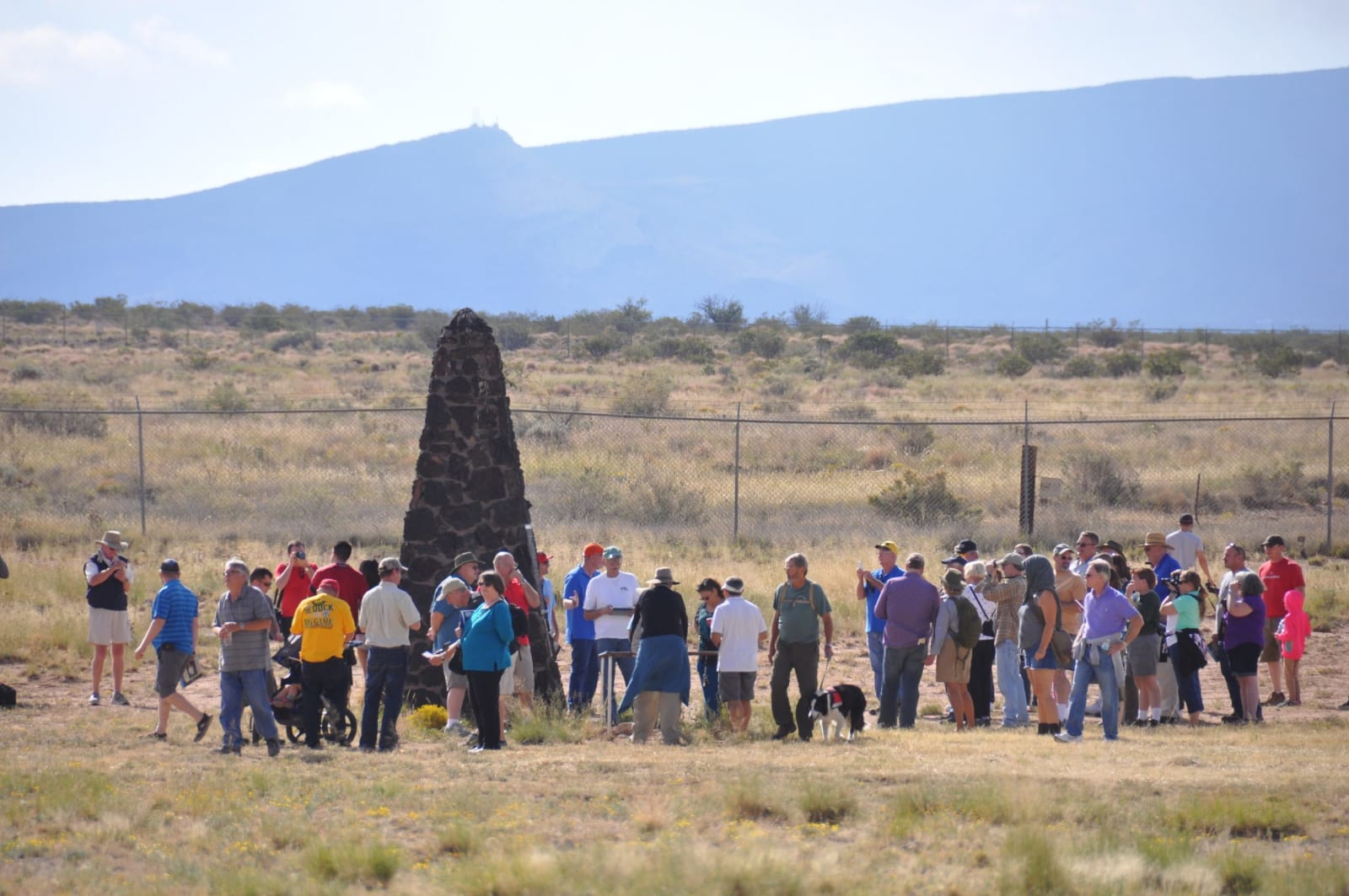
Visitors gathered around the dark stone obelisk marking ground zero during a Trinity Site open houseWinifred Brown / public domain via Wikimedia Commons
🏛️Historical

Trinity Site

Part ofAlbuquerque & the Middle Rio Grande

Where the first atomic bomb was exploded on July 16, 1945, open one day a year, and remembered by its neighbors as the start of decades of illness the government took eighty years to acknowledge.

Off the Beaten PathIconicFree
⏱
Duration
Most of the day, with the drive and the lines.
🎟
Admission
Free.
📅
Best Season
Open one day a year, the third Saturday in October.

The Story

At 5:29 on the morning of July 16, 1945, scientists from Los Alamos exploded the first atomic bomb on a steel tower in the Jornada del Muerto, on ground that is now the Army's White Sands Missile Range. Ground zero is marked by a dark obelisk of lava rock inside a fenced circle. A short drive away stands the McDonald ranch house, where the bomb's plutonium core was assembled in the days before the test.

The site opens to the public once a year, on the third Saturday in October, through the Stallion Gate on NM-525, reached from US-380 east of San Antonio. The visit is self-guided and free; photographs are allowed at ground zero and the ranch house, there is no fuel anywhere on the range, and the Army's own figure is that an hour at ground zero adds about half a millirem of radiation.

The people who lived downwind were told nothing. Ranching and farming families across the Tularosa Basin and beyond went on living with the fallout, and many of their children and grandchildren count generations of cancers since. When Congress passed the Radiation Exposure Compensation Act in 1990, it paid downwinders of the Nevada test site and left New Mexico's out. The Tularosa Basin Downwinders Consortium, founded in 2005 by Tina Cordova and others, pressed for two decades to change that, and in July 2025 an expansion of the law finally covered them and their families.

A state sign honoring the downwinders went up outside the missile range on the test's eightieth anniversary, and Congress has since ordered the Defense Department to raise monuments to them at White Sands and at Holloman Air Force Base.

Visitor Info

⏱
Time Needed
Most of the day, with the drive and the lines.
🎟
Admission
Free.
📅
Best Season
Open one day a year, the third Saturday in October.
🛣️
Highway
US-380

On the Map

Nearby

The closest stops worth working into your route

natural25 mi away
Bosque del Apache National Wildlife Refuge
A Rio Grande refuge south of Socorro where cranes and geese winter by the tens of thousands on wetlands and fields kept by people, because the river no longer floods to make them.
cultural36 mi away
Three Rivers Petroglyph Site
More than 21,000 petroglyphs on a basalt ridge above the Tularosa Basin, one of the few places in the Southwest set aside for its rock art alone, walked on a rough half-mile trail.
historical52 mi away
Smokey Bear Historical Park
The small park in Capitan where the living Smokey Bear is buried, a cub found clinging to a burned tree in the Capitan Mountains in 1950, six years after the cartoon was invented.
historical64 mi away
Lincoln Historic Site
One street of adobe in the Bonito valley kept much as it was in the 1870s, where the Lincoln County War was fought over who would supply Fort Stanton and the Mescalero agency.
historical64 mi away
Salinas Pueblo Missions National Monument
Three Spanish mission churches raised over Tiwa and Tompiro pueblos east of the Manzano Mountains in the 1600s, each of its own stone, and one never finished.
natural64 mi away
White Sands National Park
The largest gypsum dunefield on Earth, a national park since 2019, surrounded on all sides by military ground whose missile tests close its only road for hours at a time.