Home / Kansas / Wichita & South Central Kansas / Strataca
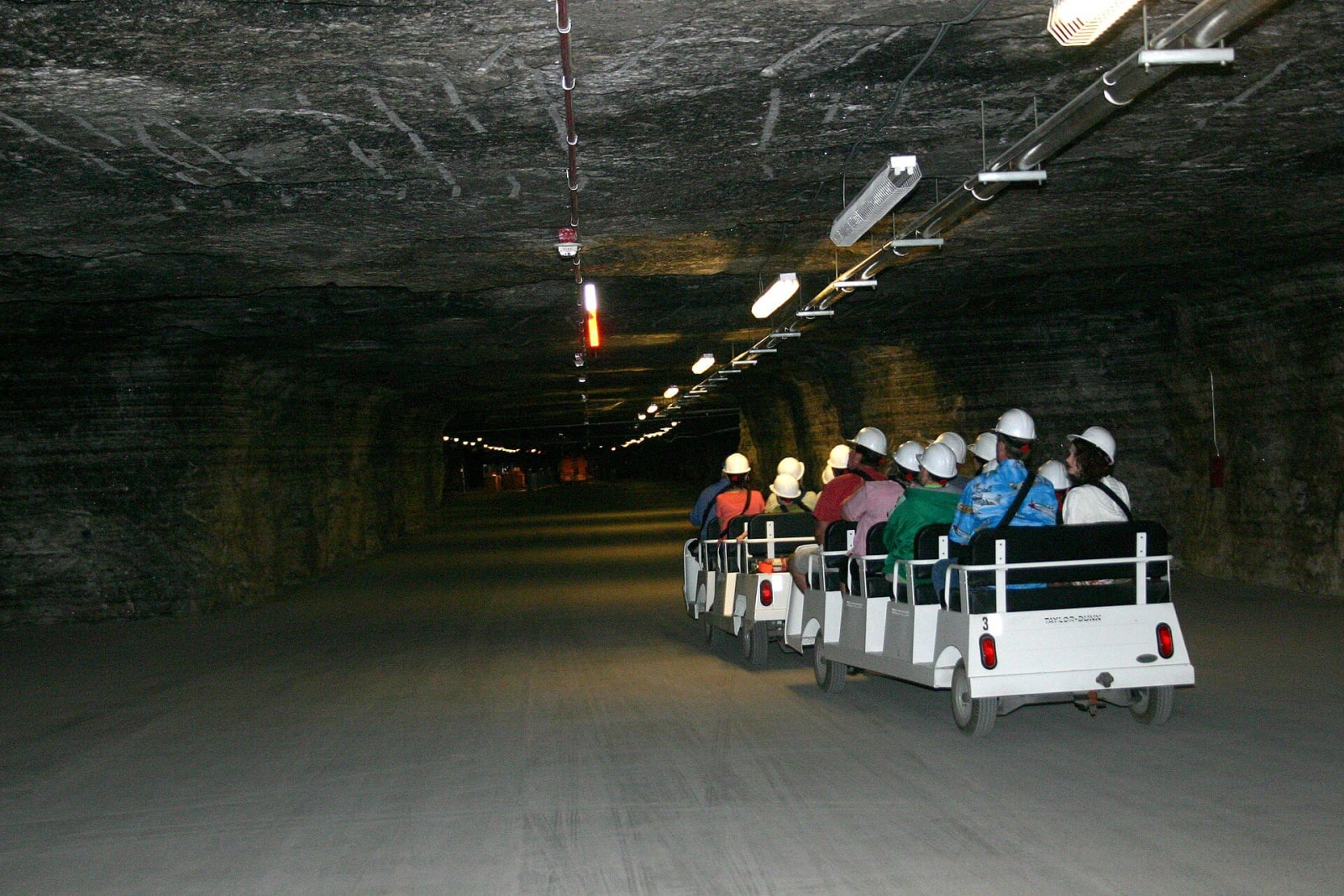
Visitors in hard hats ride an open tram down a long, lamp-lit tunnel cut through rock salt at Strataca.undergrounddarkride / CC BY 2.0 via Wikimedia Commons
🏭Industrial

Strataca

Part ofWichita & South Central Kansas

An underground museum 650 feet down in Hutchinson's working salt mine, reached through a shaft sunk in 2004 by freezing the aquifer above the Permian salt.

⏱
Duration
Two to two and a half hours; three to three and a half with the Salt Safari.
🎟
Admission
Salt Blast Pass (museum and 30-minute dark ride): adults $35, children 4 and over $18, seniors 60 and over and military $23, Reno County residents $19. Combo with the Salt Safari: adults $50. Children under 4 cannot go underground.
📅
Best Season
Year-round; tours Tuesday through Saturday 9 a.m. to 3 p.m. and Sunday 1 to 3 p.m., closed Monday. Reservations recommended.

The Story

Under Hutchinson lies a bed of rock salt laid down about 275 million years ago, in the Permian Period. The Carey Salt Company began mining it in 1923, and its successor, the Hutchinson Salt Company, still does, by the room and pillar method: blasting out square rooms and leaving pillars of salt 40 feet square to hold up the rock above. The checkerboard now covers about 980 acres, and laid end to end the rooms would run about 150 miles. Most of this rock salt goes onto winter roads and to livestock.

For decades the only way down was the mine's single shaft, and it carried no more than ten people at a time. To build a museum, the Reno County Historical Society and Underground Vaults & Storage, which keeps film, records and other materials in a separate part of the mine, shared the cost of a new shaft. It had to pass through the water-bearing Equus Beds, so in 2004 contractors froze the ground by pumping brine and liquid nitrogen through 24 pipes, then blasted down and lined the shaft in concrete as they went. The museum opened in 2007 and took the name Strataca in 2013.

A double-deck elevator now makes the 650-foot descent in about 90 seconds. Below, the air holds near 68 degrees all year. Visitors walk galleries of mining machinery that was brought down in pieces and welded back together underground, ride a 30-minute tram through dark worked-out chambers,. A longer guided tour goes on into the working mine.

Visitor Info

⏱
Time Needed
Two to two and a half hours; three to three and a half with the Salt Safari.
🎟
Admission
Salt Blast Pass (museum and 30-minute dark ride): adults $35, children 4 and over $18, seniors 60 and over and military $23, Reno County residents $19. Combo with the Salt Safari: adults $50. Children under 4 cannot go underground.
📅
Best Season
Year-round; tours Tuesday through Saturday 9 a.m. to 3 p.m. and Sunday 1 to 3 p.m., closed Monday. Reservations recommended.
🛣️
Highway
K-61 / US-50

On the Map

Nearby

The closest stops worth working into your route

attraction3.3 mi away
Cosmosphere
Hutchinson's space museum, begun in 1962 with a used star projector in a fairgrounds poultry building, now home to the Apollo 13 command module and Liberty Bell 7.
cultural28 mi away
Coronado Quivira Museum
Lyons's museum of Quivira, the country of grass-lodge towns where the Wichita people's ancestors lived when Coronado arrived in 1541, and of the Rice County newspapermen who connected the two.
cultural28 mi away
Kauffman Museum
Bethel College's museum in North Newton of the Mennonites who settled the central plains in the 1870s, home to the copper plates of the 1685 Martyrs Mirror.
natural34 mi away
Quivira National Wildlife Refuge
A rare inland salt marsh on Rattlesnake Creek, fed by salty groundwater, where whooping cranes stop on migration and the refuge's senior water right keeps coming up short.
historical37 mi away
Old Cowtown Museum
Wichita's open-air museum of its 1865 to 1880 years, begun in 1950 to save a first church found inside a rooming house, in a city that was never sure it wanted to be called a cowtown.
cultural37 mi away
Keeper of the Plains
Blackbear Bosin's 44-foot steel figure on the point where the Little Arkansas meets the Arkansas, the ground where Wichita refugees built grass houses in 1864.

Historical markers nearby

Roadside plaques and monuments within a short detour

Marker21 mi away
Kansas Indian Treaty