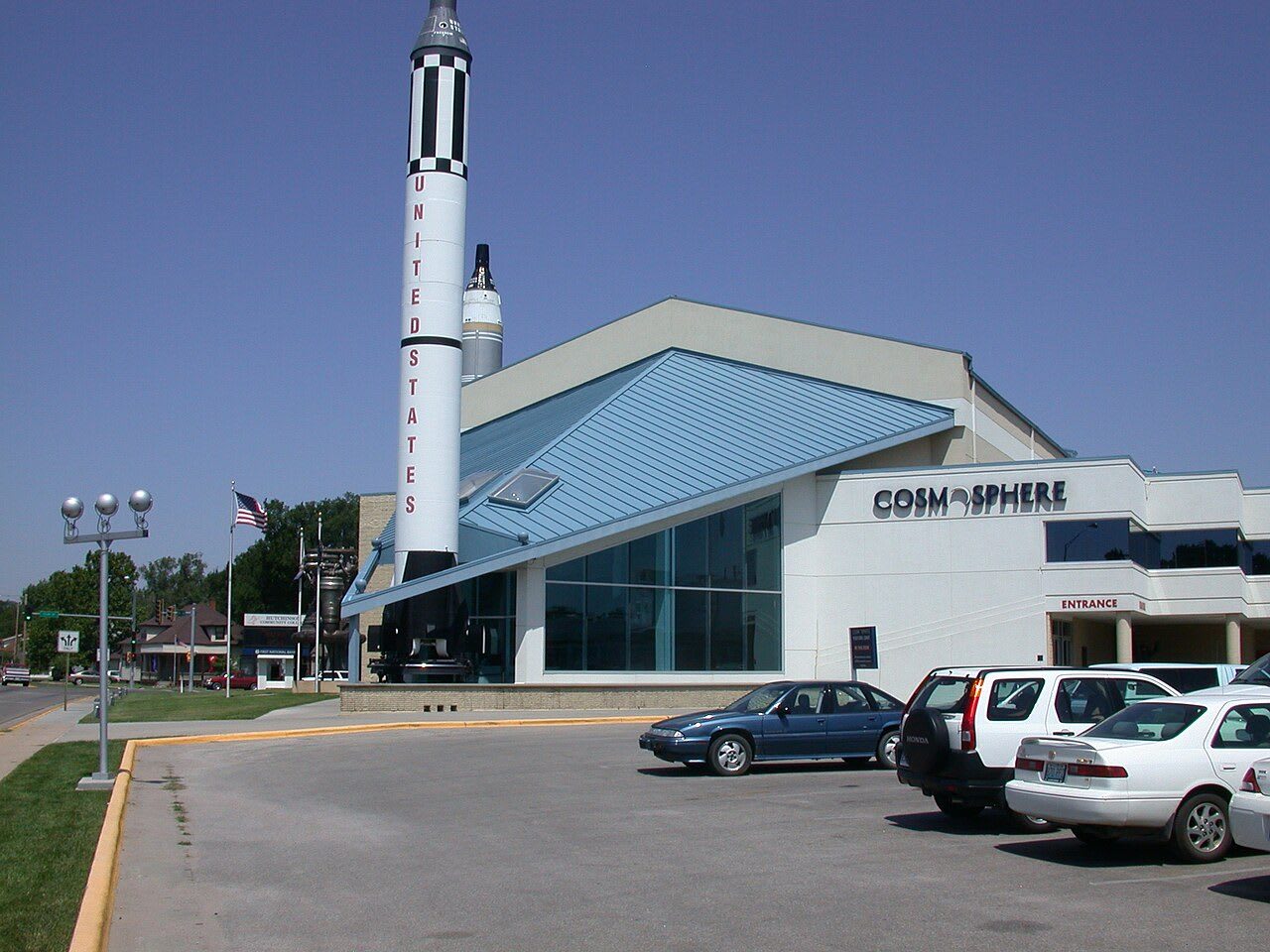
 Ppelleti / CC BY-SA 3.0 via Wikimedia Commons
The Story
The Cosmosphere began on December 2, 1962, in the empty poultry building at the Kansas State Fairgrounds, where Patty Carey, a Hutchinson woman who loved astronomy, set up a used star projector and rented folding chairs and opened Hutchinson's Theatre of the Skies. It was the first planetarium in Kansas. In 1966 the junior college gave it a domed room in its new science building, a room still in use as Dr. Goddard's Lab, and in 1976 the first major artifact came on loan from the Smithsonian, an Apollo-Soyuz command module trainer.
The collection grew to more than 13,000 spaceflight artifacts, American and Russian, from a restored V-2 and a flight-ready backup of Sputnik 1 to a Vostok capsule, the Gemini 10 spacecraft and an SR-71 Blackbird, around which the lobby was built in 1997. Much of it passed through the museum's own restoration shop, SpaceWorks. From 1995 to 1997 SpaceWorks returned the Apollo 13 command module Odyssey to its post-flight condition, and in 1999 it restored the Mercury capsule Liberty Bell 7, recovered after 38 years on the floor of the Atlantic. The Cosmosphere owns that one outright. The shop also built most of the spacecraft props for the film Apollo 13.
In 1998 the Cosmosphere became one of the first Smithsonian affiliates. The Hall of Space runs from the German rockets of the Second World War through the race to the Moon to the shuttle, and a planetarium and a two-story dome theater run shows through the day.
Visitor Info
On the Map
Nearby
The closest stops worth working into your route
Historical markers nearby
Roadside plaques and monuments within a short detour