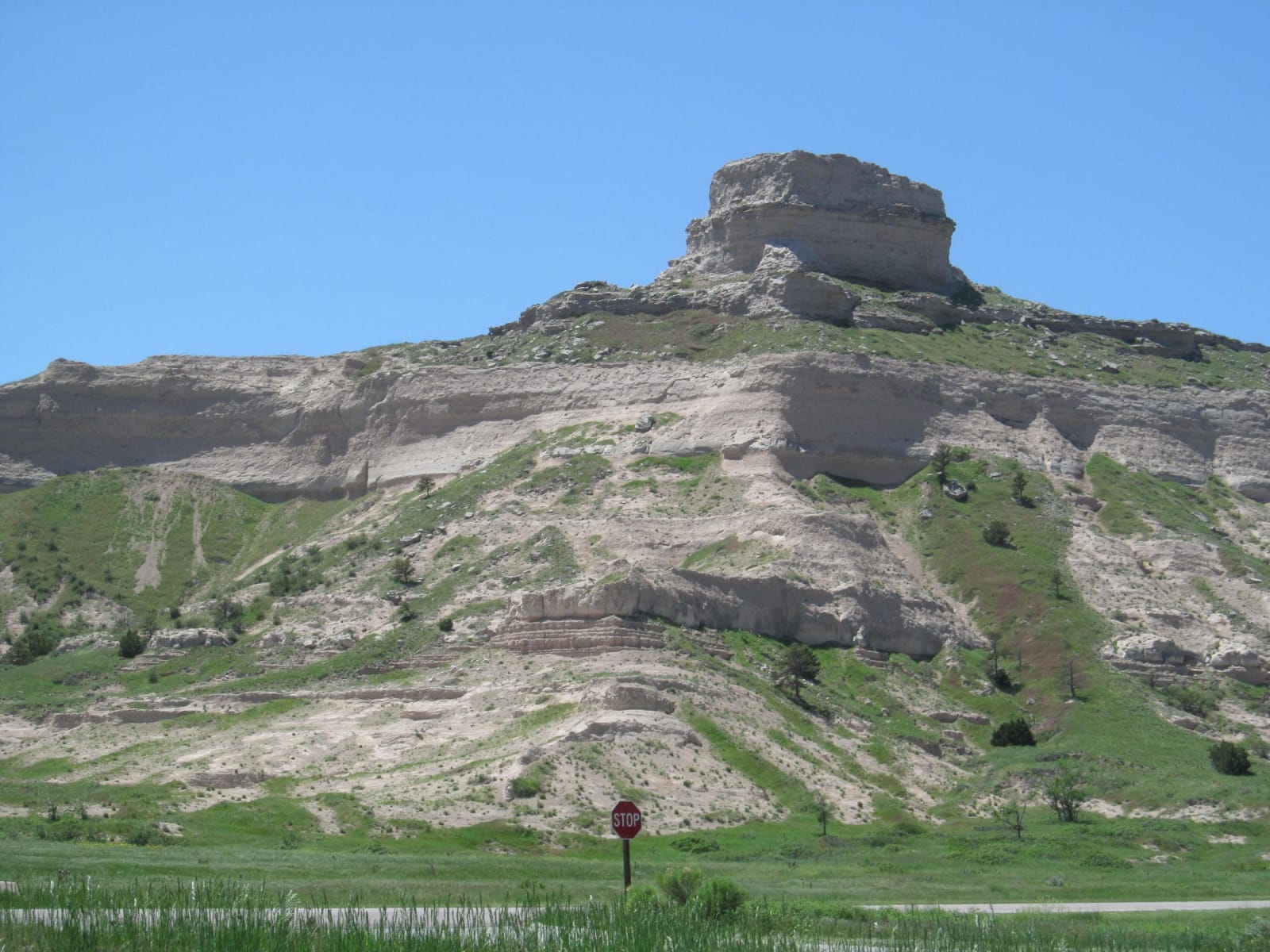
 Doug Kerr / CC BY-SA 2.0 via Wikimedia Commons
The Story
The bluff is named for a man nobody saw die. Hiram Scott, a clerk in the Rocky Mountain fur trade, fell ill on the way back to St. Louis from the 1828 rendezvous and was left behind. Warren Ferris wrote in 1830 that two companions put him in a boat, abandoned him on the bank of the Platte, and found his skeleton across the river the next spring. Washington Irving had him left at the Laramie Fork, his bones turning up the next summer near the bluffs some sixty miles away. The grave has never been found. A plaque on the North Overlook Trail at the summit stands in for it.
For the wagon trains the bluff was the obstacle. They first went around it to the south through Robidoux Pass, and from about 1851 they took Mitchell Pass beside it, a gap one wagon wide that forced the trains into single file. In 1866 William Henry Jackson came through as a bullwhacker on a freight outfit and sketched the place. The monument now holds about 1,100 objects tied to him, among them fifty watercolors, the largest single holding of his paintings.
The monument was proclaimed on December 12, 1919, and its first custodian, until 1935, was Harold Cook of the Agate Springs Ranch. The Summit Road opened on September 19, 1937, and climbs 1.6 miles through three tunnels on what is thought to be the oldest concrete road surface in Nebraska. Trailers and vehicles longer than 25 feet are not allowed on it.
Visitor Info
On the Map
A story featuring this place
Go deeper into the history and character of this stop
Nearby
The closest stops worth working into your route
Historical markers nearby
Roadside plaques and monuments within a short detour