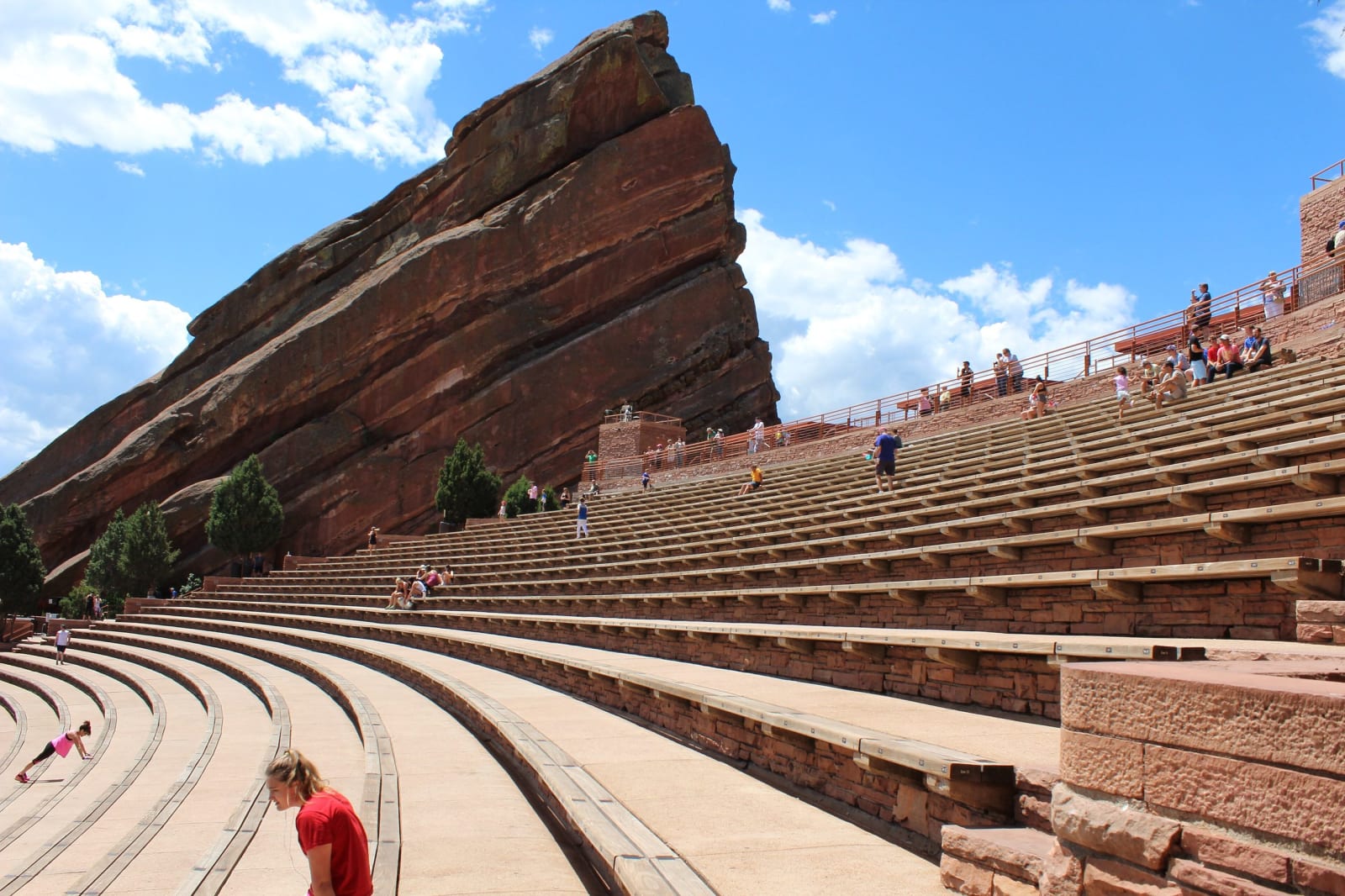
 Sarbjit Bahga / CC BY-SA 4.0 via Wikimedia Commons
The Story
The rocks are Fountain Formation, coarse red sandstone and conglomerate shed off an older range about 300 million years ago and tipped on end when the present Rockies rose, the same rock as the Flatirons and the Garden of the Gods. Two of the slabs, Ship Rock on the south and Creation Rock on the north, stand far enough apart to hold a bowl between them that carries a voice from the bottom to the top. Its earliest recorded owner called the place the Garden of the Angels.
John Brisben Walker, who had sold Cosmopolitan to William Randolph Hearst, bought the land around 1905 and renamed it the Garden of the Titans to rival the Garden of the Gods. He put a teahouse and a lookout on Creation Rock and a wooden stage at the foot of the bowl, and a band played the first recorded concert there on May 31, 1906. Walker's fortune ran down, and in the late 1920s the core of the park passed to Denver's mountain parks system.
The amphitheater belongs to George Cranmer, Denver's manager of parks, who held out for a theater against the mayor's idea of a rock garden, and to the architect Burnham Hoyt, who set the seating into the rock rather than against it. Young men from a Civilian Conservation Corps camp in Morrison, with Works Progress Administration crews, blasted, dug and laid stone from 1936, and the house was dedicated on June 15, 1941, with Helen Jepson of the Metropolitan Opera on the program. Red Rocks Park and its CCC camp became a National Historic Landmark in 2015. Outside show hours the seats are open to anyone who wants to climb them.
Visitor Info
On the Map
Nearby
The closest stops worth working into your route
Historical markers nearby
Roadside plaques and monuments within a short detour