Home / Missouri / St. Joseph & the Grand River Country / Pony Express National Museum
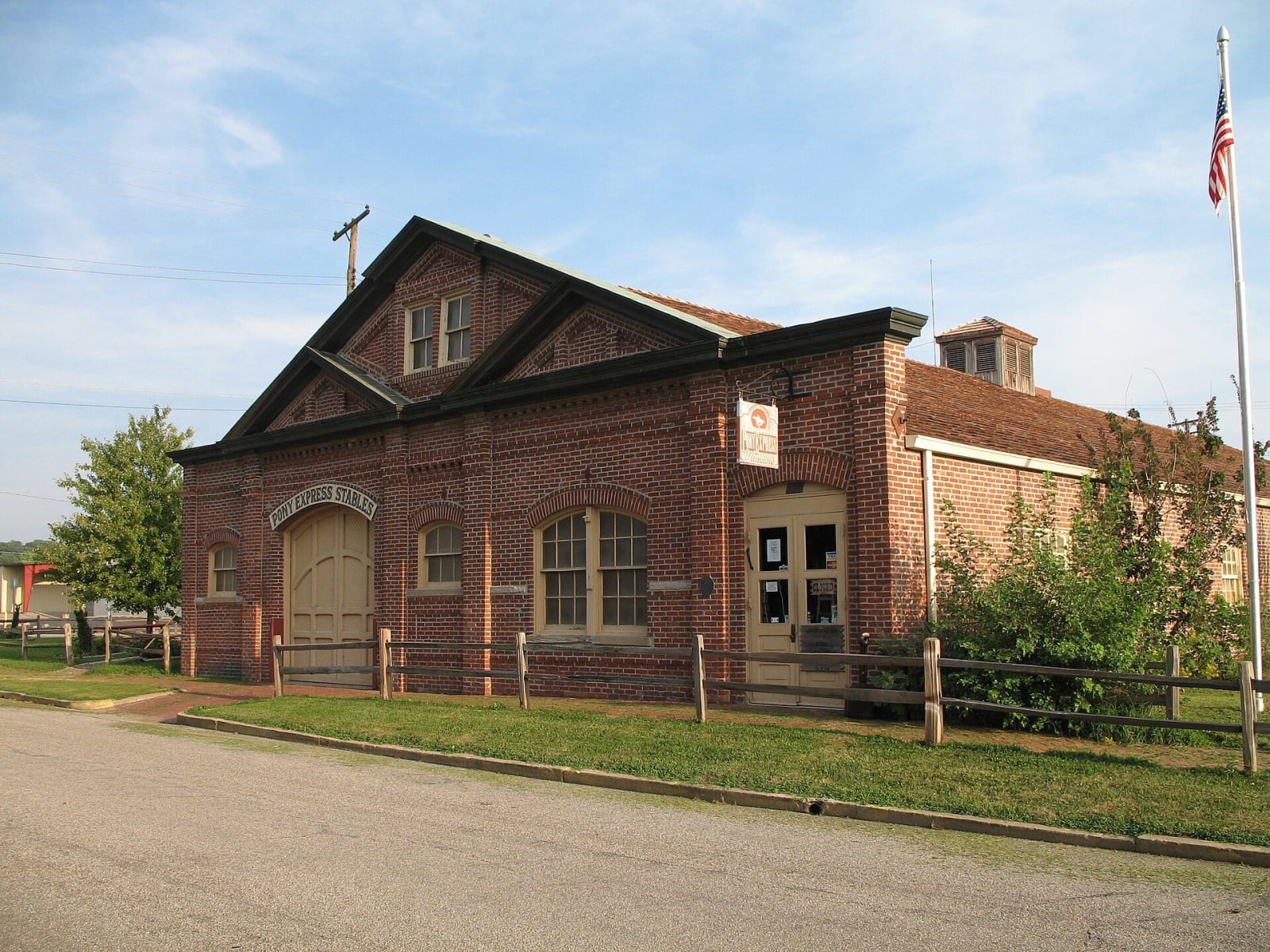
The red brick Pikes Peak Stables building that houses the Pony Express National Museum in St. Joseph.Americasroof / CC BY-SA 2.5 via Wikimedia Commons
🏛️Historical

Pony Express National Museum

Part ofSt. Joseph & the Grand River Country

The St. Joseph stables where the Pony Express began on April 3, 1860, now a museum that also tells how the venture was paid for and why it lasted eighteen months.

⏱
Duration
One to two hours; add an hour or more for Patee House, a few blocks east on Penn Street.
🎟
Admission
Adults $10; seniors 60 and over $9; students $5; children 4 to 6 $3. Group rates by arrangement.
📅
Best Season
Year round: Monday to Saturday 9 a.m. to 5 p.m., and 9 a.m. to 4 p.m. from December 1 to March 1. Closed on major holidays.

The Story

The company behind the Pony Express was Russell, Majors and Waddell, freighters who had carried army supplies west from Leavenworth since 1853 and lost heavily when their wagon trains were caught in the Utah conflict of 1857. In December 1859 Senator William Gwin of California proposed a fast-mail demonstration on the central route, and William Russell, wanting a government mail contract, talked his partners into it. On March 2, 1860, the firm chose St. Joseph as the eastern end because the town already had railroad and telegraph lines to the East. The first mail came across Missouri on a stripped-down train from Hannibal and left from these stables for Sacramento.

The riders proved the mail could cross in ten days, but the service never paid. On Christmas Eve 1860 Russell was arrested in New York, accused of using $870,000 in bonds from the Indian Trust Fund to secure loans. The coming war buried the case, and the government repaid the fund $759,525.56. In March 1861 Congress ordered the western half of the route handed to the Overland Mail Company, and on October 24, 1861, the day the transcontinental telegraph was finished, the Pony Express was discontinued. Russell filed for bankruptcy on April 3, 1865, five years to the day after the first ride.

Inside the old stable are a wheelwright and blacksmith shop, a relay station, mochila saddles, the well, a covered wagon and the Hall of Riders. A one-room schoolhouse used for programs stands next door, and Patee Park, across the street, has a steam engine from the 1800s.

Visitor Info

⏱
Time Needed
One to two hours; add an hour or more for Patee House, a few blocks east on Penn Street.
🎟
Admission
Adults $10; seniors 60 and over $9; students $5; children 4 to 6 $3. Group rates by arrangement.
📅
Best Season
Year round: Monday to Saturday 9 a.m. to 5 p.m., and 9 a.m. to 4 p.m. from December 1 to March 1. Closed on major holidays.
🛣️
Highway
I-229

On the Map

Nearby

The closest stops worth working into your route

historical0.2 mi away
Patee House Museum and Jesse James Home
An 1858 St. Joseph hotel that held the Pony Express office, a Union provost marshal and two women's colleges, with the house where Jesse James was killed moved onto its lot.
historical2.6 mi away
Glore Psychiatric Museum
The history of State Lunatic Asylum No. 2 and of mental health treatment, told in the old hospital's surgery building beside a prison, with the Black Archives Museum under the same roof.
historical22 mi away
Iowa and Sac & Fox Mission Museum
The surviving part of an 1846 Presbyterian mission school near Highland, built largely with the tribes' own annuity money and returned to the Iowa Tribe of Kansas and Nebraska in 2021. Closed during remodeling.
attraction22 mi away
Amelia Earhart Hangar Museum
A hangar at Atchison's airport built around Muriel, a 1935 Lockheed Electra 10-E of the model Earhart vanished in, saved from scrap, restored over three decades and brought to her birthplace in 2016.
natural29 mi away
Loess Bluffs National Wildlife Refuge
A 7,440-acre Missouri River marsh below the loess hills near Mound City, where up to a million snow geese stop in a typical year and 661 bald eagles were counted in December 2020.
industrial39 mi away
Watkins Woolen Mill State Historic Site
A three-story 1860 woolen mill in the Clay County hills that still holds nearly all its original machinery, at the center of the 3,660-acre Watkins farm called Bethany.

Historical markers nearby

Roadside plaques and monuments within a short detour

Marker0 mi away
Saint Joseph
Marker1.2 mi away
Elwood
Kansas
Marker11 mi away
Troy
Kansas
Marker13 mi away
Andrew County
Marker20 mi away
Platte County
Marker21 mi away
Atchison
Kansas