Home / Missouri / Kansas City & the Western Border / Watkins Woolen Mill State Historic Site
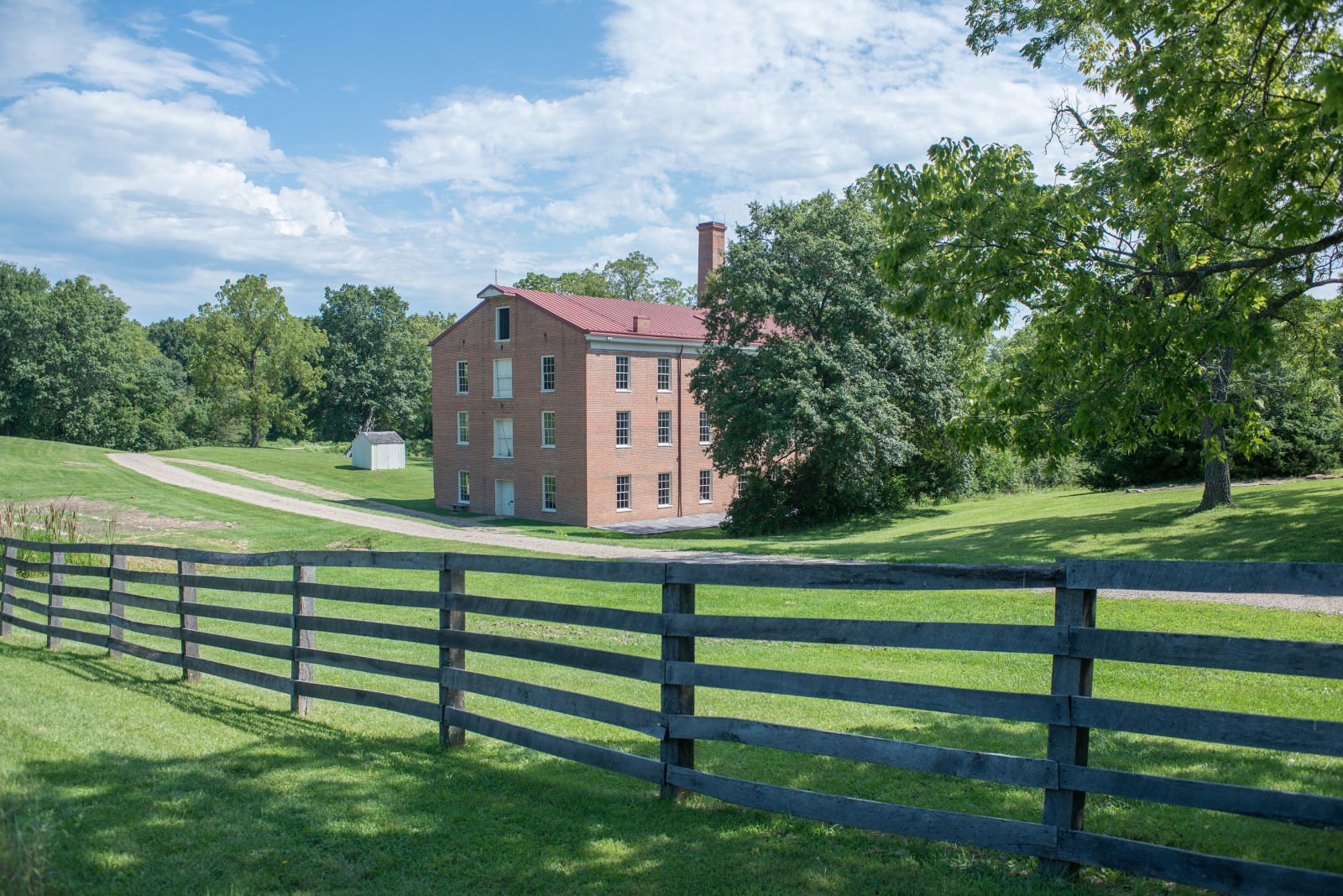
The three-story brick Watkins Woolen Mill seen across a pasture and a dark board fence.Missouri State Parks / public domain via Wikimedia Commons
🏭Industrial

Watkins Woolen Mill State Historic Site

Part ofKansas City & the Western Border

A three-story 1860 woolen mill in the Clay County hills that still holds nearly all its original machinery, at the center of the 3,660-acre Watkins farm called Bethany.

⏱
Duration
Two hours for the visitor center, a mill and house tour, and the grounds; longer with the lake trail.
🎟
Admission
Grounds and visitor center open to all; the mill and house are seen on guided tours, so call 816-580-3387 for tour times and fees.
📅
Best Season
Visitor center April 15 to October 31, 9:30 a.m. to 5 p.m. Monday to Saturday and 10:30 a.m. to 5 p.m. Sunday; November 1 to April 14 it closes at 4:30 p.m. Closed on the state holidays the park lists.

The Story

Waltus L. Watkins started Bethany in 1839 as a small livestock farm in northeast Clay County. By 1870 it had grown into a 3,660-acre farm and factory that he styled a plantation: a 1,240-acre home farm, tenant farms, a brick kiln, gristmill and sawmills, a blacksmith shop and houses for the mill and farm workers. Watkins had trained in Kentucky textile mills, and in 1860 he built a three-story mill that spun wool into yarn and wove it into cloth, blankets and shawls.

The 1976 National Historic Landmark nomination records the foundations of "some 9-10 cabins for weavers and slaves" behind the mill. The federal slave schedules for Clay County list three enslaved people under the name W. L. Watkins in 1850: a woman of 32, a man of 19 and a boy of 2. The 1860 schedule, taken in Washington Township on June 26, lists three under that name: a woman of 55, a man of 35 and a woman of 20, with one slave house. The schedules recorded age and sex, not names.

The mill ran at capacity until 1886, two years after Watkins died, and the family stayed until 1945. Nearly all of its machinery is still in the building, including the 65-horsepower steam engine, and Missouri State Parks calls it the only 19th-century textile mill in the United States with its original machinery intact. It became a National Historic Landmark in 1966. The octagonal Franklin school and Mount Vernon church stand nearby, and the adjoining park has a 3.8-mile paved trail around its lake.

Visitor Info

⏱
Time Needed
Two hours for the visitor center, a mill and house tour, and the grounds; longer with the lake trail.
🎟
Admission
Grounds and visitor center open to all; the mill and house are seen on guided tours, so call 816-580-3387 for tour times and fees.
📅
Best Season
Visitor center April 15 to October 31, 9:30 a.m. to 5 p.m. Monday to Saturday and 10:30 a.m. to 5 p.m. Sunday; November 1 to April 14 it closes at 4:30 p.m. Closed on the state holidays the park lists.
🛣️
Highway
US-69

On the Map

Nearby

The closest stops worth working into your route

historical16 mi away
Fort Osage National Historic Landmark
A reconstructed 1808 fort and government trading house on a Missouri River bluff at Sibley, where Osage leaders signed the treaty that gave up most of present Missouri.
historical23 mi away
Harry S Truman National Historic Site
The Independence house Harry Truman lived in for half a century without owning it until 1953, kept as Bess Truman left it and seen only on small ranger tours.
historical24 mi away
National Frontier Trails Museum
The City of Independence museum of the Santa Fe, Oregon and California trails, told from travelers' journals, with a research library of more than 2,300 trail diaries, letters and recollections.
historical25 mi away
Battle of Lexington State Historic Site
The Anderson House and the Missouri River bluff at Lexington, where the Missouri State Guard rolled river-soaked hemp bales toward the Union lines in September 1861.
historical27 mi away
Arabia Steamboat Museum
The cargo of a sidewheeler that sank in 1856, dug out of a Kansas cornfield in 1988 and 1989 and shown in the River Market, from boots and buttons to jarred pickles.
cultural27 mi away
Negro Leagues Baseball Museum
The national museum of Black professional baseball in Kansas City's 18th & Vine Jazz District, two blocks from the YMCA where the Negro National League was founded in 1920.

Historical markers nearby

Roadside plaques and monuments within a short detour

Marker14 mi away
Liberty
Marker15 mi away
Clinton County
Marker18 mi away
Richmond
Marker19 mi away
Fort Osage
Marker20 mi away
Kingston
Marker28 mi away
This Gateway to Kansas
Kansas