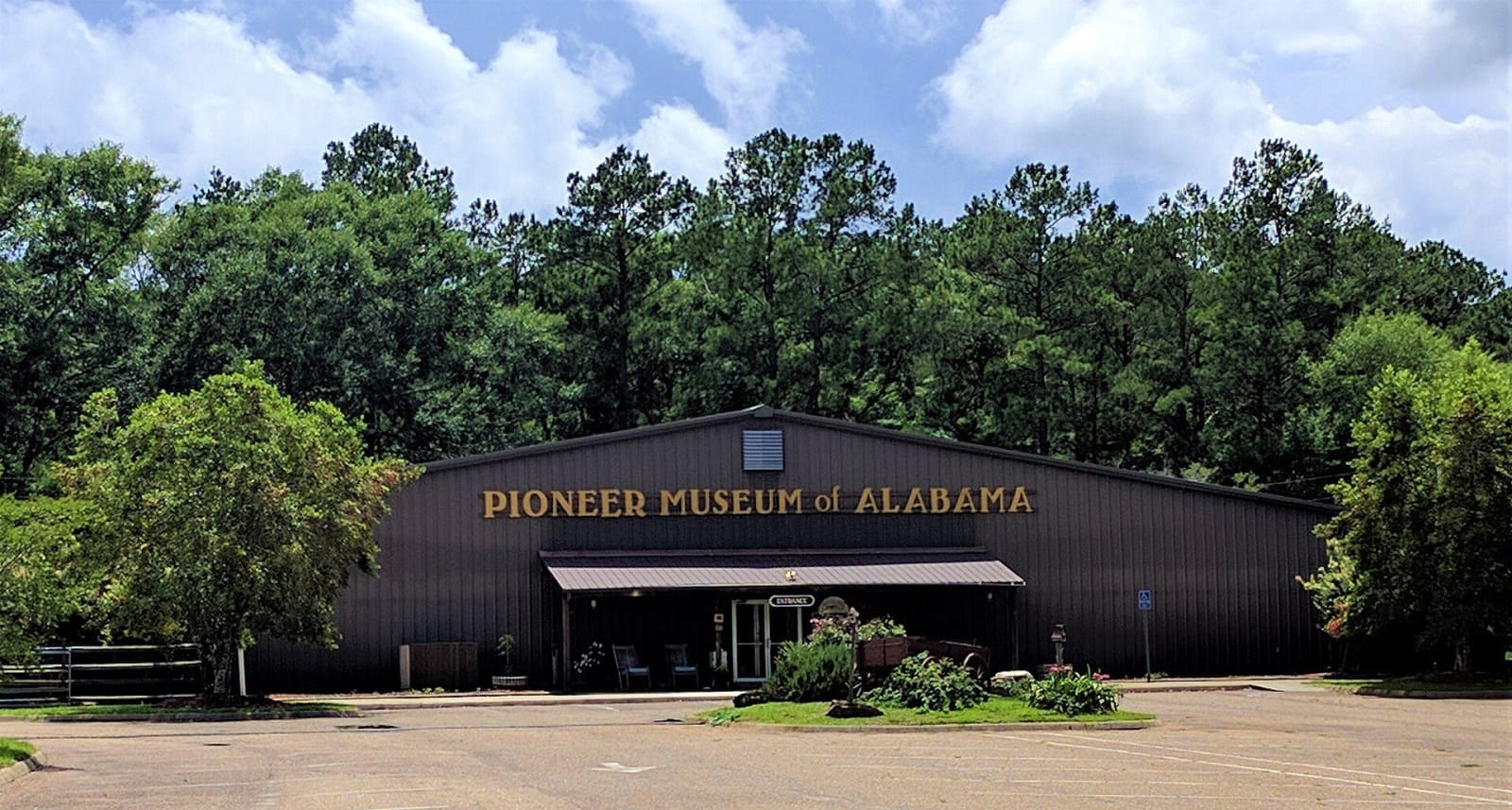
 Kreeder13 / CC BY-SA 4.0 via Wikimedia Commons
The Story
Pike County was Creek land, and some of the last fights of the Creek War of 1836 were on its border with Barbour County, at Hobdy's Bridge and on the Pea River in early 1837. By then the Army was already rounding up Creek families for removal to Indian Territory. The museum's main gallery begins with that older Alabama, in a hall on the archaeology of Southeastern Native peoples, before it turns to the farmers who came after.
Curren Farmer, who taught at Troy State, and his wife, the historian Margaret Farmer, started collecting old plows and tractors in the late 1960s so they would not be lost. They founded the Pike County Pioneer Museum in 1969 on land given by the Gibson family, opened it in 1971 and moved in the first log cabin the next year. It took its present name in the 1990s, when the buildings began coming from beyond the county. It now holds 22 structures on 40 acres and more than 20,000 artifacts.
The two houses are the heart of it. Thomas Madison built the dogtrot in Pike County in 1830, two rooms on either side of an open breezeway. The one-room tenant house, its walls insulated with cardboard and newspaper, is the kind of place sharecroppers lived into the twentieth century; John Lewis was born in 1940 to a Pike County sharecropping family and in 1957 hoped to enroll at all-white Troy State, which had never admitted a Black student. Around them stand a church, a covered bridge, a turpentine still, a cane mill and a steam locomotive.
Visitor Info
On the Map
Nearby
The closest stops worth working into your route
Historical markers nearby
Roadside plaques and monuments within a short detour