Home / Alabama / Montgomery, Selma & the Black Belt / Dexter Avenue King Memorial Baptist Church
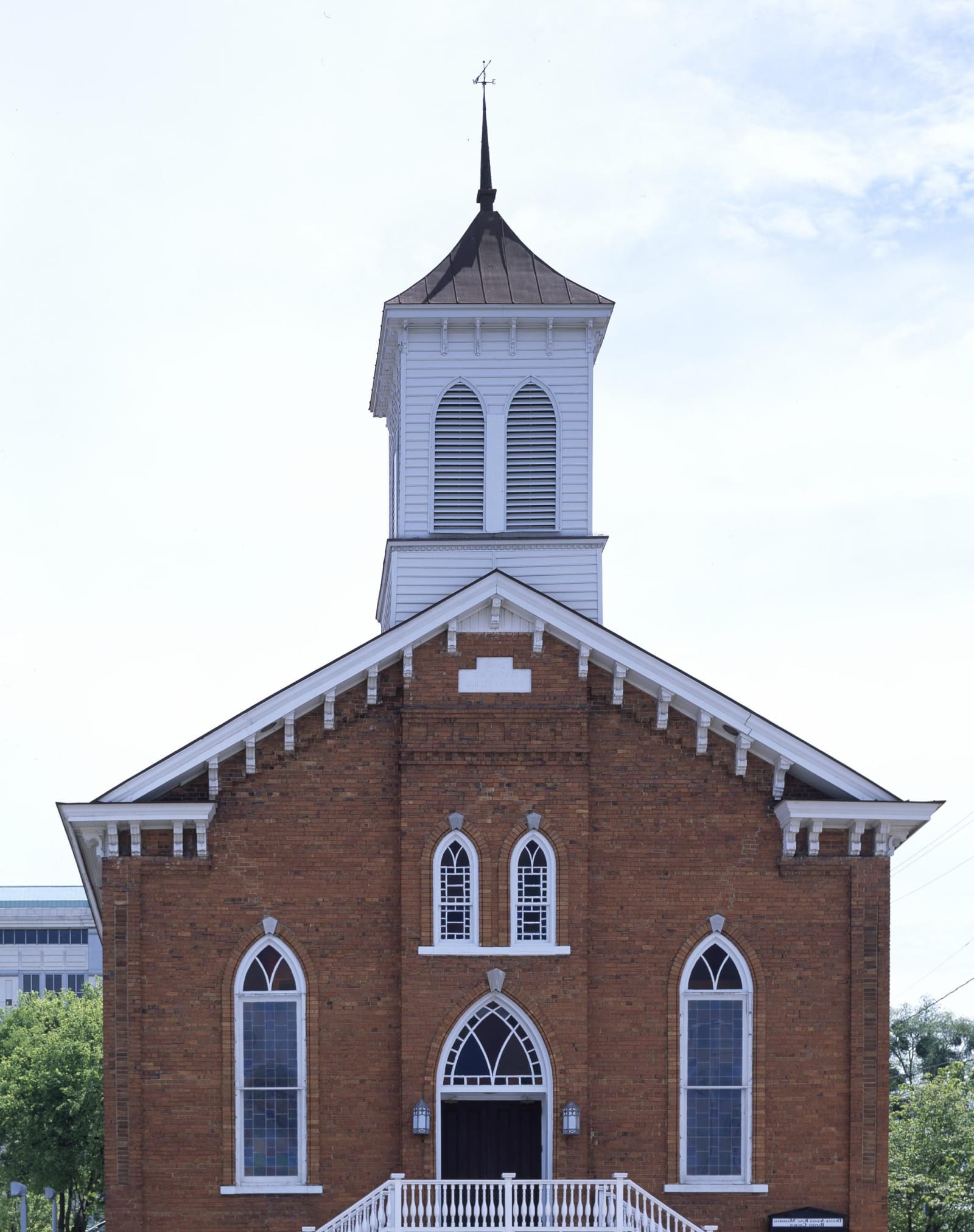
The red-brick front of a church with pointed windows and a white wooden steeple topped by a weathervane.Carol M. Highsmith / public domain via Library of Congress
🏛️Historical

Dexter Avenue King Memorial Baptist Church

Part ofMontgomery, Selma & the Black Belt
On this driveThe Selma to Montgomery National Historic Trail: US 80 from Brown Chapel to the Capitol

The red-brick 1889 church a block below the Alabama Capitol where Martin Luther King Jr. was pastor and the Montgomery bus boycott was run from the basement.

⏱
Duration
One to two hours with the parsonage.
🎟
Admission
Tours of the church and the Dexter Parsonage Museum; check the church site for times and fees.
📅
Best Season
Year round; the congregation worships on Sundays.

The Story

Members who left First Baptist (Colored) Church founded this congregation in 1877, and in 1879 they bought a lot on Market Street in the shadow of the state capitol. The red-brick church was built between 1883 and 1889 to a design by Pelham J. Anderson, mostly by William Watkins, a member of the congregation, and when the street became Dexter Avenue in 1884 the church took the new name. In 1887 Alabama's college for Black students, now Alabama State University, held its first registration in the basement.

Look up the avenue. The Capitol at its head is where delegates formed the Confederate States of America in February 1861, a government founded to protect slavery, and where Jefferson Davis took his oath. Two pastors turned this middle-class church toward that building: Vernon Johns, who pushed the congregation to challenge segregated buses, and Martin Luther King Jr., the 20th pastor, who arrived in 1954 and asked every member to register to vote and join the NAACP. During the bus boycott the work was organized from the basement, and the parsonage where King lived with Coretta Scott King was bombed while she and their infant daughter were inside. Both were unhurt.

The church was named a National Historic Landmark in 1974 and renamed for King in 1978. On March 25, 1965, the Selma marchers passed it to reach the Capitol steps, where King spoke to about 25,000 people. Tours take in the church and the parsonage where the King family lived, now a museum.

Visitor Info

⏱
Time Needed
One to two hours with the parsonage.
🎟
Admission
Tours of the church and the Dexter Parsonage Museum; check the church site for times and fees.
📅
Best Season
Year round; the congregation worships on Sundays.
🛣️
Highway
Dexter Avenue

On the Map

Nearby

The closest stops worth working into your route

historical0.4 mi away
Freedom Rides Museum
Montgomery's 1951 Greyhound station, where a white mob beat the Freedom Riders on May 20, 1961, now an Alabama Historical Commission museum.
cultural0.5 mi away
The Legacy Museum
The Equal Justice Initiative's museum on the site of a Montgomery cotton warehouse where enslaved people were forced to work, tracing a line from the slave trade to mass incarceration.
cultural0.5 mi away
Hank Williams Museum
A privately run downtown Montgomery museum of Hank Williams's suits, hats and the car of his last ride, a mile from his grave in the Oakwood Annex.
cultural0.5 mi away
Rosa Parks Museum
Troy University's museum at the downtown Montgomery stop where Rosa Parks was arrested on December 1, 1955, telling the 13-month bus boycott through the women who organized it.
historical0.7 mi away
National Memorial for Peace and Justice
The hilltop memorial in Montgomery where more than 800 steel monuments, one for each county, carry the names of more than 4,400 Black people killed in racial terror lynchings between 1877 and 1950.
historical9.4 mi away
Fort Toulouse-Fort Jackson Park
The point where the Coosa and Tallapoosa make the Alabama River: a Mississippian platform mound, a rebuilt French fort of 1751, and the ground where the Treaty of Fort Jackson took 21 million acres from the Creek Nation.

Historical markers nearby

Roadside plaques and monuments within a short detour

Marker0.1 mi away
Fred David Gray
Montgomery
Marker0.1 mi away
Black Members of the Alabama Legislature Who Served During The Reconstruction Period of 1868-1879
Montgomery
Marker0.2 mi away
First White House of the Confederacy
Montgomery
Marker0.2 mi away
The Capital City Guards
Montgomery
Marker0.2 mi away
A County Older Than the State
Montgomery
Marker0.3 mi away
Governor Shorter House
Montgomery