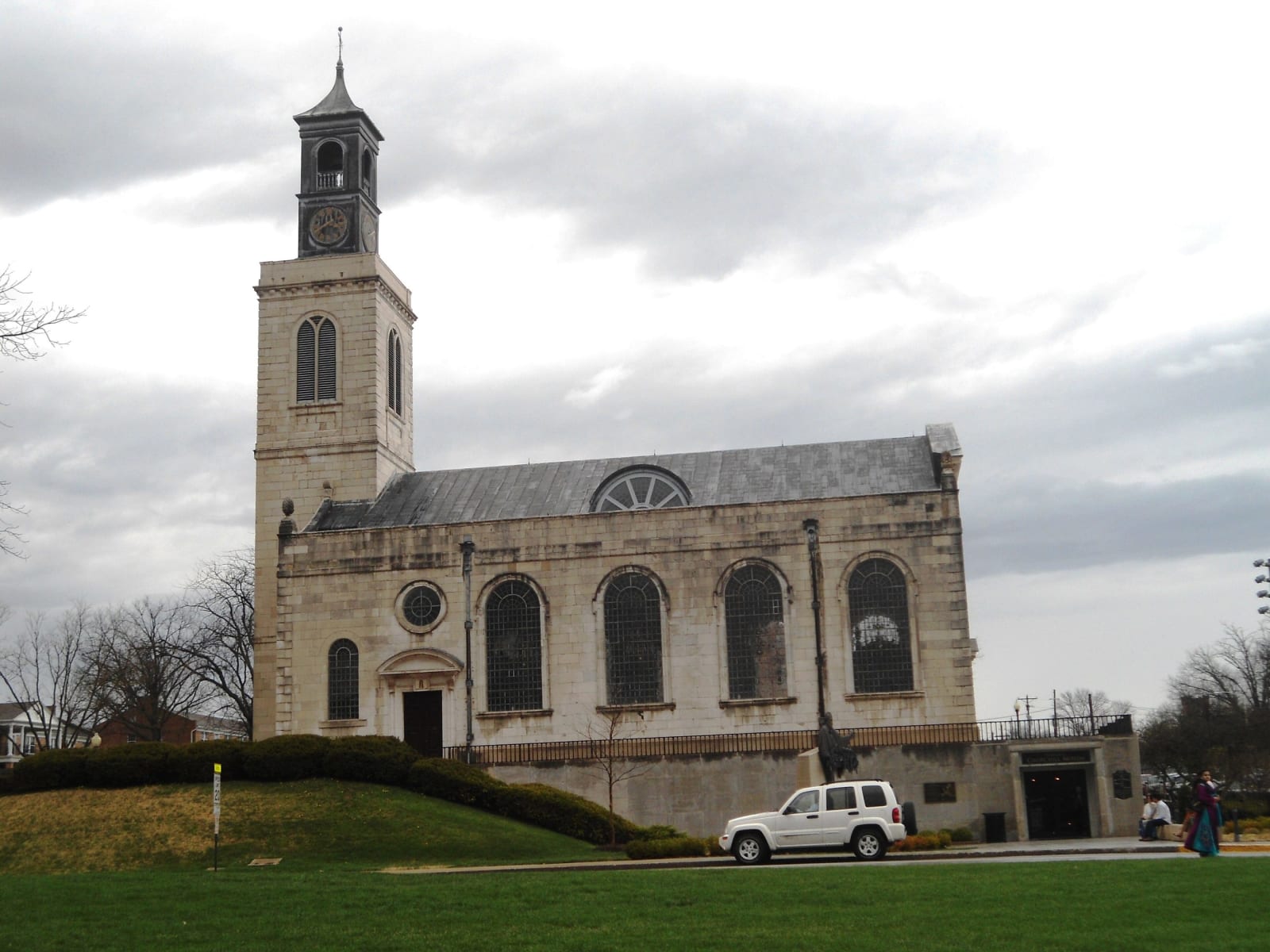
 YasirQazi / CC BY-SA 4.0 via Wikimedia Commons
The Story
On March 5, 1946, in the gymnasium of Westminster College, Winston Churchill said that from Stettin in the Baltic to Trieste in the Adriatic an iron curtain had descended across the Continent. He was out of office, beaten at the polls the summer before. The college president, Franc McCluer, had reached him through a Westminster graduate on Harry Truman's staff, Major General Harry H. Vaughan, and Truman came to Fulton to introduce him. Churchill titled the lecture The Sinews of Peace. The lectern and chair he used are in the museum, along with a film of the speech.
The church above the museum was London's St. Mary the Virgin, Aldermanbury, rebuilt by Christopher Wren after the Great Fire between 1672 and 1677. German incendiary bombs burned it to its walls on December 29, 1940, and it stood as a ruin for twenty years, slated for demolition. In 1961 Westminster's president, Robert L. D. Davidson, took up the idea of bringing it to Fulton as a memorial and college chapel. Truman broke ground on April 19, 1964. Workers in London labeled some 7,000 stones, more than 650 tons of them crossed the Atlantic free as ship's ballast, and builders in Fulton took a whole day to find the first two that fit. Noel Mander, the fire warden who had watched the church burn, built its organ. It was dedicated on May 7, 1969.
Outside stands Breakthrough, which Churchill's granddaughter Edwina Sandys made from eight sections of the Berlin Wall and unveiled on November 9, 1990.
Visitor Info
On the Map
Nearby
The closest stops worth working into your route
Historical markers nearby
Roadside plaques and monuments within a short detour