Home / North Carolina / Wilmington & the Cape Fear / Green Swamp Preserve
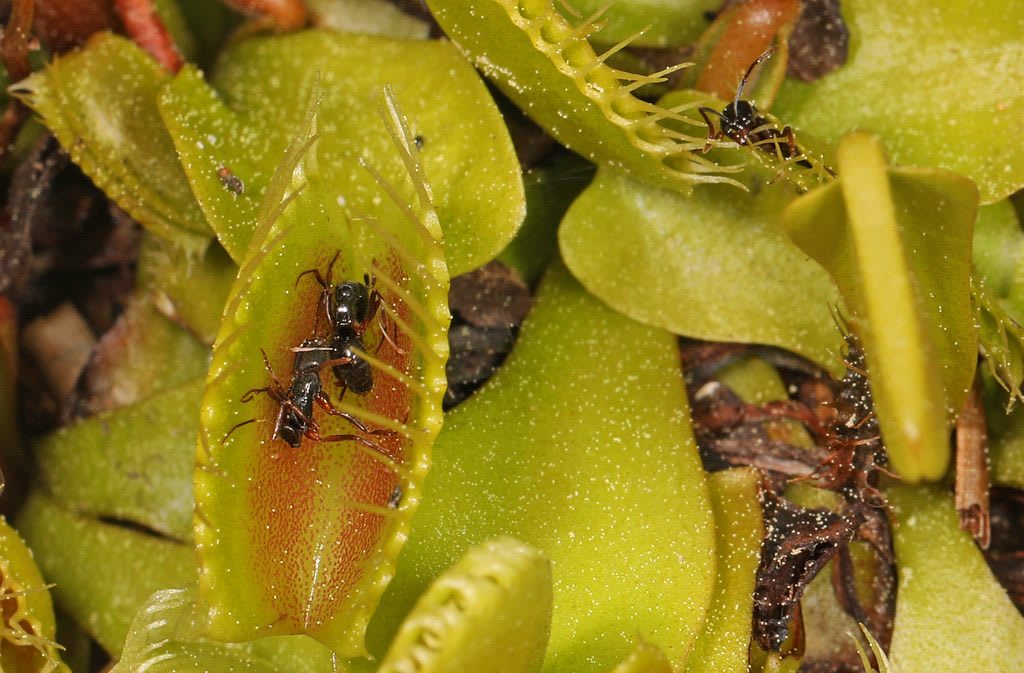
Close view of Venus flytrap leaves with red interiors, two ants crawling on an open trap.Judy Gallagher / CC BY 2.0 via Flickr
🌲Natural

Green Swamp Preserve

Part ofWilmington & the Cape Fear

Nature Conservancy longleaf savannas in the Green Swamp, kept open by fire, with wild Venus flytraps, pitcher plants, sundews and orchids.

⏱
Duration
One and a half to two hours.
🎟
Admission
Free.
📅
Best Season
Late spring for flytrap flowers and pitcher plants; fall and winter for cooler walking. Bring water and tick protection in any season.

The Story

The Venus flytrap grows wild only in a small area around Wilmington, and one of its largest wild populations is here. The Green Swamp was named a National Natural Landmark in 1974, and the Nature Conservancy's preserve covers more than 15,000 acres of it. Most of that is pocosin, a dense evergreen shrub bog of gallberry, titi and sweetbay, but the longleaf pine savannas hold at least 14 kinds of insect-eating plants, flytraps among sundews, butterworts, bladderworts and four species of pitcher plant, along with wild orchids.

The savannas live on fire. Burning keeps woody growth down and clears away the litter and grass that would shade the small plants, and flytraps fade where litter piles up. Longleaf seedlings need bare mineral soil, pond pine cones open only in the heat of a fire, and wiregrass flowers hard after a growing-season burn, so the Conservancy sets prescribed fires and is restoring old pine plantations to savanna. Red-cockaded woodpeckers, Bachman's sparrows and quail use the burned ground, and alligators and the rare Hessel's hairstreak butterfly live in the wetter country around it. Taking plants from the swamp is against state law.

The trail starts at a small lot on NC 211 about five miles north of Supply, crosses a pine savanna and a boardwalk, and runs 1.3 miles on through Shoestring, Stringbean and Beanpatch savannas before you turn back. It is flat but wet and rooty, with no benches or restrooms. Stay on the red-diamond blazes; hikers who left them have had to be rescued. Hunting is allowed in season.

Visitor Info

⏱
Time Needed
One and a half to two hours.
🎟
Admission
Free.
📅
Best Season
Late spring for flytrap flowers and pitcher plants; fall and winter for cooler walking. Bring water and tick protection in any season.
🛣️
Highway
NC 211

On the Map

Nearby

The closest stops worth working into your route

natural16 mi away
Lake Waccamaw State Park
The largest Carolina bay, buffered by limestone and home to aquatic species found nowhere else, near the Waccamaw Siouan homeland at the edge of the Green Swamp.
historical20 mi away
Brunswick Town / Fort Anderson State Historic Site
The excavated foundations of a colonial Cape Fear port burned in 1776, St. Philip's church walls, and the sand walls of Confederate Fort Anderson on the same bluff.
historical23 mi away
Gregory Congregational Church
The church of a freedpeople's school at Third and Nun streets, where Wilmington's Black students gathered in 1971 and the Wilmington Ten case began.
historical23 mi away
Bellamy Mansion Museum
A 1859-61 Market Street mansion built by enslaved and free Black craftsmen, with one of the best-preserved urban slave quarters in the country behind it.
historical23 mi away
1898 Memorial Park
Six bronze paddles on North Third Street for the Black Wilmingtonians killed on November 10, 1898, in the coup that overthrew the city's elected government.
historical23 mi away
Old Baldy Lighthouse
North Carolina's oldest standing lighthouse, an 1817 octagonal brick tower on Bald Head Island at the mouth of the Cape Fear, reached by ferry from Southport.

Historical markers nearby

Roadside plaques and monuments within a short detour

Marker12 mi away
Daniel L. Russell
Winnabow
Marker17 mi away
Robert Howe
Winnabow
Marker17 mi away
Benjamin Smith
Belville
Marker18 mi away
Hurricane Hazel
Oak Island
Marker18 mi away
Charles Town
Pinelevel
Marker18 mi away
Fort Caswell
Oak Island