Home / North Carolina / The Outer Banks & the Albemarle / Mattamuskeet National Wildlife Refuge
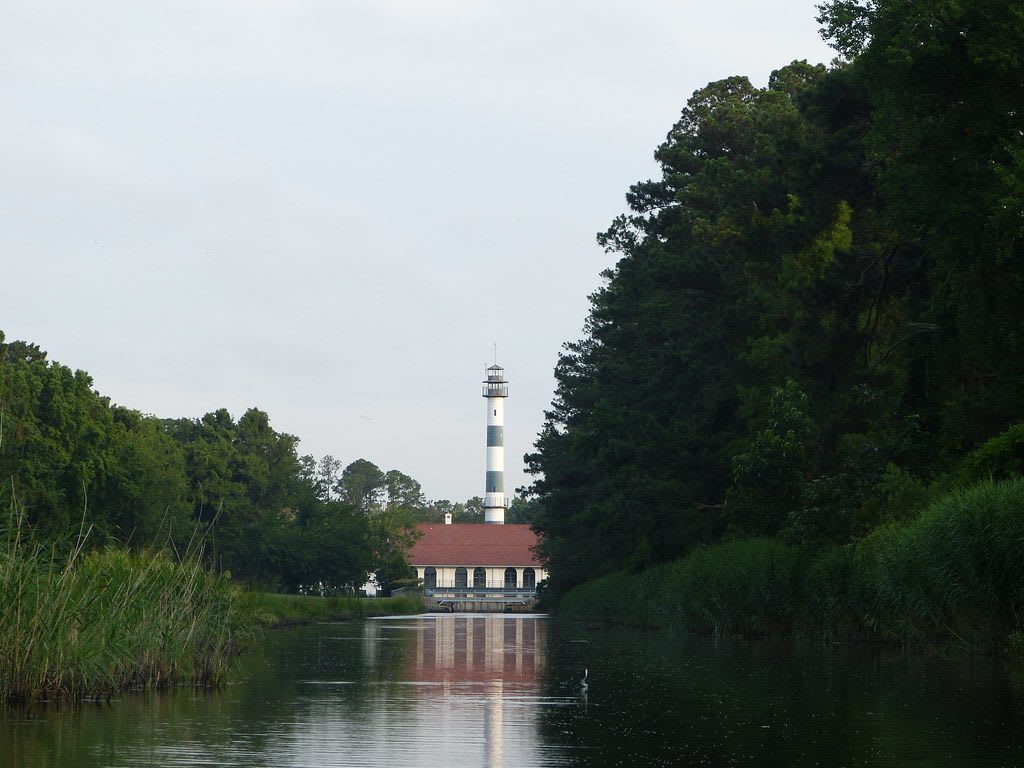
A canal lined with reeds and pines leading to Mattamuskeet Lodge, its tall striped observation tower above a red roof.Allie Stewart, USFWS / CC BY 2.0 via Flickr
🌲Natural

Mattamuskeet National Wildlife Refuge

Part ofThe Outer Banks & the Albemarle

North Carolina's largest natural lake, drained and farmed in the 1910s-1930s and given back to the swans, with the old pumping plant turned hunting lodge on its shore.

⏱
Duration
Two to three hours.
🎟
Admission
Free (USFWS, 2026).
📅
Best Season
Late fall through winter for tundra swans, geese and ducks; some areas close to the public in winter (USFWS, 2026).

The Story

Lake Mattamuskeet is the largest natural lake in North Carolina, about eighteen miles long and only two or three feet deep. For a century people tried to farm it. In 1825 the legislature gave the lake to the state Literary Board to drain and sell for the support of public schools. The first attempt at draining it, in the mid-1800s, was dug with the labor of enslaved people.

In 1909 a reclamation company bought 48,830 acres of lake and shore for two dollars an acre. By 1916 it had dredged canals and finished what was billed as the largest-capacity pumping plant in the world, its steam pumps fed by coal through a 120-foot smokestack. The company failed in 1923. New York investors led by August Heckscher drained the lake in 1925 and farmed the bed for six years, and a town called New Holland, after the Dutch polders, rose on the dry bottom. Heavy rains and pests ended it by 1932, and in 1934 the government bought the whole lake for a waterfowl refuge.

Young men of the Civilian Conservation Corps stripped the pumps, added guest rooms and capped the smokestack with a glass observation room, and the plant opened in 1937 as Mattamuskeet Lodge, a famous goose-hunting hotel until the hunt closed in 1974. The lodge, on the National Register since 1980, now belongs to the state. Come between November and February, when great flocks of tundra swans, geese and ducks winter on the lake, and drive the NC 94 causeway across it at dusk.

Visitor Info

⏱
Time Needed
Two to three hours.
🎟
Admission
Free (USFWS, 2026).
📅
Best Season
Late fall through winter for tundra swans, geese and ducks; some areas close to the public in winter (USFWS, 2026).
🛣️
Highway
US 264

On the Map

Nearby

The closest stops worth working into your route

historical26 mi away
Ocracoke Light Station
The squat white 1823 tower in Ocracoke village, the oldest operating light station in North Carolina, on the island where Blackbeard was killed in 1718.
historical27 mi away
Somerset Place State Historic Site
One of the Upper South's largest plantations, on Lake Phelps, told through the more than 861 enslaved people who lived and worked there from 1785 to 1865.
natural27 mi away
Pettigrew State Park
Lake Phelps, a clear rain-fed Carolina bay where some thirty Algonquian dugout canoes have been found, the oldest about 4,400 years old.
historical27 mi away
Portsmouth Village
The 1753 lightering port at Ocracoke Inlet, through which cargo and captive Africans passed, empty since its last residents left in 1971 and reached only by boat.
natural33 mi away
Alligator River National Wildlife Refuge
The pocosin wetlands of mainland Dare and Hyde, set aside in 1984, where the world's most endangered wolf was first returned to the wild in 1987.
historical36 mi away
Historic Bath
North Carolina's first town, chartered in 1705 on the Pamlico River, struck in the Tuscarora War of 1711 and keeping the state's oldest church and Blackbeard's brief retirement.

Historical markers nearby

Roadside plaques and monuments within a short detour

Marker2.1 mi away
Mattamuskeet
Marker9.2 mi away
Hyde County School Boycott
Swan Quarter
Marker9.3 mi away
British Invasion
Swan Quarter
Marker27 mi away
Aquascogoc
Belhaven
Marker29 mi away
Lt. Robert Maynard
Ocracoke
Marker29 mi away
USRC Mercury
Ocracoke