Home / North Carolina / Fayetteville, Pinehurst & the Sandhills / Weymouth Woods-Sandhills Nature Preserve
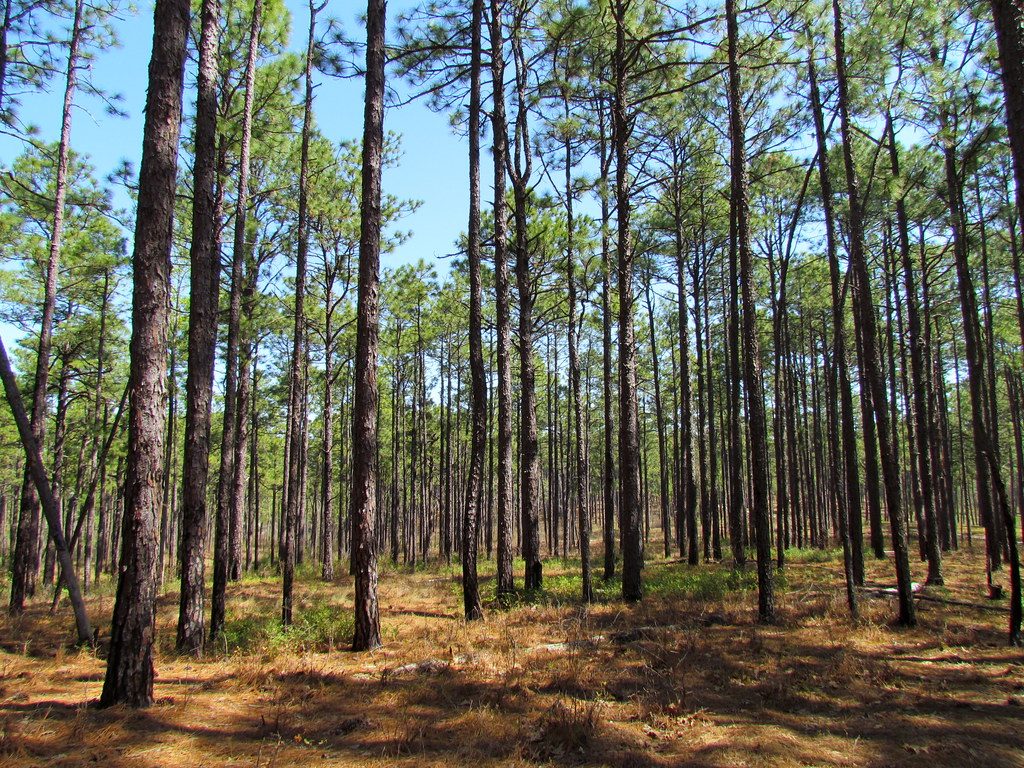
Tall, straight longleaf pines rising from a floor of pine needles and low grass under a blue sky.bobistraveling / CC BY 2.0 via Flickr
🌲Natural

Weymouth Woods-Sandhills Nature Preserve

Part ofFayetteville, Pinehurst & the Sandhills

A remnant of the old longleaf pine forest at Southern Pines, saved by the novelist James Boyd's family, with trees centuries old and the scars of the turpentine trade.

⏱
Duration
One to three hours.
🎟
Admission
Free for day use (NC State Parks, 2026).
📅
Best Season
Spring and fall; summer mornings before the heat. The visitor center keeps daytime hours that vary by season (NC State Parks, 2026).

The Story

The Sandhills are old dunes, sand blown into sheets and ridges between about 75,000 and 6,000 years ago, and longleaf pine once covered them along with millions of acres across the South. Scottish Highlanders settling here in the mid-1700s found trees a hundred feet tall and more. Then came the naval stores trade: workers cut V-shaped faces into the trunks to bleed resin, which was distilled into turpentine and boiled into tar and pitch for ships. By 1850 North Carolina's pine forests made a third of the world's supply. The railroads arrived in the 1870s, and by 1900 nearly all the old trees were gone.

James Boyd's grandfather bought a large tract east of Southern Pines early in the 20th century to keep the loggers off it, and named it Weymouth for the pines of Weymouth in England. Boyd grew up to write novels of the Carolina past, Drums the best known of them. In 1963 his widow, Katharine, gave 403 acres to the state, the first natural area in the state park system. A longleaf here was cross-dated at 458 years, the oldest on record, and many old trees still carry the healed cat-face scars of the turpentine cuts.

The trails cross wiregrass under the tall pines, down to blackwater James Creek. Red-cockaded woodpeckers nest in living longleaf, fox squirrels forage the open floor and pitcher plants grow in the wet places. The visitor center explains the fires that keep the forest open.

Visitor Info

⏱
Time Needed
One to three hours.
🎟
Admission
Free for day use (NC State Parks, 2026).
📅
Best Season
Spring and fall; summer mornings before the heat. The visitor center keeps daytime hours that vary by season (NC State Parks, 2026).
🛣️
Highway
US 1

On the Map

Nearby

The closest stops worth working into your route

architectural6.5 mi away
Pinehurst Village
The resort village a Boston soda-fountain maker laid out in cutover longleaf country in 1895, with Olmsted's curving lanes, a village green and Donald Ross's No. 2.
historical22 mi away
House in the Horseshoe State Historic Site
Philip Alston's house above a bend of the Deep River, shot full of holes in a 1781 Loyalist attack, later a cotton plantation where about fifty people were enslaved.
historical26 mi away
Laurinburg Institute
The Black boarding school Emmanuel and Tinny McDuffie founded in 1904 at Booker T. Washington's urging, where Dizzy Gillespie was a student from 1933.
historical27 mi away
Fayetteville State University
The historically Black university that grew from the 1867 Howard School, founded on land seven Black men bought, where Charles W. Chesnutt was principal.
historical29 mi away
Market House
The 1832 arcaded market and town hall in the traffic circle at the heart of Fayetteville, where enslaved people were sold, built on the site of the state house of 1789.
historical29 mi away
Battle of Hayes Pond
The field near Maxton where several hundred Lumbee people broke up a Ku Klux Klan rally on January 18, 1958, marked by a state roadside marker.

Historical markers nearby

Roadside plaques and monuments within a short detour

Marker2.2 mi away
James Boyd
Southern Pines
Marker3.4 mi away
Walter Hines Page
Aberdeen
Marker6.1 mi away
State Sanatorium
McCain
Marker7.6 mi away
Camp Mackall
McCain
Marker13 mi away
Monroe's Crossroads
Raeford
Marker14 mi away
Cameron Morrison School
Hoffman