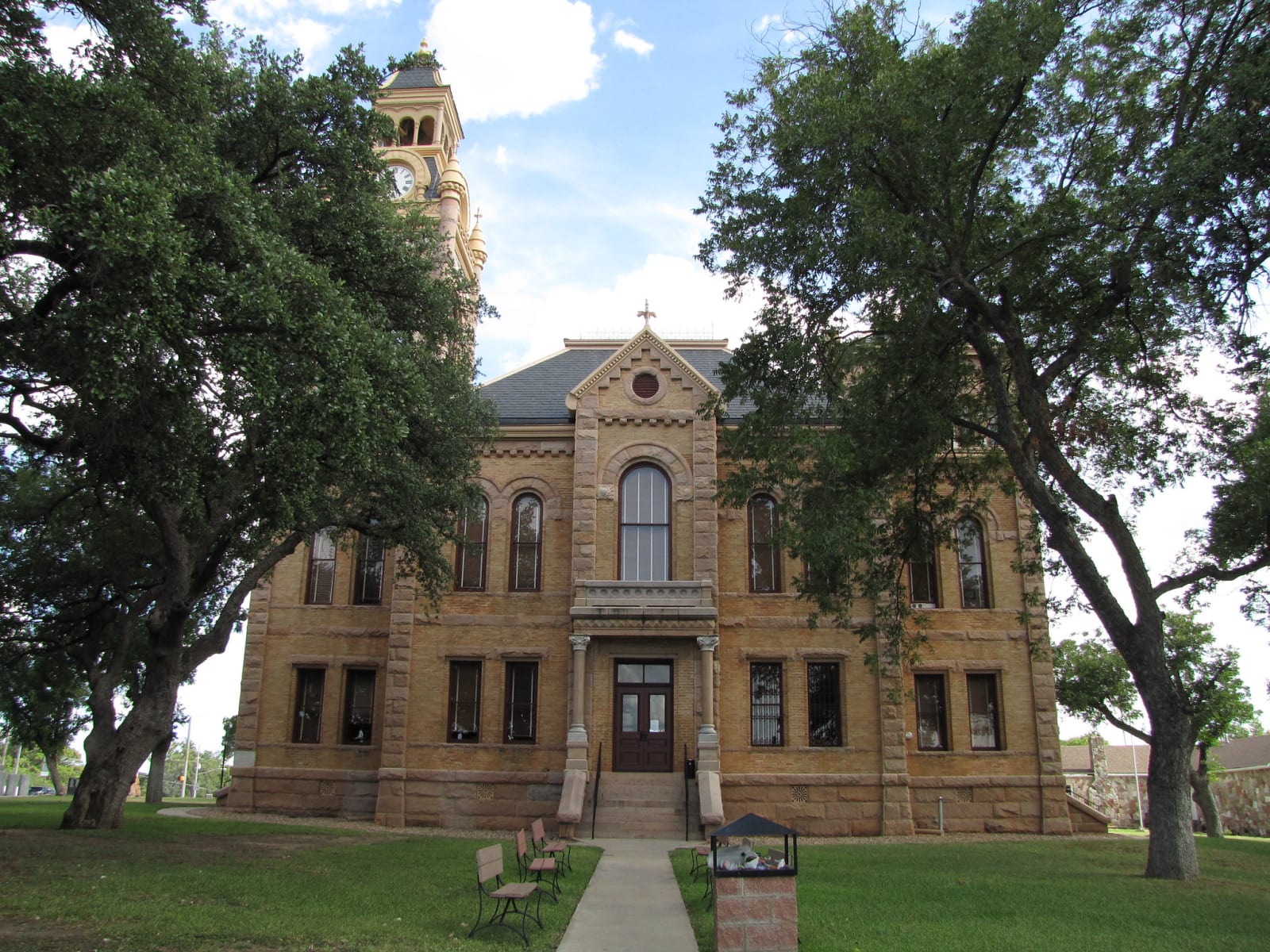
 QuesterMark / CC BY-SA 2.0 via Flickr
The Story
Llano was chosen as county seat in 1856 at an election held under a live oak on the south bank of the Llano River, and for its first decades it was a frontier trading post of log buildings. Its fortunes turned in 1886, when iron deposits at Iron Mountain in the northwest of the county drew money from Dallas and the northern states. Promoters planned a furnace, a dam, streetcars and electric lights, laid out streets named Birmingham, Pittsburgh and Bessemer on the north bank, and spoke of the Pittsburgh of the West. In 1892 the town incorporated, the river was bridged and the Austin and Northwestern Railroad reached a terminal on the north side.
Only a small dam and the street lights were built. On the courthouse square south of the river, the county had finished an ornate brick courthouse in 1885; it burned on January 22, 1892, and the present building, designed by A. O. Watson in the Romanesque style and built by J. A. and G. H. Wilson, was occupied on August 1, 1893. The county jail followed in 1895, by the Pauly Jail Building and Manufacturing Company. Both are on the National Register, and the courthouse is a Recorded Texas Historic Landmark.
Brick business blocks of the boom went up around a second square on the north side of the river, and granite cutters moved to town once the railroad came.
Visitor Info
On the Map
Nearby
The closest stops worth working into your route
Historical markers nearby
Roadside plaques and monuments within a short detour