Home / South Dakota / The Grand River & the Northwest / Lemmon Petrified Wood Park
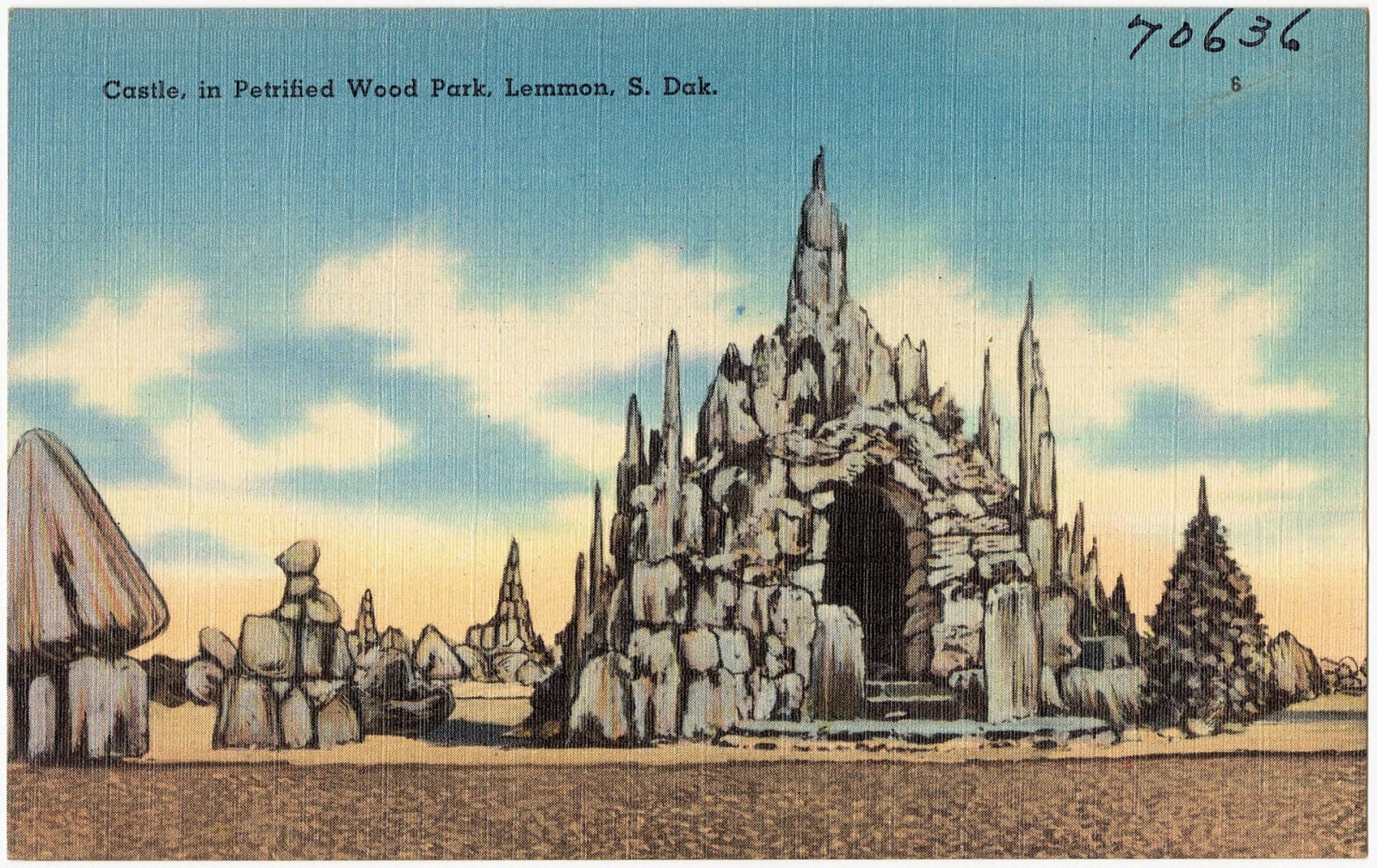
A mid-century postcard of the castle built of petrified wood in Lemmon's Petrified Wood Park, surrounded by spires and cones of the same stoneTichnor Brothers postcard / public domain via Wikimedia Commons
🛣️Roadside

Lemmon Petrified Wood Park

Part ofThe Grand River & the Northwest

A city block of spires, pyramids and a castle built of petrified wood and dinosaur bone by out-of-work men during the Depression, for travelers coming in off the treeless prairie.

Year-RoundOff the Beaten PathFossilsWeird & WonderfulFree
⏱
Duration
Half an hour.
🎟
Admission
Free; the museum is open in summer.
📅
Best Season
Year-round outside; museum Memorial Day to Labor Day.

The Story

Ole S. Quammen came into Lemmon on the first passenger train in 1907, ran a lumberyard and served as the town's mayor, and spent his spare time walking the ranches of the Grand River country, where petrified logs and bones lay on the open range. Ranchers thought him odd for hauling them away. In 1930, with the Depression on, he put out-of-work men to collecting the stone by the wagonload and building it into something travelers would stop for.

What they built, opening in May 1932, fills a city block downtown: more than a hundred spires, cones and pyramids of cemented petrified wood, some of them twenty feet tall, so that drivers coming in off the treeless prairie would find themselves passing through a forest of stone. There is a wishing well, a waterfall, and the Castle, an octagonal tower of spires and turrets built of some three hundred tons of petrified wood and dinosaur and mammoth bone. A museum of petrified logs with a floor of petrified grass followed in 1933, and Quammen faced the gas station he owned at the end of the block in the same stone. The round boulders scattered through the park are cannonball concretions from the Cannonball River just over the North Dakota line.

Quammen and his son David both died in 1934. His daughter Alice ran the park for twenty years and in 1954 gave it to the city on the condition that it never be altered, and it has stayed as he built it. At Christmas the stone trees are strung with lights.

Visitor Info

⏱
Time Needed
Half an hour.
🎟
Admission
Free; the museum is open in summer.
📅
Best Season
Year-round outside; museum Memorial Day to Labor Day.
🛣️
Highway
US-12

On the Map

Nearby

The closest stops worth working into your route

historical13 mi away
Hugh Glass Monument and Shadehill Reservoir
Where the forks of the Grand River meet under a reservoir, a monument a poet raised in 1923 for a trapper mauled by a grizzly, with a message for the people of 2023.
historical52 mi away
Slim Buttes
Pine-topped buttes where a starving army column, eating its horses, fell on a Lakota village in September 1876 and found a Seventh Cavalry flag on a lodge.
cultural79 mi away
Lakota Cultural Center, Eagle Butte
The Cheyenne River Sioux Tribe's own cultural center, beside the tribal headquarters on the highway into Eagle Butte, with a hall of murals by local artists.
historical86 mi away
Sitting Bull and Sakakawea Monuments
A granite head carved by the Crazy Horse sculptor over a grave dug up at Fort Yates by night in 1953, on a bluff above the Missouri on the Standing Rock Reservation.
natural111 mi away
Medicine Rocks State Park
Sandstone towers worn full of holes, holy ground to the Lakota and Cheyenne and a stone register of everyone who came after.
cultural115 mi away
Carter County Museum
Montana's first county museum, built in 1936 by a ranch county to keep the dinosaurs its own ground kept giving up.