 Ian Poellet / CC BY-SA 3.0 via Wikimedia Commons
The Story
Ing Hay came to the United States in 1883, the year after Congress passed the Chinese Exclusion Act, and in 1887 reached John Day, where he met Lung On, a fellow immigrant with a head for business. Together they took over a stone building put up in the 1870s and made it Kam Wah Chung, a general store, an herbal pharmacy, a shrine and a gathering place for the Chinese workers who had come to the eastern Oregon goldfields. Lung On ran the business. Ing Hay, whom everyone called Doc Hay, practiced medicine.
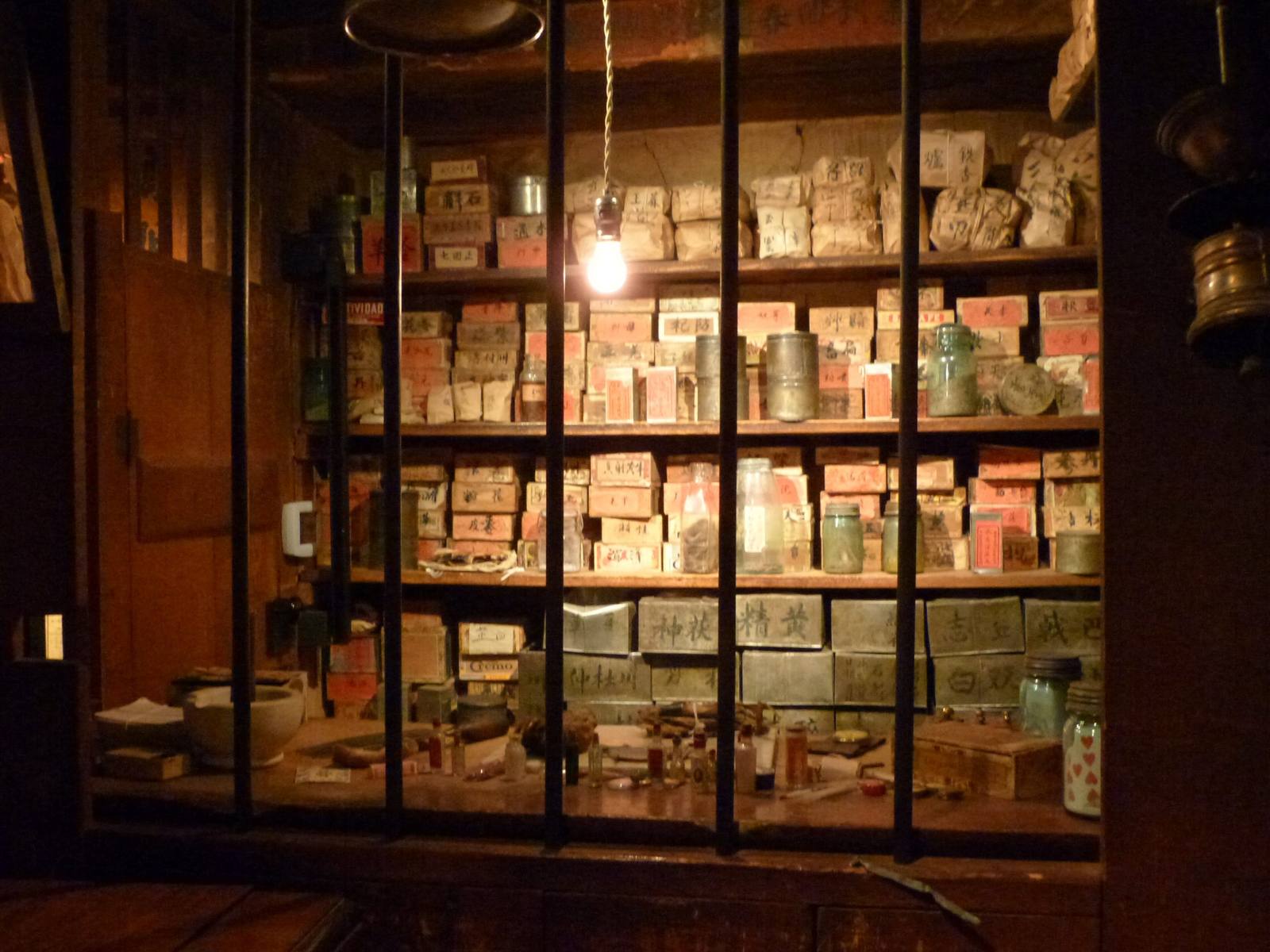
He diagnosed by the pulse, the traditional Chinese method, and prescribed formulas of as many as sixty herbs ordered from San Francisco and Hong Kong, cooked down with oil or honey in a wok in the building's kitchen. His patients came from every part of the town and the ranch country around it, and jealous doctors had him charged three times with practicing medicine without a license; each time the charges were dismissed. When patients paid by check he often simply put the checks away. Lung On died in 1940. Doc Hay, nearly blind, closed the pharmacy in 1948 and died in 1952, and more than $23,000 in uncashed checks turned up in his quarters, some of them written during the Depression.
His nephew, Bob Wah, deeded the building and everything in it to the city of John Day in 1955 for a museum, and then it sat, locked and nearly forgotten, until the city rediscovered it in 1967. Inside, nearly five hundred herbs and remedies are still on the shelves, along with the shrine, the kitchen, letters from Ing Hay's family in China asking for help, and magazine pictures pinned to the walls. It is a National Historic Landmark and a state heritage site, seen on guided tours.
Visitor Info
On the Map
Nearby
The closest stops worth working into your route