Home / Arkansas / Crowley's Ridge & the Upper Delta / Johnny Cash Boyhood Home
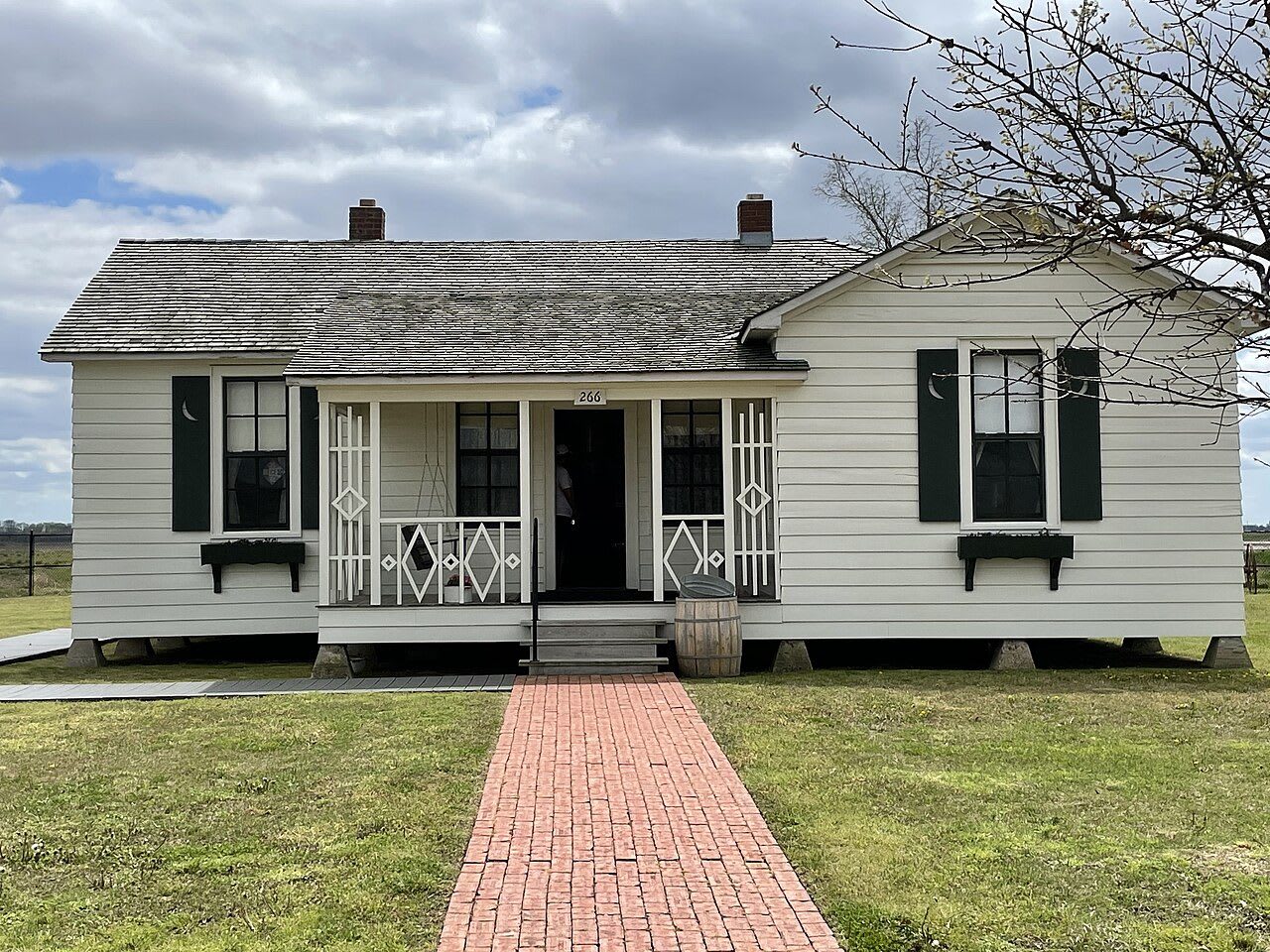
The white clapboard Cash family farmhouse with green shutters and a diamond-pattern porch rail, reached by a brick walk across a lawn under a cloudy sky.Dr. Blazer / CC BY-SA 4.0 via Wikimedia Commons
🏛️Historical

Johnny Cash Boyhood Home

Part ofCrowley's Ridge & the Upper Delta

A restored five-room farmhouse in the Dyess Colony, the New Deal resettlement town where Johnny Cash grew up from 1935, with the colony's Administration Building as its museum.

⏱
Duration
About two hours.
🎟
Admission
Ticketed guided tour; $20 regular, $15 seniors, military and groups, $10 ages 5-17, free under 5 (ASU, 2026).
📅
Best Season
Year round. Tours leave hourly Monday to Saturday, 9 a.m. to 3 p.m. (2026); tickets at the Visitors Center or online.

The Story

The Johnny Cash Boyhood Home is part of the Dyess Colony, one of the largest New Deal farm resettlement projects. The Federal Emergency Relief Administration bought some 16,000 acres of swampy bottomland in Mississippi County in 1934, and about 1,300 men from Arkansas relief rolls began building roads and houses on May 22. The colony was laid out like a wagon wheel around a community center, with 500 five-room houses. Families repaid the cost of land and house and used scrip called doodlum. Like most New Deal housing projects, the colony was intended for white people only. Eleanor Roosevelt visited on June 9, 1936, when about 2,500 people lived there. Half of them left for war work in the 1940s.

Ray and Carrie Cash moved their family into a house here on March 24, 1935, and Johnny Cash graduated from Dyess High School in 1950. Arkansas State University bought the farmstead in 2011, after the house had spent five years on the state's most endangered list. His younger siblings Joanne Cash Yates and Tommy Cash sketched the rooms for the restoration, and Carrie Cash's piano is in the living room. The house opened on August 16, 2014, and joined the National Register in 2018.

Tours start at the Dyess Colony Visitors Center, 110 Center Drive, with a short film, then go through the Administration Building museum and end at the house.

Visitor Info

⏱
Time Needed
About two hours.
🎟
Admission
Ticketed guided tour; $20 regular, $15 seniors, military and groups, $10 ages 5-17, free under 5 (ASU, 2026).
📅
Best Season
Year round. Tours leave hourly Monday to Saturday, 9 a.m. to 3 p.m. (2026); tickets at the Visitors Center or online.
🛣️
Highway
Highway 297 / Center Drive

On the Map

Nearby

The closest stops worth working into your route

cultural9.9 mi away
Hampson Archeological Museum State Park
A free state museum on the town square in Wilson that holds the Nodena collection, one of the best Late Mississippian pottery collections known, from a palisaded village on the Mississippi occupied from A.D. 1400 to 1650.
historical11 mi away
Southern Tenant Farmers Museum
A museum in the 1930s dry cleaner and filling station where leaders of the Southern Tenant Farmers Union met, telling the story of cotton tenancy and the Black and white union it produced.
historical20 mi away
Herman Davis State Park
A one-acre state park in Manila around the grave and memorial of Pvt. Herman Davis, a duck-hunting guide who became a scout and sharpshooter in the First World War and was fourth on Pershing's list of heroes.
historical29 mi away
Parkin Archeological State Park
A National Historic Landmark on the St. Francis River preserving a 17-acre Mississippian village, AD 1000 to 1550, that many archeologists think was Casqui in the Hernando de Soto accounts.
cultural31 mi away
Arkansas State University Museum
A free university museum in the Dean B. Ellis Library, with a mastodon cast, an Old Town Arkansas street, Native American and Rockabilly galleries and a tinkering studio, and the hub of the university heritage sites.
recreational40 mi away
Crowley's Ridge State Park
A 1933 state park on the loess hills of Crowley's Ridge, built around Benjamin Crowley's homestead spring and the stone-and-log pavilion, dam and cabins of the Civilian Conservation Corps.