Home / Arkansas / Helena & the Lower Delta / Parkin Archeological State Park
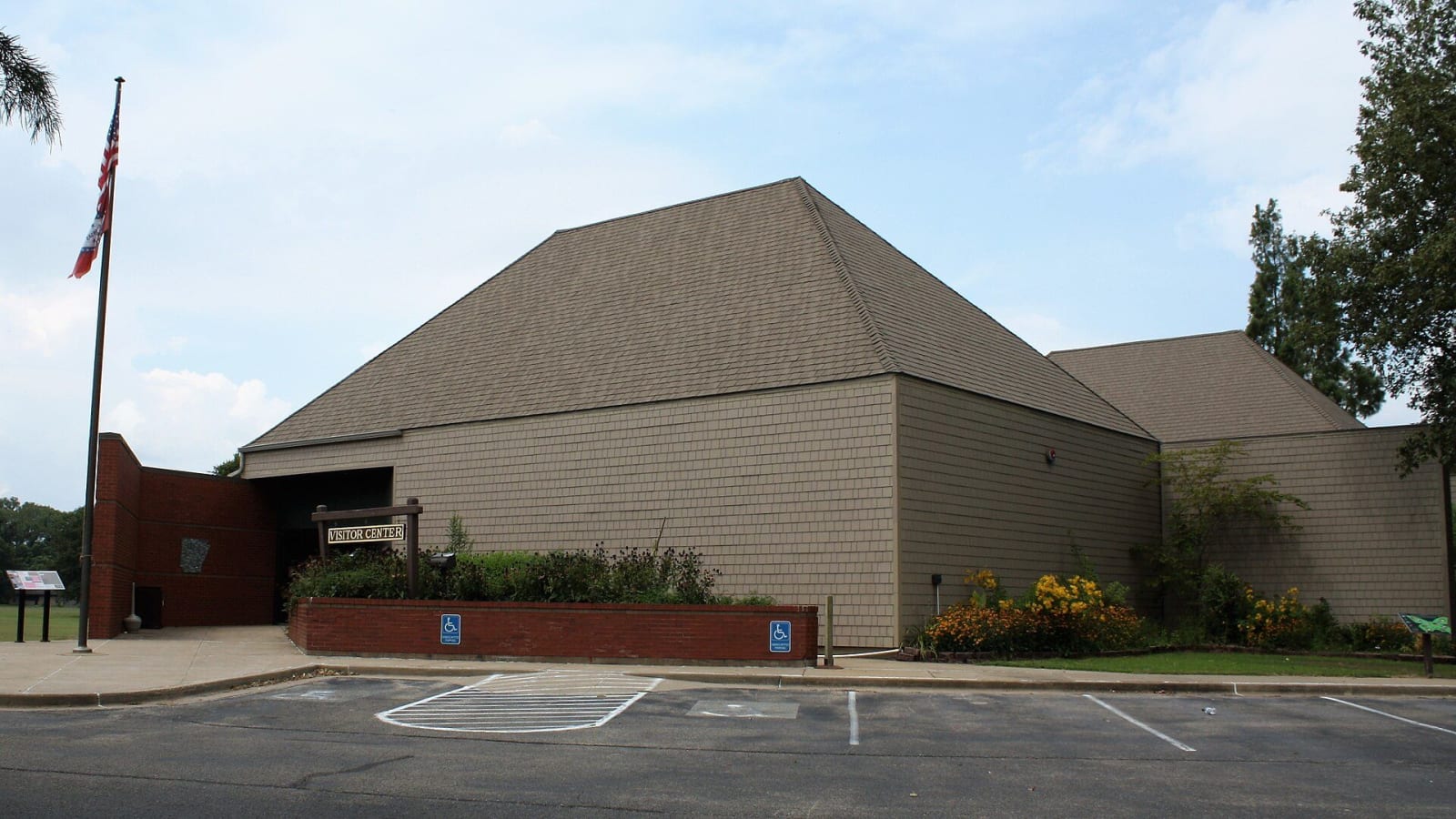
The low shingled visitor center at Parkin Archeological State Park, with a flagpole at left, a brick entry wall, flower beds and a parking lot in front.Brandonrush / CC0 via Wikimedia Commons
🏛️Historical

Parkin Archeological State Park

Part ofHelena & the Lower Delta

A National Historic Landmark on the St. Francis River preserving a 17-acre Mississippian village, AD 1000 to 1550, that many archeologists think was Casqui in the Hernando de Soto accounts.

⏱
Duration
One to two hours.
🎟
Admission
Free for self-guided tours and the museum exhibits.
📅
Best Season
Year round; museum open Wednesday through Saturday 8 a.m. to 5 p.m. and Sunday 1 p.m. to 5 p.m. (dated figures; closed Mondays and Tuesdays).

The Story

Parkin Archeological State Park, in Cross County on the St. Francis River, preserves a Mississippian village that stood here from about AD 1000 to 1550. The village covered about seventeen acres and was enclosed by the river on one side and a moat on three, with a wooden palisade, and a large platform mound still overlooks the river. It is believed to be the most intact village of its time in northeast Arkansas.

European-made trade items from the era of Hernando de Soto's expedition were found here, and written descriptions of the village support the theory that de Soto's party visited in 1541. Many archeologists think Parkin may be Casqui, a town named in the expedition's journals. The site survived because of the town that grew over it. After Parkin was founded in 1887, cotton farmers could not plow across the wide ditch that had been the moat, and a sawmill and homes were built within the old village. A University of Arkansas field school in 1965 tested whether enough of the deposits were intact to justify a park. The park also keeps the Northern Ohio School, a one-room school for African American children.

A research station of the Arkansas Archeological Survey is inside the visitor center, where visitors can watch work in progress. The exhibit hall shows artifacts, and a theater tells the story of the site. The museum is open Wednesday through Saturday and on Sunday afternoons. A paved trail, picnic area and boat ramp are on the grounds.

Visitor Info

⏱
Time Needed
One to two hours.
🎟
Admission
Free for self-guided tours and the museum exhibits.
📅
Best Season
Year round; museum open Wednesday through Saturday 8 a.m. to 5 p.m. and Sunday 1 p.m. to 5 p.m. (dated figures; closed Mondays and Tuesdays).
🛣️
Highway
US-64 / AR-184

On the Map

Nearby

The closest stops worth working into your route

historical18 mi away
Southern Tenant Farmers Museum
A museum in the 1930s dry cleaner and filling station where leaders of the Southern Tenant Farmers Union met, telling the story of cotton tenancy and the Black and white union it produced.
historical29 mi away
Johnny Cash Boyhood Home
A restored five-room farmhouse in the Dyess Colony, the New Deal resettlement town where Johnny Cash grew up from 1935, with the colony's Administration Building as its museum.
cultural35 mi away
Hampson Archeological Museum State Park
A free state museum on the town square in Wilson that holds the Nodena collection, one of the best Late Mississippian pottery collections known, from a palisaded village on the Mississippi occupied from A.D. 1400 to 1650.
cultural40 mi away
Arkansas State University Museum
A free university museum in the Dean B. Ellis Library, with a mastodon cast, an Old Town Arkansas street, Native American and Rockabilly galleries and a tinkering studio, and the hub of the university heritage sites.
natural43 mi away
Mississippi River State Park
A state park and gateway to the St. Francis National Forest, where the river, Crowley's Ridge and the Delta meet, with a Trail of Tears site at the Mississippi and St. Francis confluence.
historical47 mi away
Herman Davis State Park
A one-acre state park in Manila around the grave and memorial of Pvt. Herman Davis, a duck-hunting guide who became a scout and sharpshooter in the First World War and was fourth on Pershing's list of heroes.