Home / Arkansas / Crowley's Ridge & the Upper Delta / Crowley's Ridge State Park
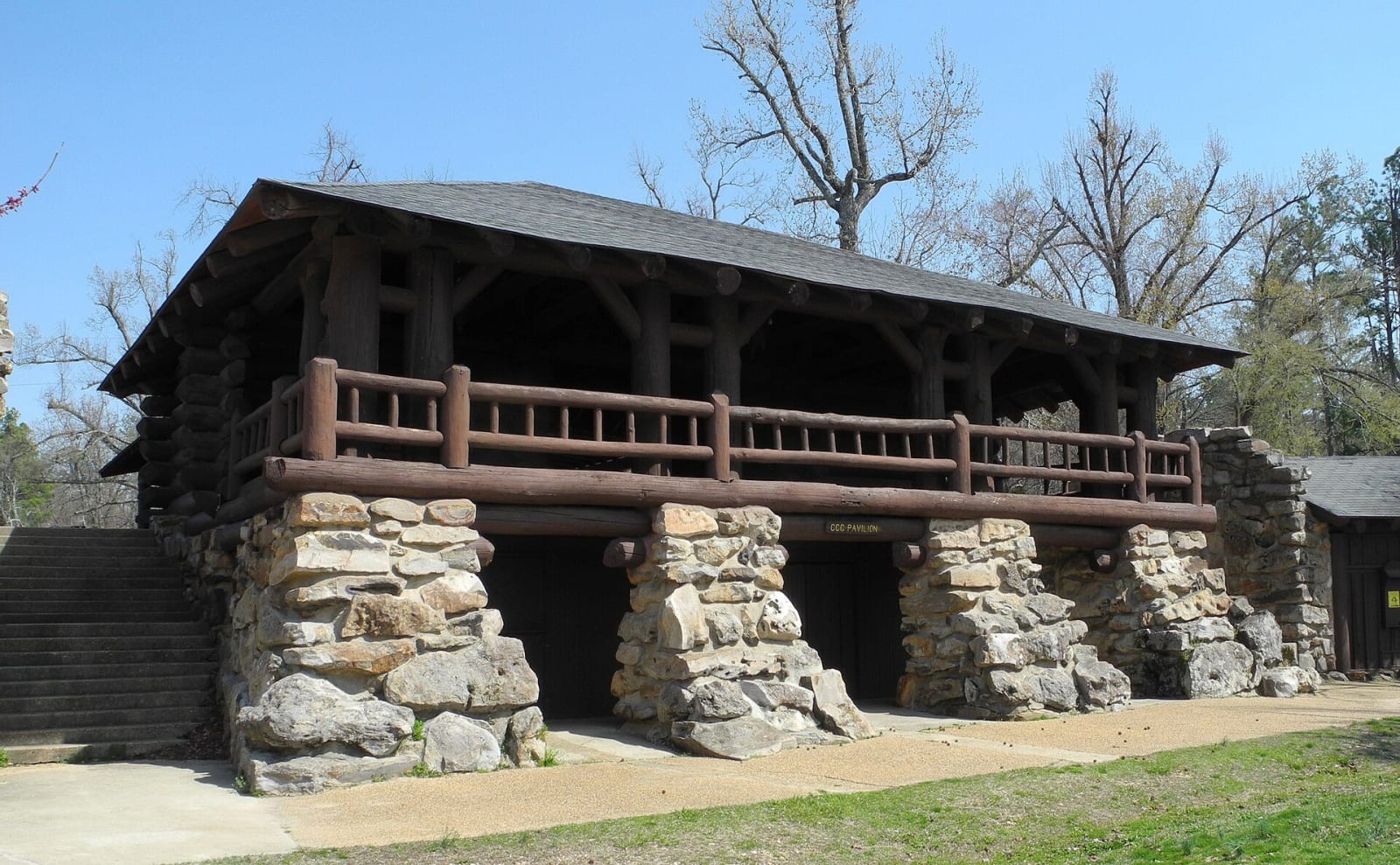
A rustic two-level pavilion of logs on fieldstone piers, with a log railing along the upper deck, stands among bare trees at Crowley's Ridge State Park.Kbh3rd / CC BY-SA 3.0 via Wikimedia Commons
🏕️Recreational

Crowley's Ridge State Park

Part ofCrowley's Ridge & the Upper Delta

A 1933 state park on the loess hills of Crowley's Ridge, built around Benjamin Crowley's homestead spring and the stone-and-log pavilion, dam and cabins of the Civilian Conservation Corps.

⏱
Duration
Two hours to a weekend.
🎟
Admission
Free entry; fees for camping, cabins, pavilions and the summer swimming area (swimming $5 for ages 6 and up on the 2026 park page).
📅
Best Season
Year round. Visitor center open daily 8 a.m. to 5 p.m. (closed New Year's Day, Thanksgiving, Christmas Eve and Christmas); the swimming area runs Memorial Day weekend to Labor Day.

The Story

Crowley's Ridge State Park stands on the ridge that gave the park its name. Benjamin F. Crowley, a War of 1812 veteran and the first prominent white settler in the region, arrived in 1820 and chose the site for its high ground and a spring that still flows. His neighbors named the long line of hills for him, and he is buried in the park. The ridge is generally thought to be an island that the Mississippi and Ohio rivers once flowed around, and it is capped by wind-blown loess up to fifty feet deep, so its slopes are steep and its forest has beech, sugar maple and tuliptree, trees like those of the western Appalachians rather than the flat Delta around it.

The spot was a summer campground long before it was a park. Belle Hodges Wall of the Paragould Chamber of Commerce led the campaign, and the state accepted the land on July 21, 1933, as its fourth state park. In October the first Civilian Conservation Corps detachment arrived, mostly young men from northern Missouri, and grew to 207. They built trails, bridges, cabins, a pavilion and bathhouse, roads and a 300-foot earthen dam. About 8,000 people crowded the unfinished park on July 4, 1935, and it was dedicated on June 21, 1937.

The stone-and-log pavilion and bathhouse is still the focal point, and four CCC structures are on the National Register. The park is nine miles west of Paragould on US 412, then two miles south on Highway 168, with cabins, campsites, trails, a 31-acre fishing lake, summer swimming and kayak rentals.

Visitor Info

⏱
Time Needed
Two hours to a weekend.
🎟
Admission
Free entry; fees for camping, cabins, pavilions and the summer swimming area (swimming $5 for ages 6 and up on the 2026 park page).
📅
Best Season
Year round. Visitor center open daily 8 a.m. to 5 p.m. (closed New Year's Day, Thanksgiving, Christmas Eve and Christmas); the swimming area runs Memorial Day weekend to Labor Day.
🛣️
Highway
US-412 / Highway 168

On the Map

Nearby

The closest stops worth working into your route

cultural14 mi away
Arkansas State University Museum
A free university museum in the Dean B. Ellis Library, with a mastodon cast, an Old Town Arkansas street, Native American and Rockabilly galleries and a tinkering studio, and the hub of the university heritage sites.
historical23 mi away
Davidsonville Historic State Park
The ghost-town site of Arkansas's first post office, courthouse and federal land office, on the Black River, with open-frame outlines of the courthouse and a dogtrot house.
historical25 mi away
Powhatan Historic State Park
A river port and county seat on the Black River whose 1888 courthouse, 1873 jail, log house and academy still stand where they were built, with a state archives branch in the same park.
historical30 mi away
Herman Davis State Park
A one-acre state park in Manila around the grave and memorial of Pvt. Herman Davis, a duck-hunting guide who became a scout and sharpshooter in the First World War and was fourth on Pershing's list of heroes.
cultural35 mi away
Hemingway-Pfeiffer Museum
The Piggott house and barn where Ernest Hemingway visited his in-laws, the Pfeiffers, and worked on A Farewell to Arms in 1928, kept with the family's own Stickley furniture.
historical40 mi away
Johnny Cash Boyhood Home
A restored five-room farmhouse in the Dyess Colony, the New Deal resettlement town where Johnny Cash grew up from 1935, with the colony's Administration Building as its museum.