Home / South Carolina / Myrtle Beach, Georgetown & the Grand Strand / Hobcaw Barony
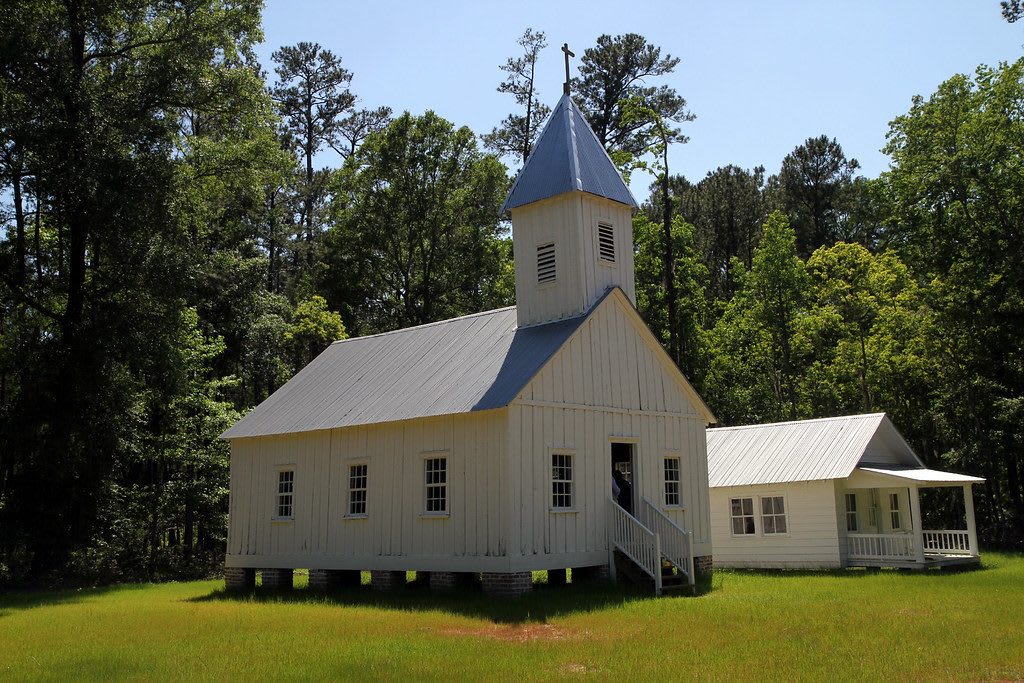
A white board church with a small steeple and a cottage beside it on a grassy clearing in the pines at Hobcaw Barony.anoldent / CC BY-SA 2.0 via Flickr
🏛️Historical

Hobcaw Barony

Part ofMyrtle Beach, Georgetown & the Grand Strand
On this driveUS 17 up the Waccamaw Neck: Georgetown, Brookgreen, Myrtle Beach and Atlantic Beach

Sixteen thousand acres on Waccamaw Neck: rice plantations, four villages built by enslaved people, Bernard Baruch's hunting retreat and a research reserve.

⏱
Duration
Two to three hours with a tour.
🎟
Admission
Discovery Center free. Discover Hobcaw two-hour bus tour weekdays $30; Saturday Explore tour $40; reservations required (Hobcaw Barony, 2026).
📅
Best Season
Year round; fall through spring is most comfortable on the walking stops.

The Story

Long before rice, people fished and gathered shellfish along the creeks of North Inlet, and the shell middens they left are part of the story the Discovery Center tells. In 1718 the Crown granted this point between Winyah Bay and the ocean to John, Lord Carteret as a barony. It was sold off in parcels in 1766 and 1767 and became about a dozen rice plantations, worked by enslaved people through the decades when Georgetown District grew nearly half the country's rice.

Four of the villages those enslaved people built still stand. Their descendants lived in them well into the twentieth century. Friendfield Village keeps antebellum cabins, a dispensary and the board-and-batten Friendfield Church of 1890; the Strawberry School was built in 1915 for the Black children who lived on the property. Old rice-field banks and canals, and the ruins of the Friendfield rice mill, remain in the woods.

Bernard Baruch, the Camden-born financier, bought the tract between 1905 and 1907 as a winter hunting retreat and entertained Winston Churchill in 1932 and Franklin Roosevelt for a month in 1944. His daughter Belle bought it from him piece by piece, owned all of it by 1956 and left it at her death in 1964 to a foundation for research. The Discovery Center on US 17 is free; the land behind the gate is open only on guided tours, which stop at a village and Baruch's house. Reserve ahead.

Visitor Info

⏱
Time Needed
Two to three hours with a tour.
🎟
Admission
Discovery Center free. Discover Hobcaw two-hour bus tour weekdays $30; Saturday Explore tour $40; reservations required (Hobcaw Barony, 2026).
📅
Best Season
Year round; fall through spring is most comfortable on the walking stops.
🛣️
Highway
US 17 (Ocean Highway)

On the Map

Nearby

The closest stops worth working into your route

historical3.2 mi away
Georgetown Historic District
South Carolina's third-oldest town on Winyah Bay: the rice port, Joseph Rainey's hometown, and the Rice Museum in the 1842 market building.
cultural13 mi away
Brookgreen Gardens
The Huntingtons' sculpture garden laid over four rice plantations, where the Lowcountry Trail tells of the more than a thousand people Joshua John Ward enslaved.
natural14 mi away
Huntington Beach State Park
Three miles of undeveloped beach, salt marsh and the Huntingtons' Moorish-style winter house, Atalaya, across the highway from Brookgreen.
natural20 mi away
Waccamaw National Wildlife Refuge
Old tidal rice fields and blackwater swamp where the Waccamaw and Great Pee Dee rivers run side by side, with a visitor center at Yauhannah.
natural26 mi away
Myrtle Beach State Park
South Carolina's first state park, opened in 1936 and built by the Civilian Conservation Corps: a mile of undeveloped beach and maritime forest.
culinary30 mi away
Scott's Bar-B-Que
A country store in an oak grove where the Scott family has cooked whole hogs over wood coals since 1972.

Historical markers nearby

Roadside plaques and monuments within a short detour

Marker0.4 mi away
Prospect Hill
Georgetown
Marker0.5 mi away
Clifton Plantation
Georgetown
Marker0.5 mi away
Lafayette
Georgetown
Marker1.9 mi away
Attacks Upon Georgetown
Georgetown
Marker3 mi away
Antipedo Baptist Church
Georgetown
Marker3.1 mi away
William Screven
Georgetown