Home / West Virginia / Wheeling & the Northern Panhandle / Grave Creek Mound Archaeological Complex
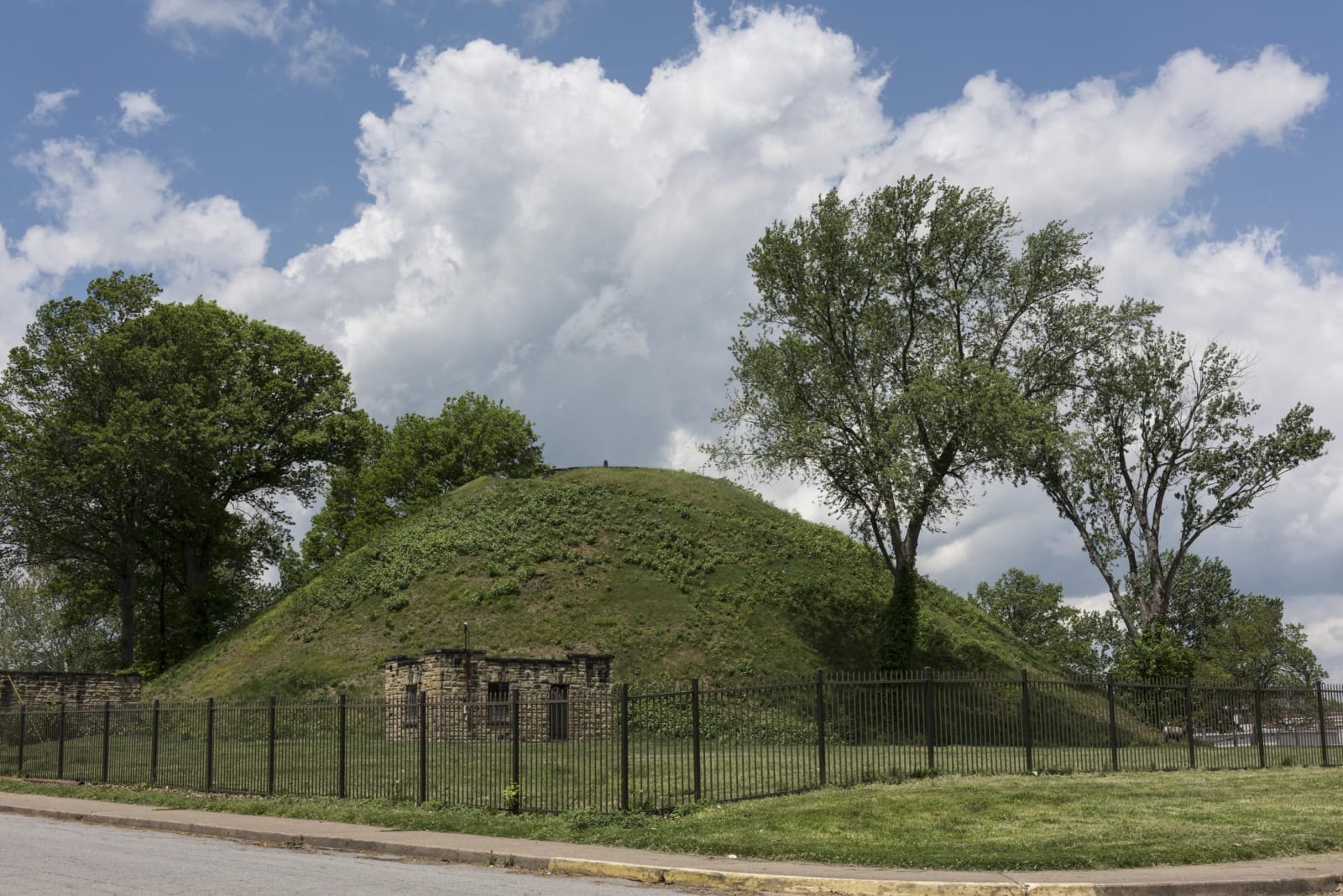
The grass-covered Grave Creek Mound rises behind an iron fence and a small stone building in Moundsville, under a cloud-filled sky.Carol M. Highsmith / public domain via Library of Congress
🏛️Historical

Grave Creek Mound Archaeological Complex

Part ofWheeling & the Northern Panhandle

The state's archaeology museum in Moundsville, beside the great Adena burial mound built about 250 to 150 B.C. A burial place: look, do not climb.

⏱
Duration
One hour.
🎟
Admission
Free (West Virginia Department of Arts, Culture and History, 2026).
📅
Best Season
Year round. Open Tuesday to Saturday, closed Sundays and Mondays (2026).

The Story

Two thousand years ago people of the culture archaeologists call Adena raised a mound here over their dead, carrying earth in baskets, load after load, until it stood more than sixty feet high. Construction ran from about 250 to 150 B.C., with burials laid at different levels as it grew, and a ditch about forty feet wide once ringed it, crossed by at least one causeway. The flat ground where Moundsville stands was once dotted with smaller mounds and earthworks; plowing and treasure hunting destroyed nearly all of them.

This one was not spared either. In 1838 local men tunneled into it and found two burial vaults holding human remains with shell and bone beads, copper bracelets and sheets of mica. Their tunnels were bricked up and the mound became a sideshow, with a saloon on its summit at one point and horse races run around its base. The state bought it in 1909, and the amateur archaeologist Delf Norona and the West Virginia Archeological Society opened the first museum here in 1952.

The Delf Norona Museum, opened in 1978, tells the Adena story through their tools, ornaments and way of life, with a lower gallery of ice-age fossils, and the complex keeps the state's archaeological collections. The mound itself is a burial place, sacred to Native people, and the complex asks visitors to treat it with respect. See it from the grounds, leave the slopes alone, and do not climb it.

Visitor Info

⏱
Time Needed
One hour.
🎟
Admission
Free (West Virginia Department of Arts, Culture and History, 2026).
📅
Best Season
Year round. Open Tuesday to Saturday, closed Sundays and Mondays (2026).
🛣️
Highway
WV 2 (Jefferson Avenue)

On the Map

Nearby

The closest stops worth working into your route

historical0.1 mi away
West Virginia Penitentiary
The Gothic state prison in Moundsville, opened in 1867 and closed in 1995 after a court found its cells cruel and unusual, now open for guided tours.
architectural8 mi away
Prabhupada's Palace of Gold
The marble and gold-leaf palace Hare Krishna devotees built on McCreary's Ridge at New Vrindaban, with rose gardens and a temple nearby.
historical9.8 mi away
Elm Grove Stone Arch Bridge
The 1817 three-arch limestone bridge that carries the National Road over Little Wheeling Creek, the oldest bridge in West Virginia.
historical10 mi away
West Virginia Independence Hall
Wheeling's 1859 federal custom house, where the 1861 conventions broke the western counties away from secessionist Virginia and drafted a new state.
cultural11 mi away
Capitol Theatre
Wheeling's 1928 movie palace on Main Street, home stage of WWVA's Jamboree, the country music show that began here before a live audience in 1933.
architectural11 mi away
Wheeling Suspension Bridge
Charles Ellet's 1849 wire suspension bridge over the Ohio, once the longest span in the world, now open to people on foot and on bicycles.

Historical markers nearby

Roadside plaques and monuments within a short detour

Marker0.3 mi away
Rosby's Rock
Moundsville
Marker0.5 mi away
Thomas H. Trainer
Moundsville
Marker1.8 mi away
Samuel A. J. Cockayne / The Cockayne Farm
Glen Dale
Marker2.6 mi away
Harriet B. Jones
Glen Dale
Marker3 mi away
Washington's Land
Moundsville
Marker6.6 mi away
Benwood Mine Disaster
Benwood