 Carol M. Highsmith / public domain via Library of Congress
The Story
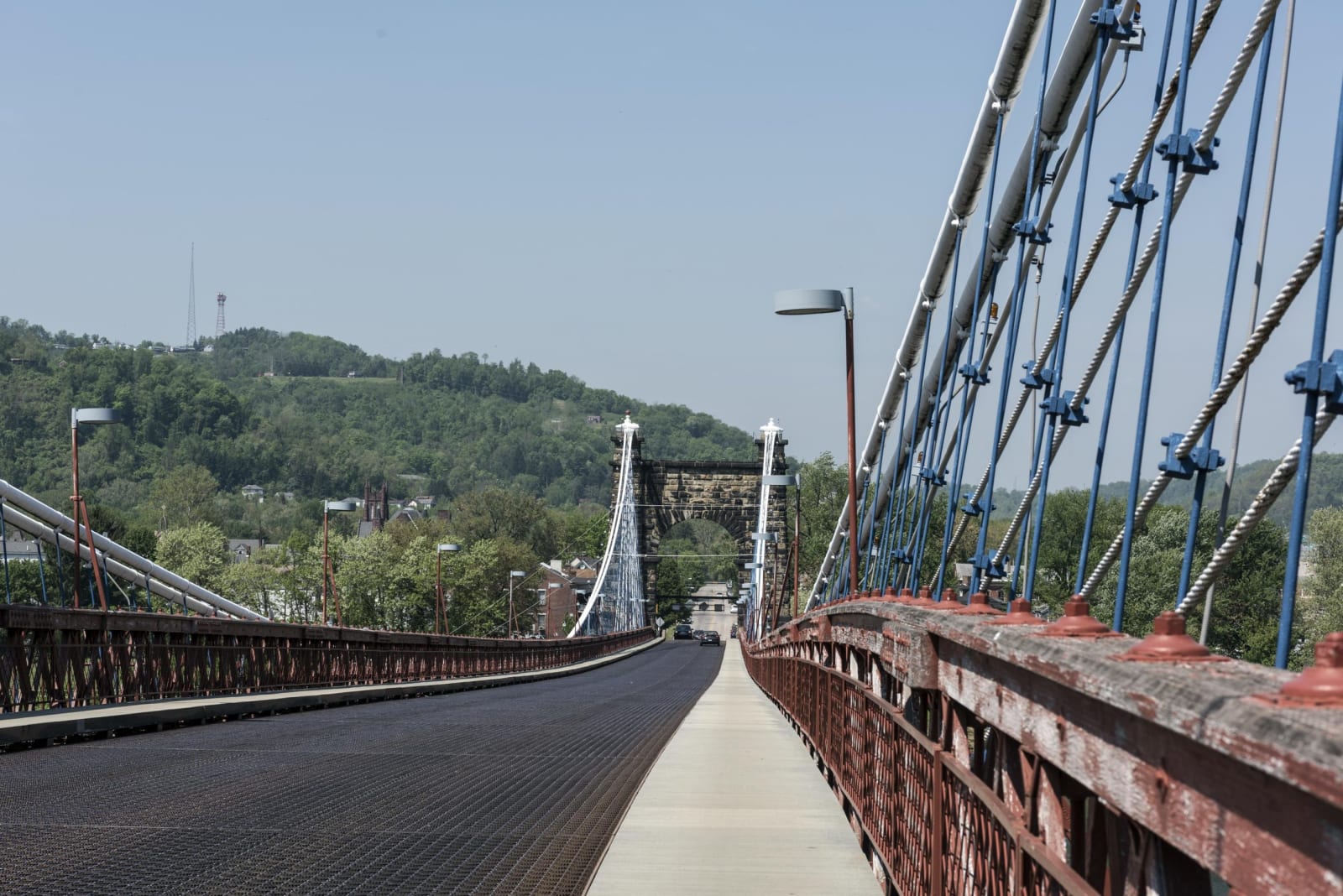
When this bridge opened in October 1849, its 1,010-foot span over the east channel of the Ohio was the longest clear span in the world. Charles Ellet Jr., who had studied suspension bridges in France, designed it; every part of it, down to the drawn wrought-iron wire, was supplied locally, and local stockholders paid for it without state or federal money. It carried the National Road across to Wheeling Island and on into Ohio.
Pittsburgh's interests wanted it gone. Pennsylvania sued in the Supreme Court, arguing that the deck blocked the tall stacks of steamboats bound upriver, with Edwin M. Stanton, later Lincoln's secretary of war, arguing the case. In 1852 the Court ordered the bridge raised to 111 feet, which amounted to tearing it down. Wheeling's backers went to Congress instead, which declared the bridge a post road that August, and the steamboats lowered their stacks. On May 17, 1854, a windstorm threw the deck into the river. Pennsylvania went back to court and lost, and William McComas rebuilt the bridge by 1860 with the cables regrouped and timber trusses along the roadway, much as it looks now.
A steel-grid deck replaced the planks in 1956. After a tour bus ignored the two-ton limit in 2019 and wedged under a barrier, the state closed the bridge to vehicles. Walk it instead: the towers frame the old downtown on one side and the island's houses on the other.
Visitor Info
On the Map
Nearby
The closest stops worth working into your route
Historical markers nearby
Roadside plaques and monuments within a short detour