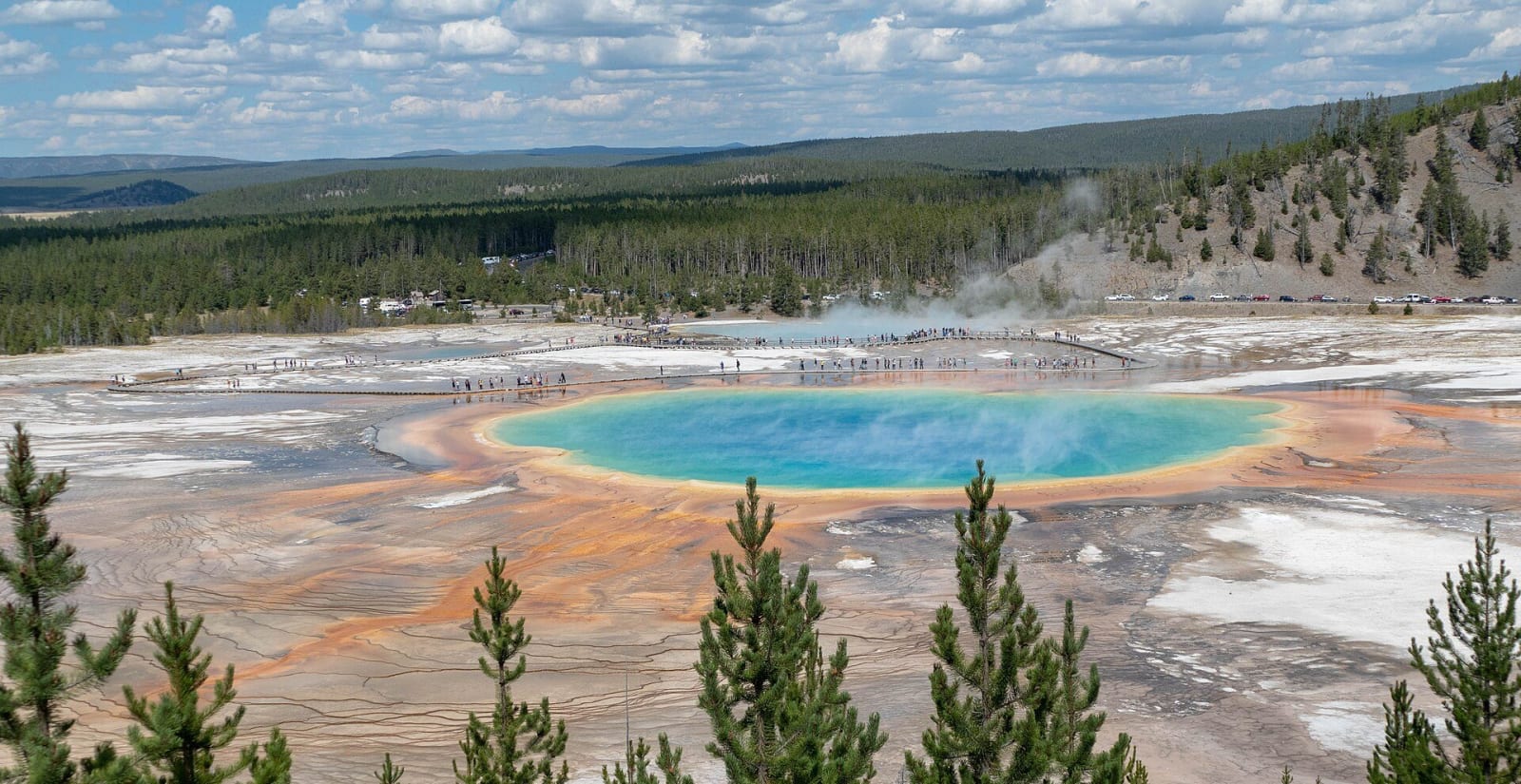
 Diane Renkin, National Park Service / public domain via Wikimedia Commons
The Story
Fur trappers crossing this basin in 1839 noted a boiling lake some three hundred feet across. It is the largest hot spring in the United States, about 370 feet wide and 160 feet deep, and the bands of color that ring it are alive. The deep blue center is the hottest water; outward, as the runoff cools, mats of bacteria and other microbes take over in rings of yellow, orange and red, their colors set by the balance of chlorophyll and carotenoid pigments and by the temperature of the water they grow in. The boardwalk crosses the runoff at ground level, where the spring is mostly steam; the whole pattern shows only from above, at an overlook on the Fairy Falls Trail nearby.
Life in hot water turned out to matter far beyond the park. In 1966 the microbiologist Thomas Brock and an undergraduate, Hudson Freeze, sampled a mat in the runoff of Mushroom Spring, a small pool a few miles north in the Lower Geyser Basin, and grew from it a bacterium they named Thermus aquaticus. Two decades later its heat-proof enzyme, Taq polymerase, made the polymerase chain reaction practical, the method of copying DNA behind genetic testing, forensic work and the COVID-19 test, and Kary Mullis shared a Nobel Prize for the method in 1993. The park received nothing from the discovery, and the episode changed how the Park Service handles research on its microbes.
Visitor Info
On the Map
Nearby
The closest stops worth working into your route
Historical markers nearby
Roadside plaques and monuments within a short detour