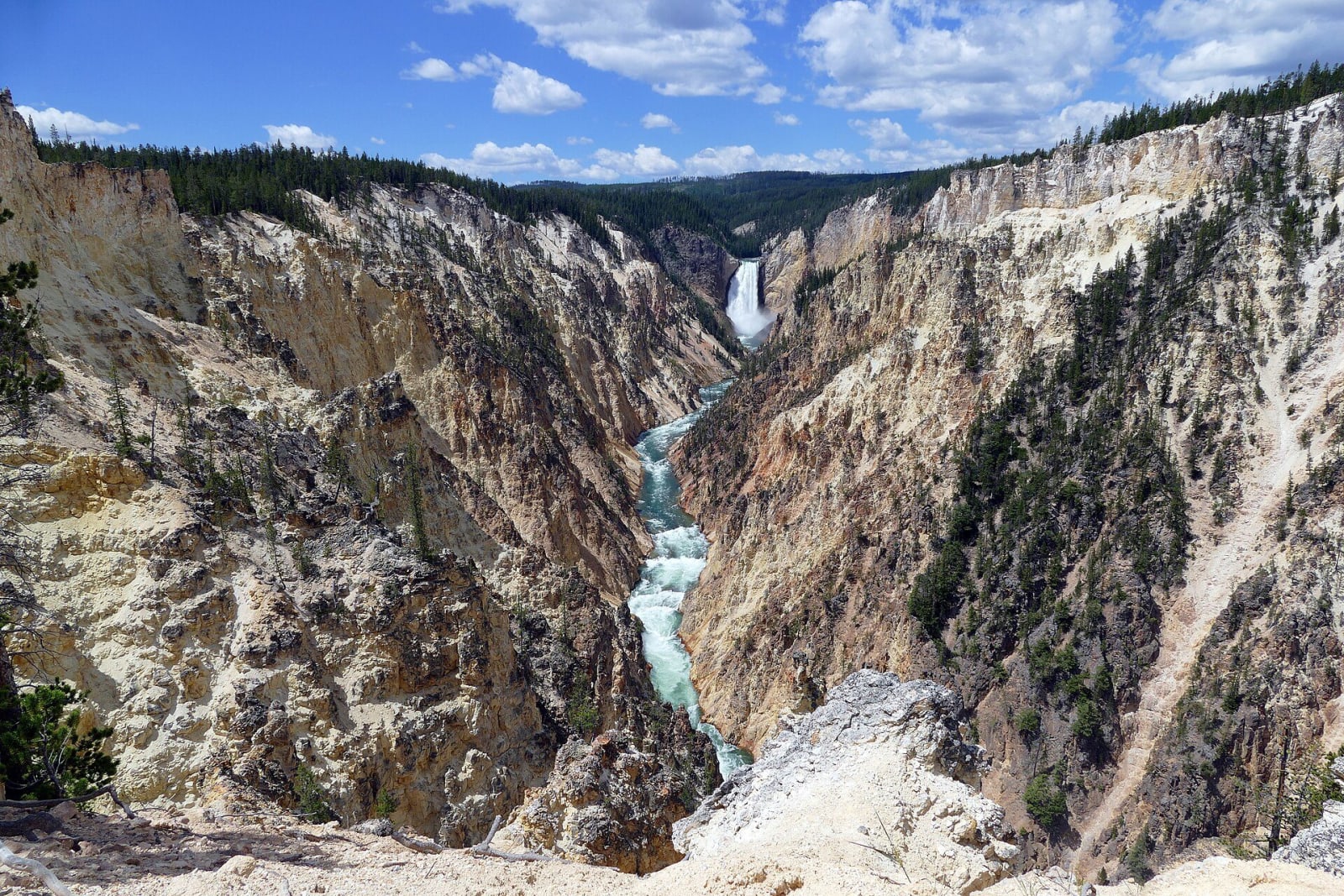
 Diane Renkin, National Park Service / public domain via Wikimedia Commons
The Story
The Yellowstone River drops 109 feet at the Upper Falls and 308 feet at the Lower, almost twice the height of Niagara, and then runs through a canyon some twenty miles long and more than a thousand feet deep. Its colors are chemistry. Hot water and gases rising through the rhyolite altered and softened it, staining it yellow, pink and orange and leaving it weak enough for the river to carve; the Lower Falls pours over a lip of harder rhyolite the hot water never reached.
Thomas Moran saw the canyon in 1871 as a guest of Ferdinand Hayden's survey, sketched and took notes along the rim, and spent about eight months in his New Jersey studio turning them into a canvas some seven by twelve feet. Yellowstone became a park in March 1872, and that year Congress bought the painting for $10,000 while giving the new park nothing at all to run on. It hung in the Capitol until 1950 and now belongs to the Interior Department.
Artist Point, on the south rim, is not where Moran worked, despite its name; the views he drew came from the north rim, near the overlook now called Moran Point. Both rims have drives, overlooks and trails, and the lower level at Artist Point is wheelchair accessible.
Visitor Info
On the Map
Nearby
The closest stops worth working into your route