 Frank Schulenburg / CC BY-SA 4.0 via Wikimedia Commons
The Story
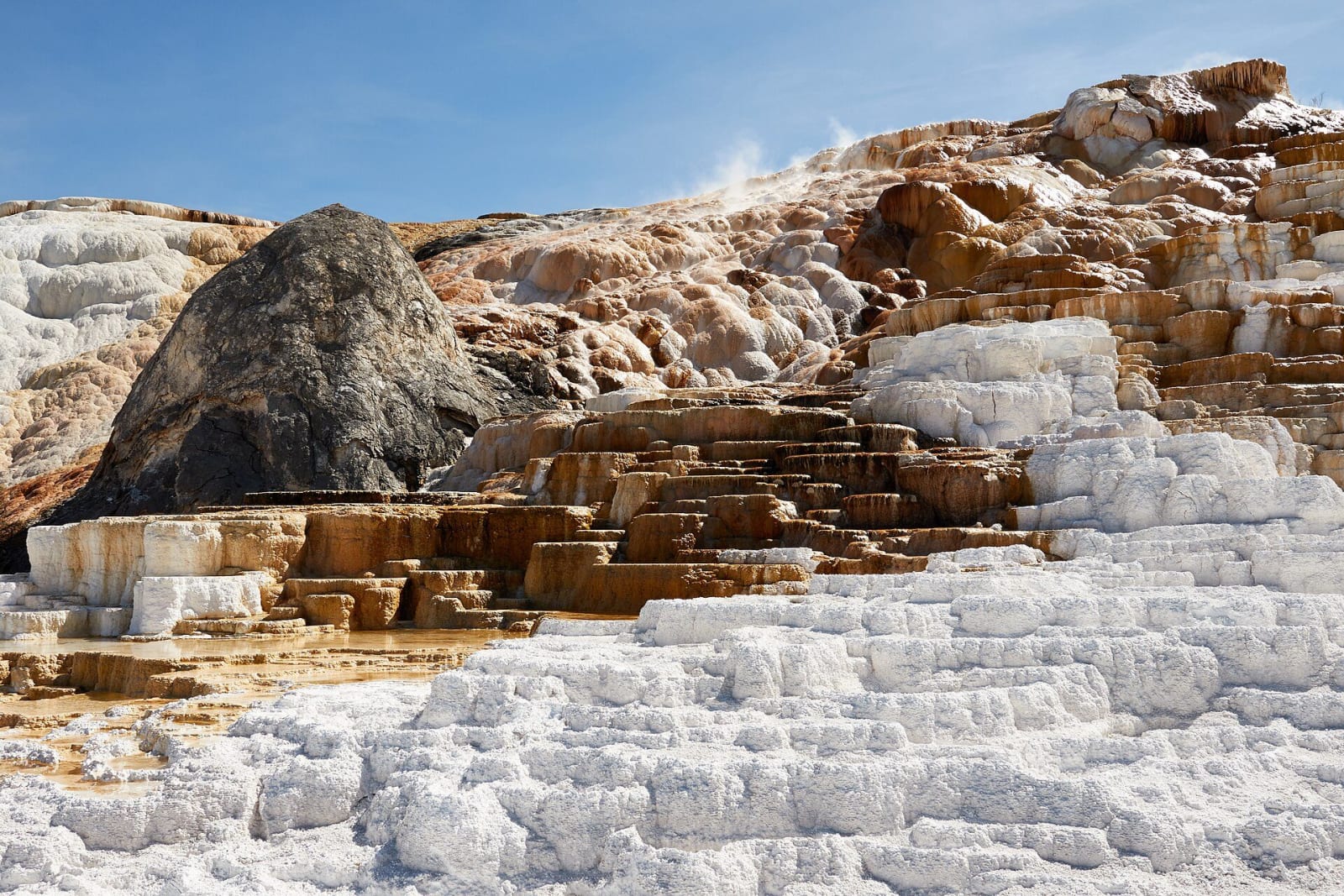
Mammoth Hot Springs is a hill of stone that is still being built. Hot water rises along a fault through old limestone, dissolving it underground, and where it reaches the air it gives up carbon dioxide and drops the dissolved stone as travertine, more than two tons of it a day. The result is a staircase of terraces that changes from season to season. Springs go quiet and the terraces they built turn white, then gray and crumbly, while new vents open elsewhere and begin to grow. Minerva Terrace has passed through active and dry spells ever since records began in the 1890s, and Opal Spring, across the road from Liberty Cap, woke in 1926 and laid down as much as a foot of travertine a year. Where water flows, microbes tint the surface orange, brown and green.
Liberty Cap, a tall cone at the north end of the springs, is a dormant vent that built itself up over many years before its water went elsewhere. The settlement below stands on travertine too: the old hotel and the stone buildings of Fort Yellowstone sit on a long-dead formation called Hotel Terrace. Boardwalks climb the Lower Terraces from the parking area, and a short drive loops through the upper terraces above. The road from the north entrance to Mammoth stays open all year.
Visitor Info
On the Map
Nearby
The closest stops worth working into your route
Historical markers nearby
Roadside plaques and monuments within a short detour