Home / Alabama / Montgomery, Selma & the Black Belt / Fort Toulouse-Fort Jackson Park
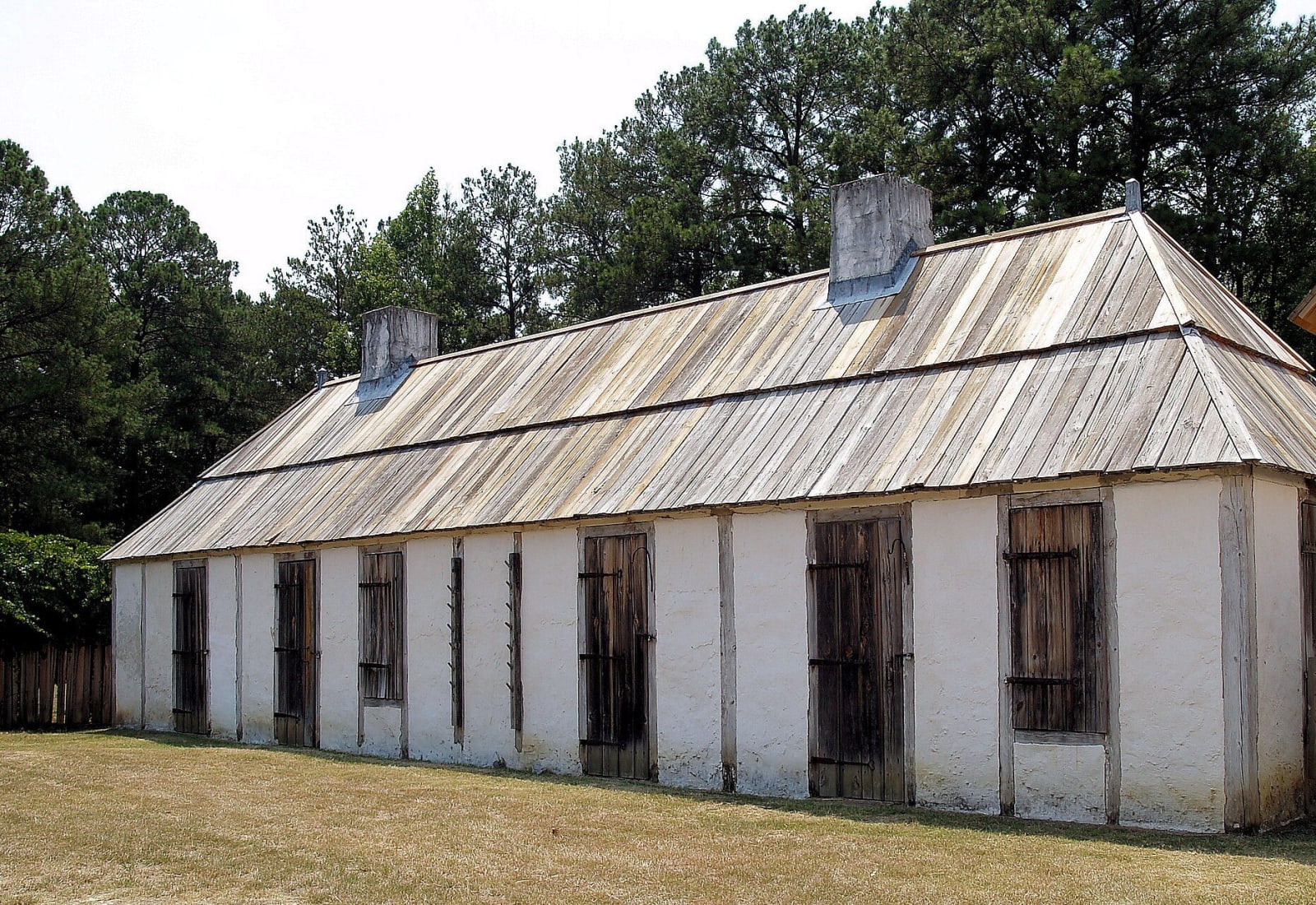
The reconstructed French barracks at Fort Toulouse, a long whitewashed building with plank shutters and a weathered board roof, before tall pines.Altairisfar / public domain via Wikimedia Commons
🏛️Historical

Fort Toulouse-Fort Jackson Park

Part ofMontgomery, Selma & the Black Belt

The point where the Coosa and Tallapoosa make the Alabama River: a Mississippian platform mound, a rebuilt French fort of 1751, and the ground where the Treaty of Fort Jackson took 21 million acres from the Creek Nation.

⏱
Duration
One to three hours.
🎟
Admission
Small admission fee charged by the Alabama Historical Commission; living-history events may cost more.
📅
Best Season
Spring and fall, when the Alabama Historical Commission holds most of its living-history weekends.

The Story

The Coosa and the Tallapoosa meet here to become the Alabama River, and people have lived at the fork for about 10,000 years. Long before any European arrived, a Mississippian town with a central plaza and a palisade stood on this ground, and its rectangular platform mound, now called Taskigi Mound, still stands in the park. In the eighteenth century Upper Creek towns lined both rivers, and the Alabama people lived just below the confluence, which is why the French called their post Fort des Alibamons.

France built the fort in 1717 to trade blankets, guns, copper pots and beads with the Creeks for deerskins and to pull them away from the British in Carolina. The garrison rarely topped 50 men, and France gave up the post in 1763. The ground mattered again in 1814. After the Battle of Horseshoe Bend, Andrew Jackson's troops built a stockade over the old French works, near the sacred Creek site known as Hickory Ground, and on August 9 about 36 Creek leaders signed the Treaty of Fort Jackson. Jackson demanded more than 21 million acres in Alabama and Georgia, taking land from the Creeks who had fought beside the United States as well as from the defeated Red Sticks. The Creek negotiators called him Sharp Knife, and the cession set the course toward removal in the 1830s.

The Alabama Historical Commission has owned the site since 1971. Visitors walk through a reconstruction of the 1751 French fort, rebuilt Creek houses and the partly restored 1814 earthworks, and the William Bartram Nature Trail follows the river.

Visitor Info

⏱
Time Needed
One to three hours.
🎟
Admission
Small admission fee charged by the Alabama Historical Commission; living-history events may cost more.
📅
Best Season
Spring and fall, when the Alabama Historical Commission holds most of its living-history weekends.
🛣️
Highway
West Fort Toulouse Road (off US 231)

On the Map

Nearby

The closest stops worth working into your route

cultural9.2 mi away
The Legacy Museum
The Equal Justice Initiative's museum on the site of a Montgomery cotton warehouse where enslaved people were forced to work, tracing a line from the slave trade to mass incarceration.
historical9.4 mi away
Dexter Avenue King Memorial Baptist Church
The red-brick 1889 church a block below the Alabama Capitol where Martin Luther King Jr. was pastor and the Montgomery bus boycott was run from the basement.
cultural9.5 mi away
Hank Williams Museum
A privately run downtown Montgomery museum of Hank Williams's suits, hats and the car of his last ride, a mile from his grave in the Oakwood Annex.
cultural9.6 mi away
Rosa Parks Museum
Troy University's museum at the downtown Montgomery stop where Rosa Parks was arrested on December 1, 1955, telling the 13-month bus boycott through the women who organized it.
historical9.7 mi away
Freedom Rides Museum
Montgomery's 1951 Greyhound station, where a white mob beat the Freedom Riders on May 20, 1961, now an Alabama Historical Commission museum.
historical10 mi away
National Memorial for Peace and Justice
The hilltop memorial in Montgomery where more than 800 steel monuments, one for each county, carry the names of more than 4,400 Black people killed in racial terror lynchings between 1877 and 1950.

Historical markers nearby

Roadside plaques and monuments within a short detour

Marker2.8 mi away
Ronnie Lovejoy Sr. (1950-2001)
Wetumpka
Marker3.3 mi away
Wetumpka Methodist Church
Wetumpka
Marker3.3 mi away
Wetumpka L&N Depot
Wetumpka
Marker3.4 mi away
Wetumpka Impact Crater
Wetumpka
Marker3.4 mi away
Wetumpka's Bridges
Wetumpka
Marker4.7 mi away
Wetumpka, Alabama: Site of Alabama's First State Penitentiary
Wetumpka