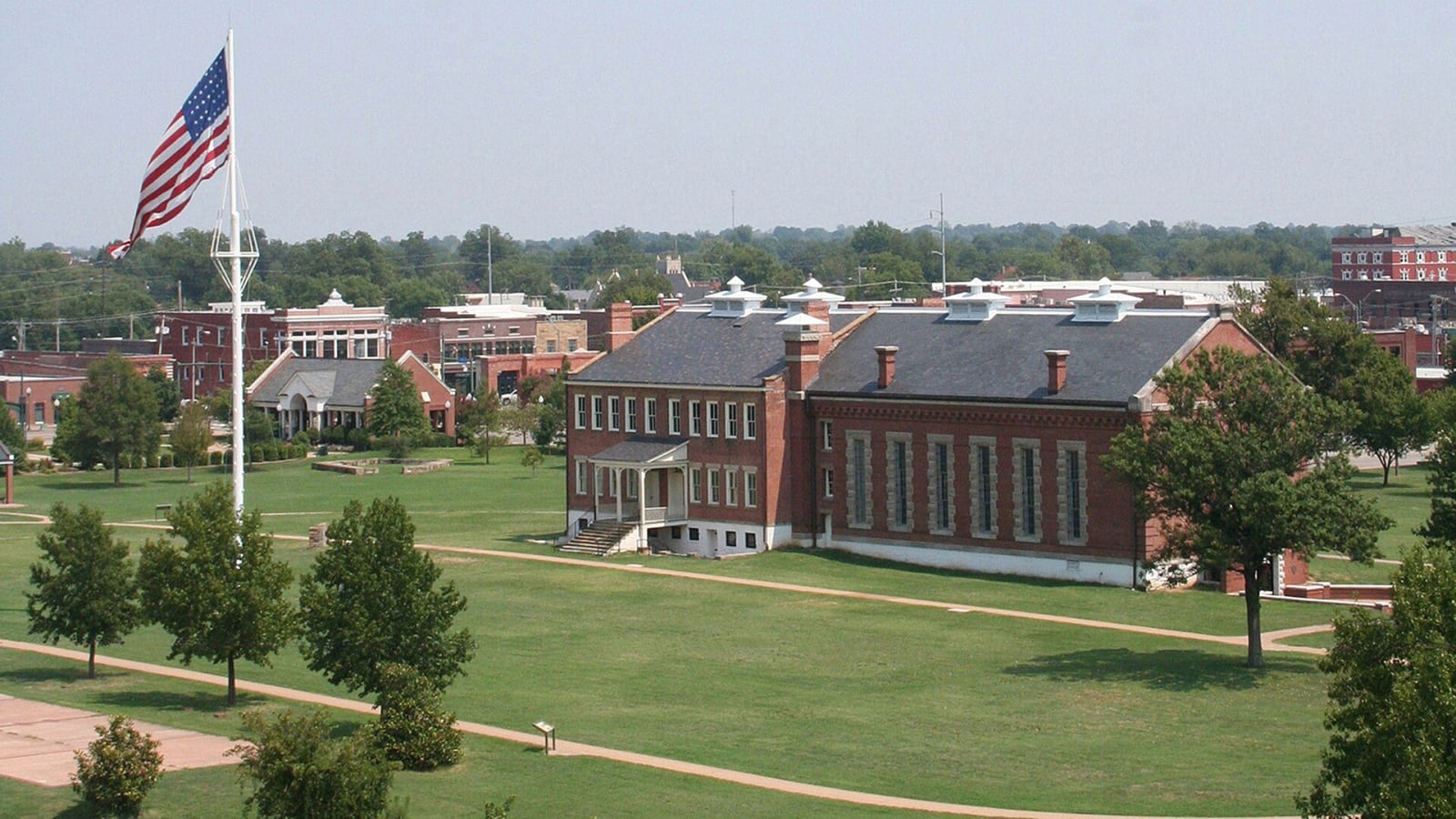
 National Park Service (public domain), via Wikimedia Commons
The Story
Fort Smith began on December 25, 1817, when riflemen under Major William Bradford landed at Belle Point, where the Poteau River meets the Arkansas. They came to keep the peace between the Osage, who hunted here, and the Cherokee, who had moved into the region from about 1808 under federal pressure. The two nations made peace by 1822 and the army left in 1824. From 1831 the Arkansas became part of the water route of the Trail of Tears, and the log buildings held supplies for the Choctaw. The 1817 foundations and a Trail of Tears overlook sit along the river trail.
A second fort, finished in 1846, became a supply depot for the Mexican War. Confederate troops held it until Union forces took it in 1863, and the garrison closed in 1871. The next year the old barracks became the federal courthouse and jail for the Western District of Arkansas and Indian Territory. From 1873 to 1896, eighty-six men were hanged on the gallows here, all convicted of rape or murder; the National Park Service counts 35 American Indians, 33 white men and 18 African Americans, 79 of them under Judge Isaac C. Parker, who took the bench in 1875. In 1885 a visitor, Anna Dawes, called the basement jail, with 109 men held there, a "veritable hell upon earth," and Congress funded a new one in 1886.
The visitor center is in the old barracks at 301 Parker Avenue, and the park suggests at least 45 minutes for its exhibits. Outside are the second fort's commissary, a reconstructed gallows and paved paths.
Visitor Info
On the Map
Nearby
The closest stops worth working into your route
Historical markers nearby
Roadside plaques and monuments within a short detour