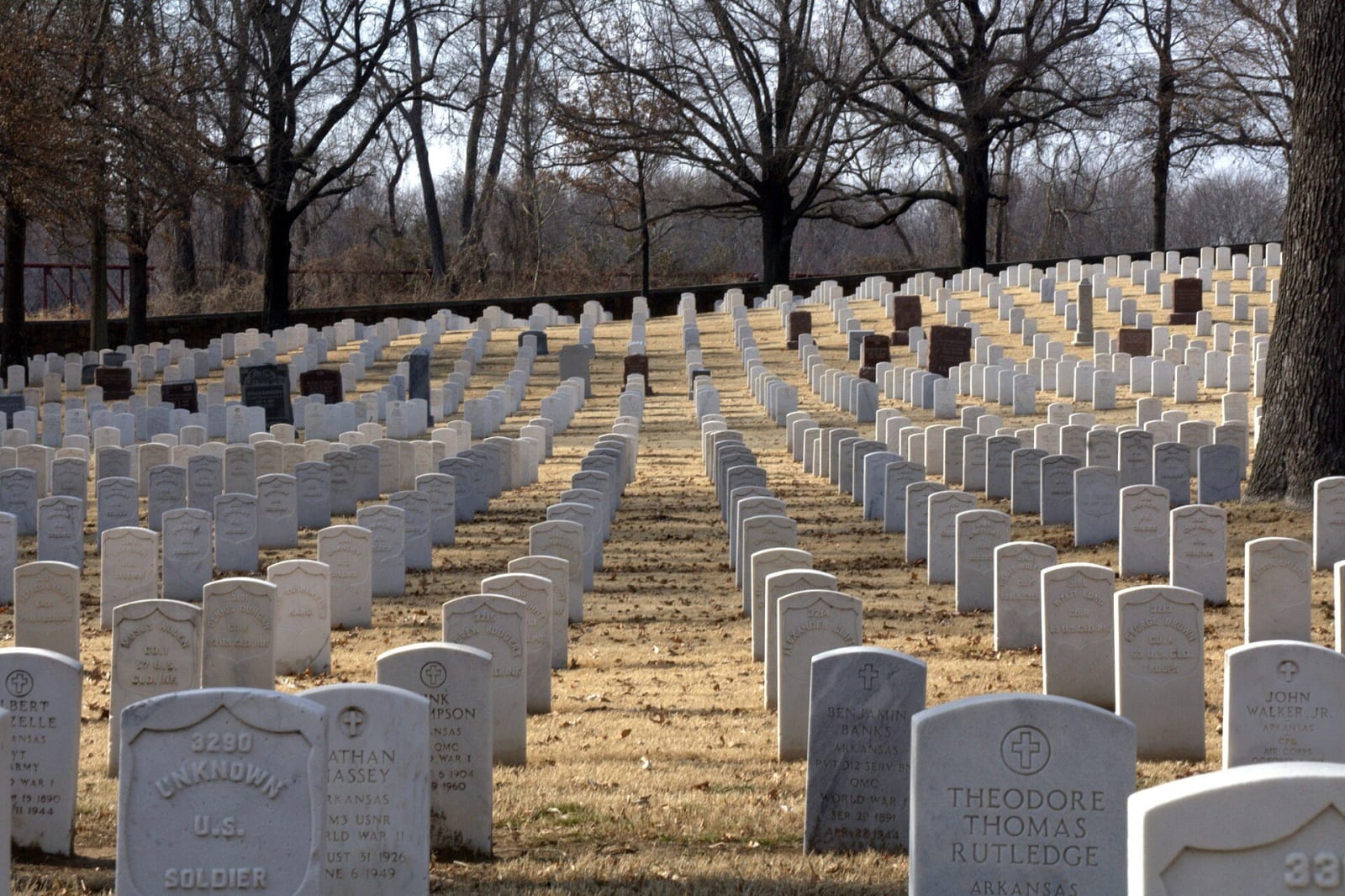
 Tnkntx, CC BY-SA 2.0, via Wikimedia Commons
The Story
The cemetery began as the post burial ground of the first Fort Smith. The first recorded burial is the surgeon Thomas Russell, a veteran of the War of 1812 who came with the riflemen in 1817 and died on August 24, 1819. Fifty men died at the post in 1823, forty-four of them in the summer, about a quarter of the command, and the army closed the fort in 1824. Major William Bradford, its first commander, died on October 20, 1826, and was buried here.
When the army returned in 1838, the burial ground was renovated and enlarged. From April 1861 until September 1, 1863, Confederate forces held Fort Smith, and more than 400 Confederate soldiers were buried here, among them Brigadier Generals James McIntosh and Alexander Steen. A marble memorial honors the unknown Confederate dead. Union troops retook the fort in 1863. The old burial ground became a national cemetery in 1867 with about five acres inside a whitewashed fence, and military dead were moved in from battlefields and private cemeteries. Grant ordered it kept open when the fort's reservation closed in 1871.
Judge Isaac C. Parker and his wife, Mary, are buried in Section 9, and Brigadier General William O. Darby, who founded the First Ranger Battalion, rests near them. Many private monuments face west, opposite the government stones, following a local custom of burying the dead with their feet to the east. The cemetery covers about 32 acres at 522 Garland Avenue, a little over three blocks east of Fort Smith National Historic Site.
Visitor Info
On the Map
Nearby
The closest stops worth working into your route
Historical markers nearby
Roadside plaques and monuments within a short detour