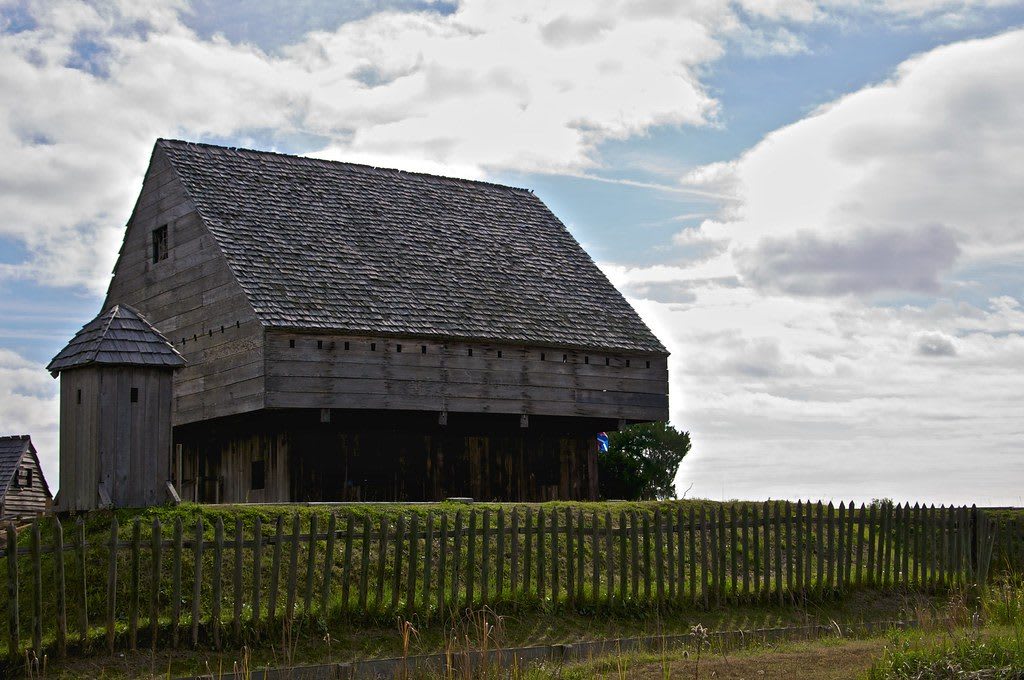
 jevx / CC BY 2.0 via Flickr
The Story
Before the English came, this stretch of the Altamaha River belonged to the Guale, and the site's museum and film begin with them and with the Spanish mission of Santo Domingo de Talaje. In 1721 South Carolina, which claimed the land as its own southern edge, sent Colonel John Barnwell to build a cypress blockhouse, barracks and a palisaded earthen fort on the river's northern bank, against the Spanish in Florida, the French and the Guale, who were by then hostile to the English. For a few years it was the southernmost outpost of the British Empire in North America.
The garrison was a company of about 100 men drawn from the Regiment of Invalids, pensioners of the Royal Hospital at Chelsea. Half had scurvy when they reached South Carolina, and they spent their first year in a hospital at Port Royal. Disease, the heat and a fire in 1726 wore the post down, and it was abandoned by 1732. Seventeen soldiers who died here lie in one of the oldest British military cemeteries in the Southeast. In 1736 Oglethorpe brought Scottish Highlanders from Inverness to settle Darien beside the old fort, and in 1739 the Darien Scots protested the legalization of slavery in Georgia.
The forty-foot blockhouse standing now was rebuilt in 1988 from the original plans, found in London, with officers' quarters, barracks, a guardhouse, moat and palisade around it. Tabby ruins and the remains of three sawmills recall the timber years, when Darien shipped yellow pine around the world until 1925.
Visitor Info
On the Map
Nearby
The closest stops worth working into your route
Historical markers nearby
Roadside plaques and monuments within a short detour