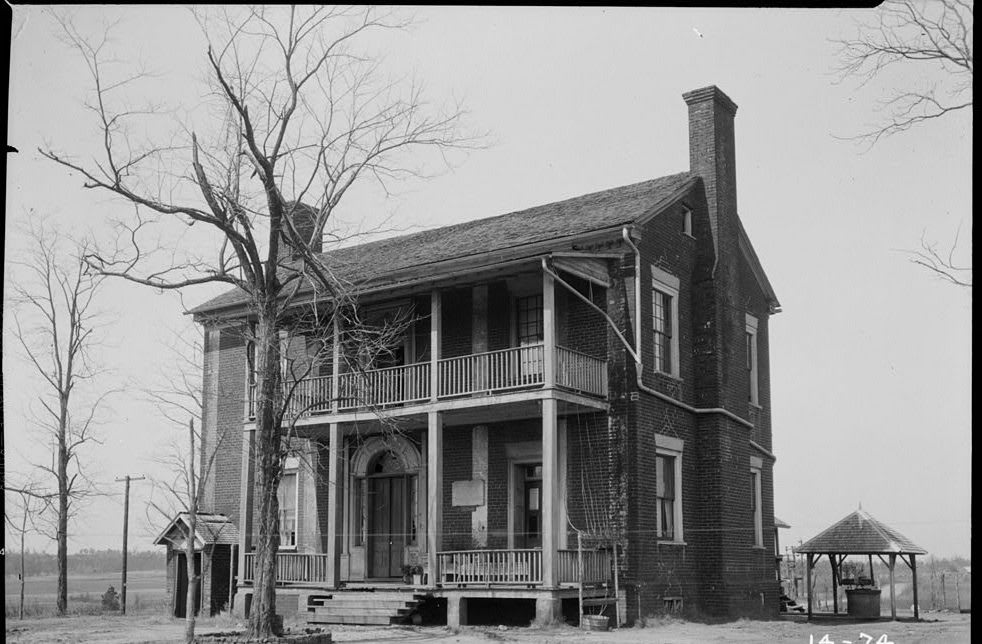
 Historic American Buildings Survey / public domain via Library of Congress
The Story
James Vann, son of a Scottish trader and a Cherokee mother, became one of the Cherokee Nation's leading men in the 1790s, grown rich on his mill and trading post on the Federal Road. Around 1804 he finished this two-and-a-half-story brick house at Spring Place, the most elegant in the Nation, of bricks from its own red clay. He had invited Moravian missionaries to open a school here in 1801, and Elias Boudinot was among the Cherokee children who learned in it. The house was part of the Cherokee answer to Georgia's pressure: proof that the Nation could prosper on its own land and its own terms.
That prosperity rested on enslaved Black people. The plantation's 800 acres held 42 dwellings for the people Vann enslaved, beside barns, orchards and a still. Vann was shot dead in 1809 by an unknown killer, and his son Joseph, who grew even wealthier, inherited the house. In 1834 Georgia took it from him under a law that forfeited any Cherokee's land for breaking a state law; his offense was hiring a white overseer, which Georgia had made illegal for an Indian. In the fight over who would claim the house a fire was set on the stairway, and the charred floor is still there.
The state bought the house in 1952 in such disrepair that the roof was gone, and restored it to its original blue, red, green and yellow. Guided tours show the carved mantels and the cantilevered stairway, the oldest in Georgia.
Visitor Info
On the Map
Nearby
The closest stops worth working into your route
Historical markers nearby
Roadside plaques and monuments within a short detour