 Jgchemie / CC BY-SA 4.0 via Wikimedia Commons
The Story
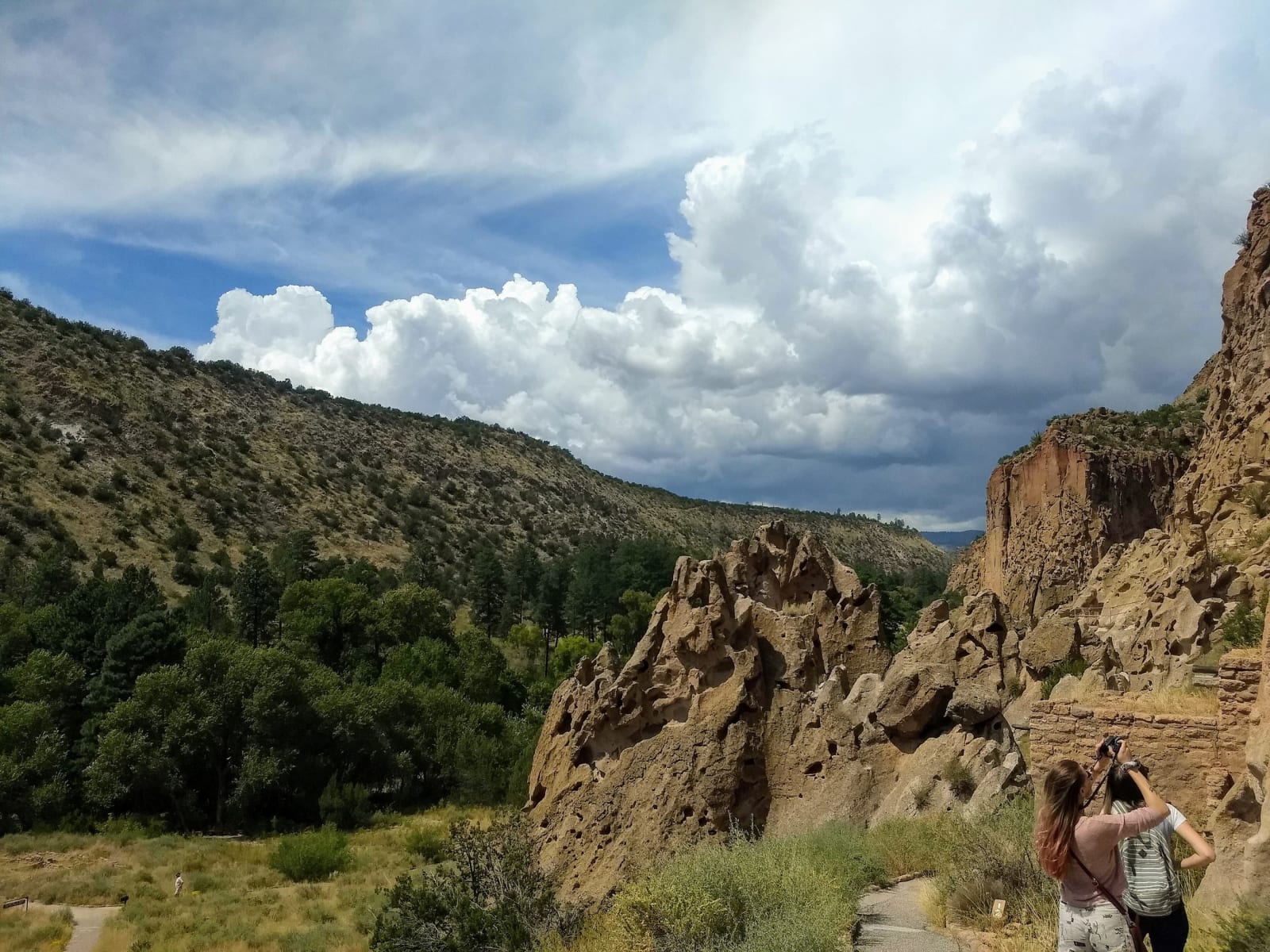
Frijoles Canyon cuts down through the Pajarito Plateau toward the Rio Grande, and its north wall is tuff, volcanic ash welded into a soft pink rock that can be shaped with a harder stone. Ancestral Pueblo people farmed the canyon floor from the twelfth century until about 1550, building their houses against the cliff and carving rooms, called cavates, back into it.
In 1880 Juan José Montoya of Cochiti Pueblo brought the Swiss-born scholar Adolph Bandelier down into the canyon to see the dwellings his people knew. Bandelier later set his novel The Delight Makers, published in 1890, among the households of the ancient canyon. The national monument proclaimed in 1916 took his name. The great circular village on the canyon floor goes by its Cochiti name, Tyuonyi, usually translated as meeting place.
The Main Loop Trail, about 1.2 miles, passes the big kiva and Tyuonyi, which rose two stories around a plaza and held some four hundred rooms. It then climbs along the cliff past Talus House, rebuilt in the 1920s, and Long House, where rows of beam sockets cut into the rock mark the floors of houses that once stood several stories high against it. Half a mile farther up the canyon, four wooden ladders and stone steps climb 140 feet to Alcove House, a ledge holding a rebuilt kiva. The visitor center and lodge were built of the same tuff by the Civilian Conservation Corps in the 1930s.
On busy days from late spring through fall, visitors ride a shuttle from the White Rock Visitor Center instead of driving into the canyon. A separate unit, Tsankawi, near White Rock, has trails worn into the tuff by centuries of feet.
Visitor Info
On the Map
Nearby
The closest stops worth working into your route