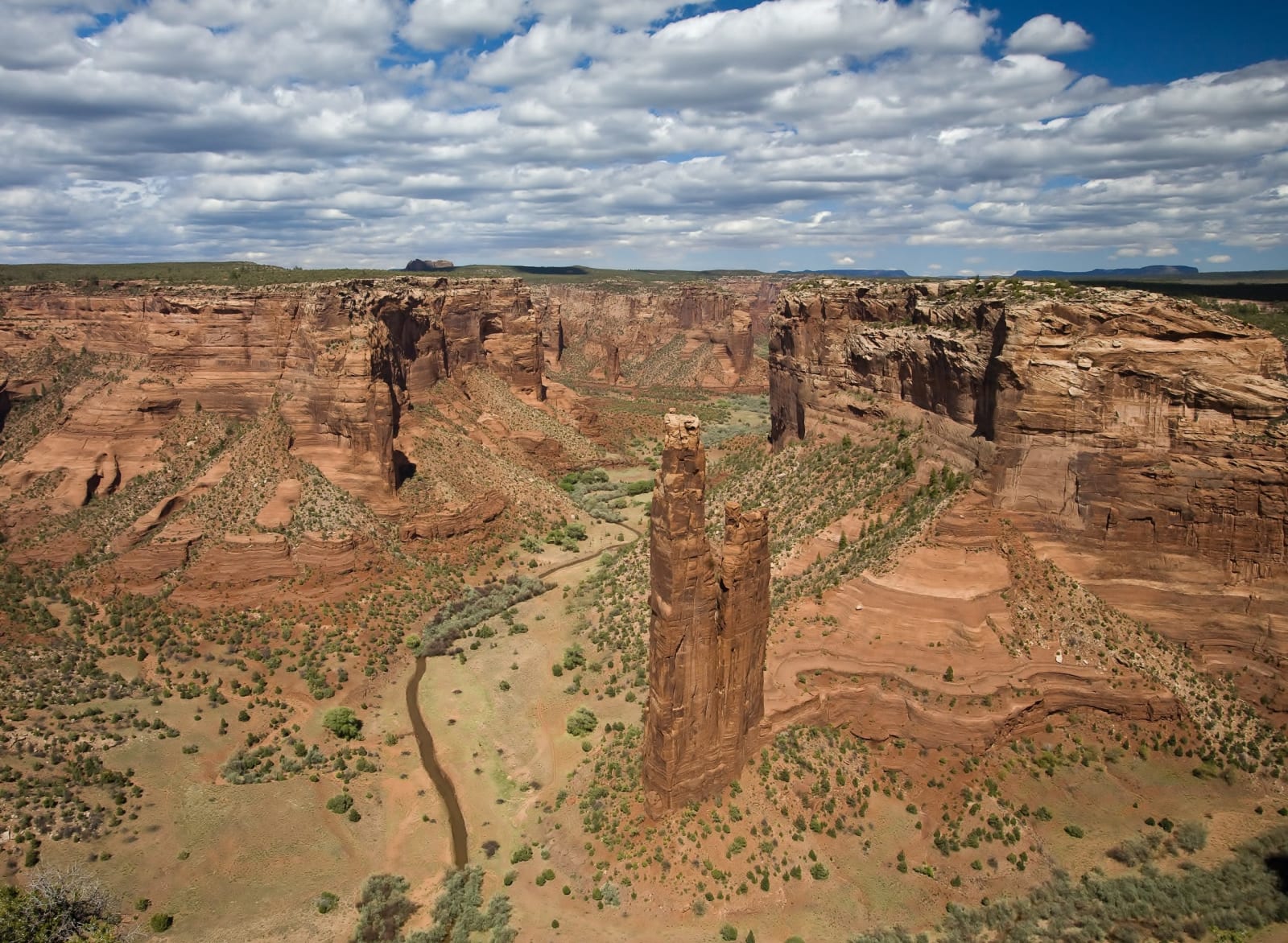
There is a thing every visitor to the northeast corner of Arizona notices, usually with a small jolt: you cannot simply go where you like. You cannot walk below the rim of Canyon de Chelly without a Diné guide. You cannot enter Antelope Canyon without one either. In the Hopi villages you cannot take a photograph, or a video, or even a sketch — not of a ceremony, not of a street, not of anything. To a traveler used to the open-access habit of American public land, this reads at first as a list of restrictions. It is the opposite. It is the single most important fact about this country, and the sooner a visitor grasps it the better: you are a guest here, in not one sovereign nation but two, and they set the terms.
The two nations could hardly be more different from each other, which is the first thing the plateau teaches. The Hopi are among the oldest peoples on the continent — Hopituh Shi-nu-mu, "the peaceful people," who have kept their world on three fingers of high rock for a thousand years. Old Oraibi, on Third Mesa, was founded around 1100 and is generally reckoned the oldest continuously inhabited settlement in North America; the Hopi were already farming corn by hand in these dry fields, timing the planting to the katsinam and the clouds, and they have not stopped since. Their twelve villages are not a single state but twelve self-governing communities, each led in the old way, and their ceremonial life is closed to outsiders on purpose — it is precisely how they held their religion whole through Spanish missionaries, the Pueblo Revolt, and every pressure after. Hopi sovereignty is the sovereignty of sheer endurance: a people who simply never stopped being themselves.
The Diné — the Navajo — are a different people entirely, with a different language, who came into the Southwest centuries later and built something different in kind. Their sovereignty is the sovereignty of a nation that was broken and rebuilt itself. In the winter of 1864, Kit Carson's soldiers moved through Canyon de Chelly burning hogans and cutting down thousands of peach trees, and starved some eight thousand Diné into surrender; they were marched three hundred miles east to a prison camp at Bosque Redondo the people remember as Hwééldi, the place of suffering. Many died there. But the survivors won a treaty in 1868 that let them return — the rare case of a people forced out who were allowed to come home — and in the century that followed they did not merely survive, they built a state. At Window Rock, beneath a sacred sandstone arch, the Navajo Nation runs a full national government: a president, a twenty-four-member council, a supreme court, spread across 27,000 square miles in three states, the largest Native nation in the country by land and among the largest by membership. In the Second World War, Navajo Marines built the one American code the enemy never broke — out of the very language the government's boarding schools had tried to beat out of them as children. There is no sharper answer to an attempted erasure than that.
Hold the two together and the plateau stops being a gallery of red-rock scenery and becomes what it is: living, governed ground. The Painted Desert and the Petrified Forest, the slot canyons, the buttes of Monument Valley, the mesas, the great washes — all of it is somebody's country, and has been for a very long time without a break. The cliff dwellings tucked under the walls of Canyon de Chelly were raised by Ancestral Puebloans; Hopi farmed the same canyon floor in summer; the Diné have held it since the 1700s, and about forty families still farm the floor today, which is why the monument is owned by the Navajo Nation and co-managed with the Park Service — the only such arrangement anywhere in the system.
It would be dishonest to paint the two nations as a single happy tenancy. They share a long border, and the federal government drew it badly. An 1882 order set aside land for "the Hopi and such other Indians as the Secretary may see fit," vague wording that seeded a century of dispute; by 1934 the expanding Navajo reservation entirely surrounded the Hopi one, and the two nations were left tangled together on ground each claimed. Washington's answer, the Navajo-Hopi Settlement Act of 1974, ran a hard line through the shared land and ordered people to the correct side of it — a partition that uprooted roughly a hundred Hopi households and some fifteen thousand Navajo, the largest forced relocation of Americans since the wartime internment of the Japanese. The Diné who lived it call it the Second Long Walk. The wound is real, and it was not the government that drew the line that has had to carry it.
So the guide requirement, the no-cameras rule, the permit and the closed ceremony are not the region's fine print. They are its whole grammar. They are two nations — having survived removal, partition, and every kind of pressure to vanish — exercising the plainest right there is: to decide who comes onto their land, and how a person behaves once there. The reward for accepting that is a place no amount of open-access sightseeing could hand you. You get to be, briefly and correctly, a guest in a country far older than the one whose license plate is on your car: to buy a carving from the person who made it, to walk the canyon floor with someone whose grandparents farmed it, to watch the noon light drop into the slot beside a guide who calls the place by its right name. Come the way you would enter anyone's home — because that is exactly what it is.