 Gorup de Besanez / CC BY-SA 4.0 via Wikimedia Commons
The Story
Woodrow Wilson Guthrie was born in Okemah on July 14, 1912, and named for the president. The center does not soften where he came from. Okemah, in the Muscogee Nation and near the Black town of Boley, was a sundown town, his father was likely a member of the Ku Klux Klan, and Woody, in the center's words, "did not emerge from the earth an enlightened human being." In Pampa, Texas, he lived through the great dust storms and wrote "So Long, It's Been Good to Know Yuh," then followed the migrants to California, speaking for them on the radio with Maxine Crissman, Lefty Lou. In the early 1940s he painted "this machine kills fascists" on his guitar. He wrote more than 3,000 songs.
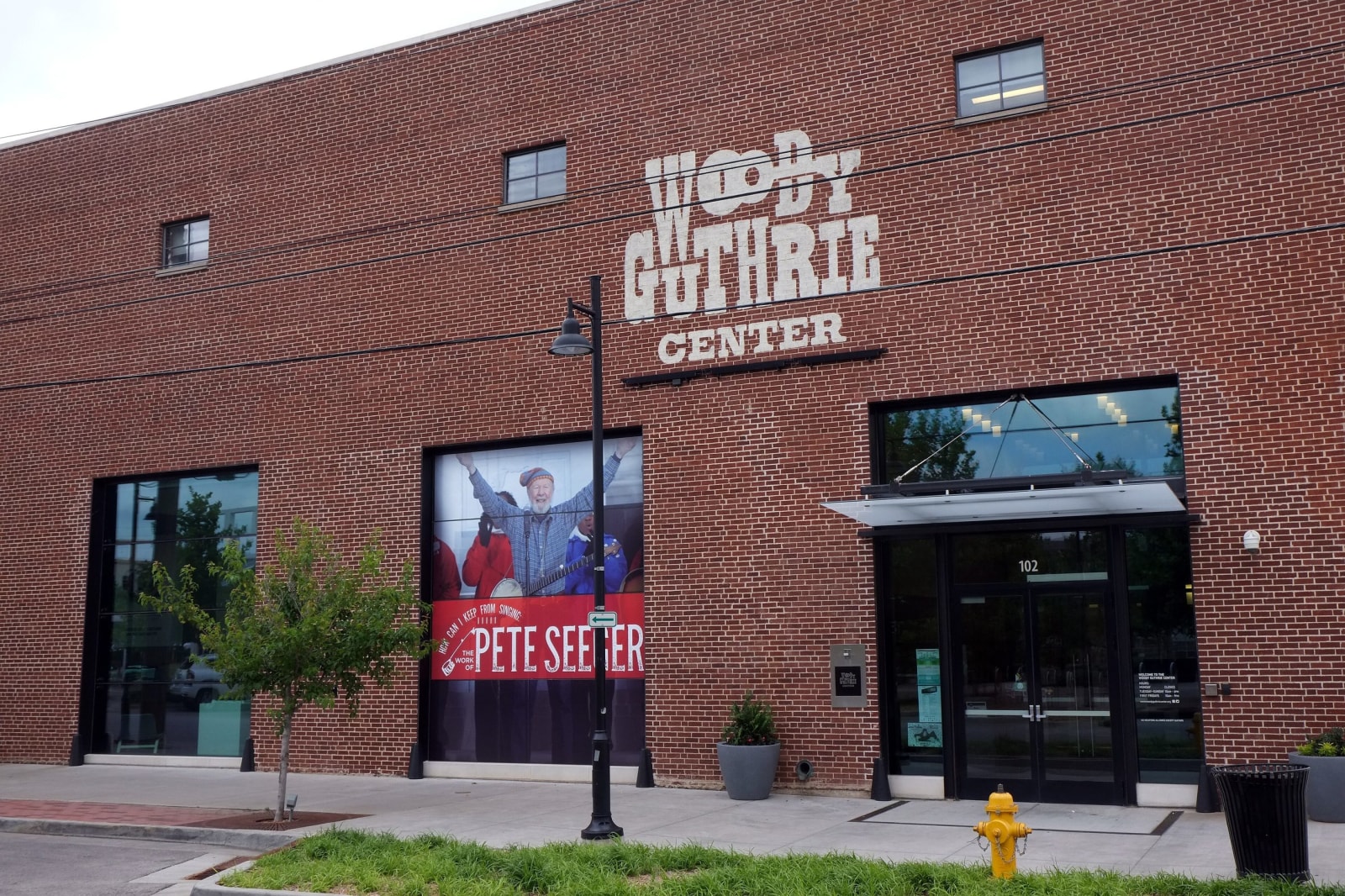
He never lived in Tulsa, as the center points out. The George Kaiser Family Foundation acquired his archives, and the center opened on April 27, 2013, in the brick building where the Tulsa Paper Company stored newsprint from 1922 to 1980. The archive holds more than 10,000 items, among them more than 100 notebooks, lyrics, letters and his own artwork, and since 2014 the papers of Phil Ochs. The main exhibit, A Dozen Loops, follows twelve of his songs on racism, labor, voting rights, immigration and fascism, and takes its title from his promise to sing for anyone the world had knocked for a dozen loops.
The center stands at Reconciliation Way and Boston Avenue, in the neighborhood its own acknowledgment notes was destroyed in the 1921 massacre, a short walk from the Bob Dylan Center.
Visitor Info
On the Map
Nearby
The closest stops worth working into your route
Historical markers nearby
Roadside plaques and monuments within a short detour