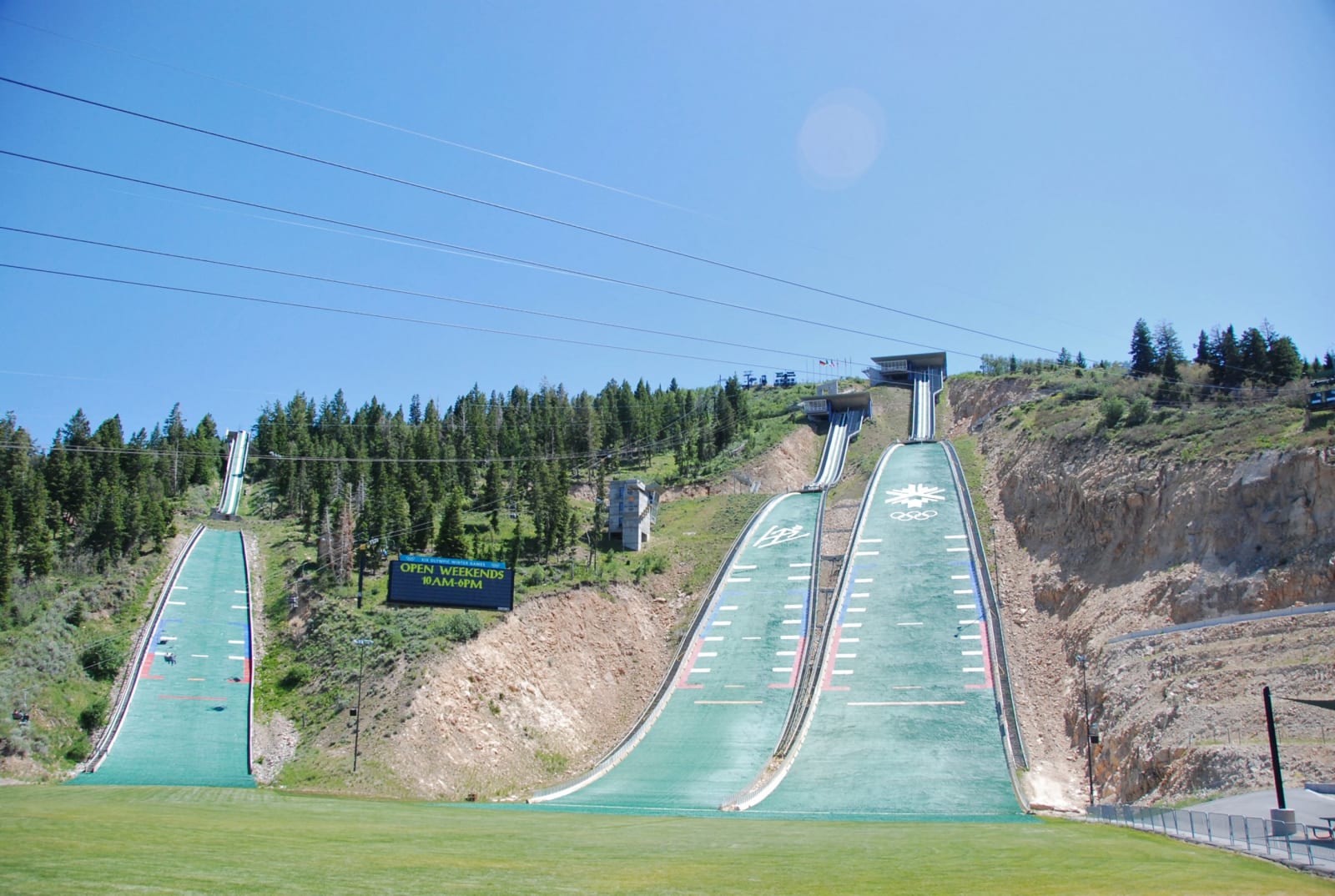
 philms / CC BY 2.0
The Story
Utah Olympic Park is the place where you can watch someone fly off a ski jump in July and then, if your courage and your insurance policy are both adequate, do it yourself. The park was built for the 2002 Winter Olympics as the venue for ski jumping, bobsled, luge, and skeleton, and rather than letting the facilities gather dust after the Games ended — the fate of many Olympic venues worldwide — Park City converted them into a year-round training center and public recreation facility where ordinary visitors can experience a taste of what Olympic athletes do at full speed.
The bobsled ride is the headline attraction, and it delivers exactly what it promises. You climb into a four-person sled with a professional driver, the sled is released into the track, and for the next 60 seconds you accelerate to roughly 70 miles per hour through a series of banked curves that press you into the seat with forces up to four Gs. The track is the same one used during the 2002 Games, and the sensation — the speed, the vibration, the lateral forces pushing your head sideways in the curves — is visceral and immediate in a way that watching bobsled on television cannot convey. You emerge at the bottom breathless, grinning, and with a significantly deeper respect for the athletes who do this at 90 miles per hour while steering.
The summer ski jumping program transforms the Olympic jumps into a training facility where athletes launch off the ramps and land in a swimming pool, practicing their aerial technique without the consequences of a winter landing. Visitors can watch from the base of the jumps, and the sight of a skier sailing 60 feet through the air in a tank top and shorts before splashing into a pool is one of the more surreal spectator experiences in American sports. On certain days, the public can try the smaller jumps under instruction, progressing from the bunny hill of ski jumping to modest aerial experiences that are thrilling enough for most civilian appetites.
The zip line courses, alpine slides, and ropes courses round out the summer activity menu, and the combination of Olympic infrastructure and adventure recreation creates an atmosphere that is part sports complex, part amusement park, and part museum. Families with children find plenty to do, and the range of intensity levels — from gentle alpine coaster rides to the full bobsled experience — means that everyone from cautious six-year-olds to adrenaline-seeking adults can find their comfort level.
The Alf Engen Ski Museum, housed in the park's main lodge, tells the story of skiing in Utah from its origins in the mining towns of the late 1800s through the 2002 Olympics and beyond. The collection includes vintage equipment, photographs, Olympic memorabilia, and interactive exhibits that trace the evolution of the sport from wooden planks and leather boots to carbon fiber and GPS timing. The museum is named for Alf Engen, a Norwegian immigrant who became one of the pioneers of American skiing and helped develop several of Utah's earliest ski areas. His story — immigrant, athlete, visionary — mirrors Utah's broader relationship with skiing, which has grown from a frontier pastime to a multi-billion-dollar industry in less than a century.
The park sits on the outskirts of Park City, about 30 minutes from Salt Lake City via Interstate 80. The location in the Wasatch Mountains provides a dramatic setting — the ski jumps are visible from the highway, their steep profiles silhouetted against the mountain skyline, and the surrounding terrain offers views that extend across the Snyderville Basin to the peaks beyond. In winter, the park hosts training sessions and competitions on the jumps and sliding tracks, and watching elite athletes practice at full speed from the spectator areas is free and genuinely impressive.
The 2002 Olympics left a complicated legacy in Utah. The Games brought international attention, infrastructure investment, and a tourism boost that continues to benefit the state. They also brought cost overruns, traffic disruption, and the inevitable debate about whether public money spent on sporting venues could have been better used elsewhere. But Utah Olympic Park has answered the legacy question more convincingly than most Olympic facilities worldwide. The park is active, accessible, and self-sustaining — a venue that serves both elite athletes and the general public, generating revenue and community engagement more than two decades after the closing ceremonies.
The park is open year-round, with different activities available by season. Summer offers the widest range of public activities, while winter focuses on training and competition. Admission to the grounds and museum is free, with individual activities priced separately. The bobsled ride is the most expensive option and the one that sells out fastest, so booking in advance is advisable during peak periods.
Utah Olympic Park is a rare thing — an Olympic legacy that works. The jumps still launch athletes into the sky. The track still sends sleds through the curves at terrifying speed. And the public still shows up, twenty-plus years later, to watch, to participate, and to experience the specific thrill of a sport that combines physics, courage, and a willingness to go very fast in a very small vehicle down a very icy chute.
Visitor Info
On the Map
Nearby
The closest stops worth working into your route
Historical markers nearby
Roadside plaques and monuments within a short detour