 Carol M. Highsmith / public domain via Library of Congress
The Story
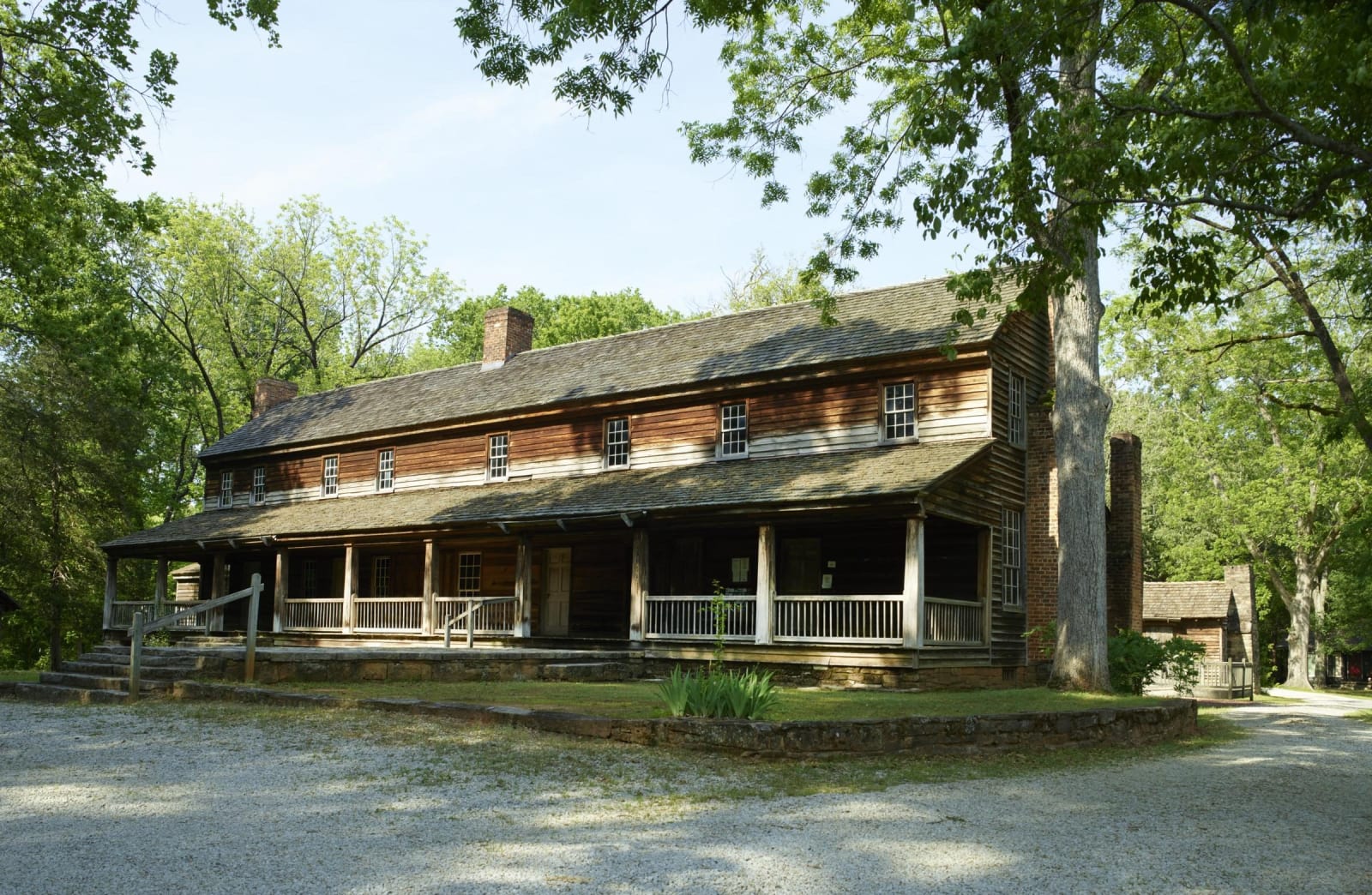
This was Cherokee country until Georgia seized the nearby Tugaloo crossing during the Revolution and opened the valley to white settlement under a 1783 treaty. In 1813 the Cherokee agreed to let the Unicoi Company build a road from the head of navigation on the Tugaloo over the mountains to the Tennessee River, with public houses at either end. The south half of this inn went up about 1815, and James Wyly was likely the first to keep it as an inn. By 1833 he had sold it to his neighbor Devereaux Jarrett.
Jarrett doubled the building to the north in the late 1830s and made it the center of a plantation along the Tugaloo that grew past 10,000 acres. That land was worked by people he held in slavery, and by his death in 1852 he enslaved many. A cabin reconstructed on an excavated slave-cabin site stands on the grounds and now holds the orientation film. The inn also served as tavern, trading post and post office; its registers carry the names of John C. Calhoun and of Governor Joseph E. Brown, who spent his wedding night here.
The inn is 90 feet long, of longleaf yellow pine, and each of its seven front rooms opens onto the long porch. Much of the furniture was made by the Jarretts or by the cabinetmaker Caleb Shaw. Three generations of the family lived here until the state bought the house and a few acres in 1955. It became a National Historic Landmark in 1964.
Visitor Info
On the Map
Nearby
The closest stops worth working into your route
Historical markers nearby
Roadside plaques and monuments within a short detour