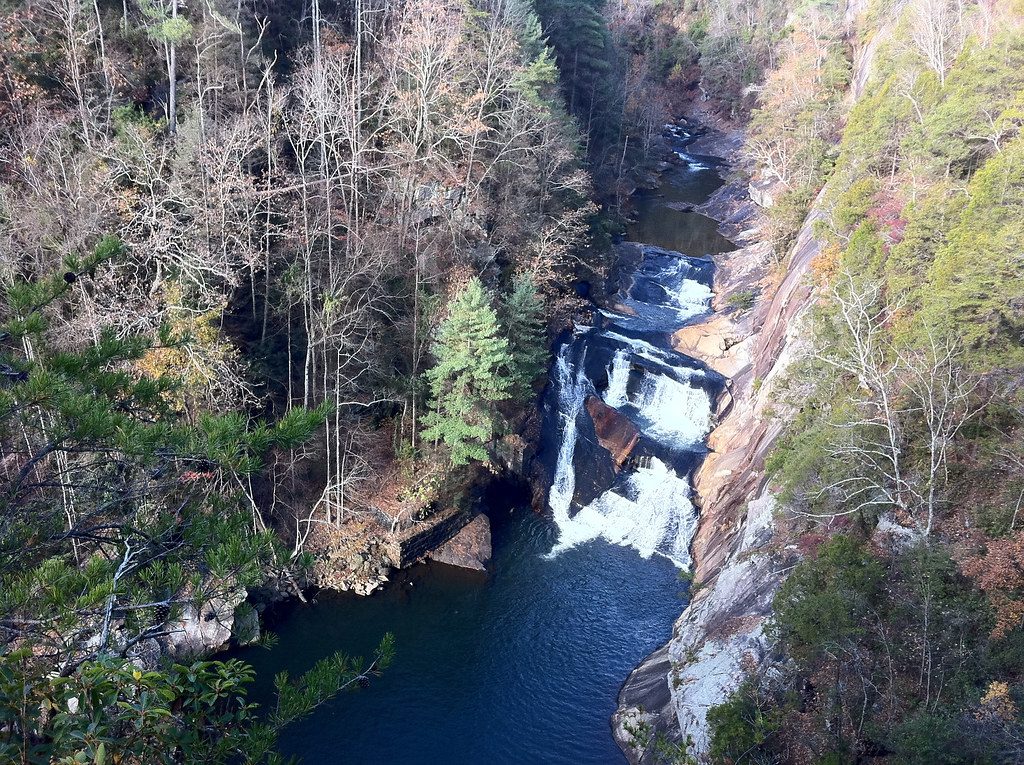
 Jeff Gunn / CC BY 2.0 via Flickr
The Story
The Cherokee called the falls Ugunyi and mostly kept away from them; the settlers who arrived around 1820 named the river and gorge Tallulah. The river once dropped some 350 feet in a mile over four main cataracts, L'Eau d'Or, Tempesta, Hurricane and Oceana, through a gorge two miles long and nearly 1,000 feet deep. The railroad came in 1882, close to twenty hotels and boardinghouses followed, and Tallulah Falls was soon called the Niagara of the South.
Then the power companies arrived. Georgia Power bought land from the resort's leading owner, Rufus Moss, in 1909, and in 1911 Helen Dortch Longstreet of Gainesville, widow of the Confederate general James Longstreet, organized the Tallulah Falls Conservation Association to stop the dam and make the gorge a state park. It was one of Georgia's first conservation campaigns. Her lobbying forced a state lawsuit in 1912, which the company won before a Rabun County jury and the state supreme court. The 116-foot masonry dam was finished in 1913, a 6,666-foot tunnel carried the water to a powerhouse downstream, and the falls went mostly quiet.
The state and Georgia Power opened the park in 1992, and the rim trail has carried her name since 1999. The Jane Hurt Yarn Interpretive Center tells the resort years and the gorge's rare species. Rim trails reach overlooks and a suspension bridge 80 feet above the riverbed, and Karl Wallenda's towers from his tightrope crossing still stand. Free permits, limited to 100 a day and handed out after a safety briefing, open the steep route to the gorge floor.
Visitor Info
On the Map
Nearby
The closest stops worth working into your route
Historical markers nearby
Roadside plaques and monuments within a short detour