 National Park Service / public domain via Wikimedia Commons
The Story
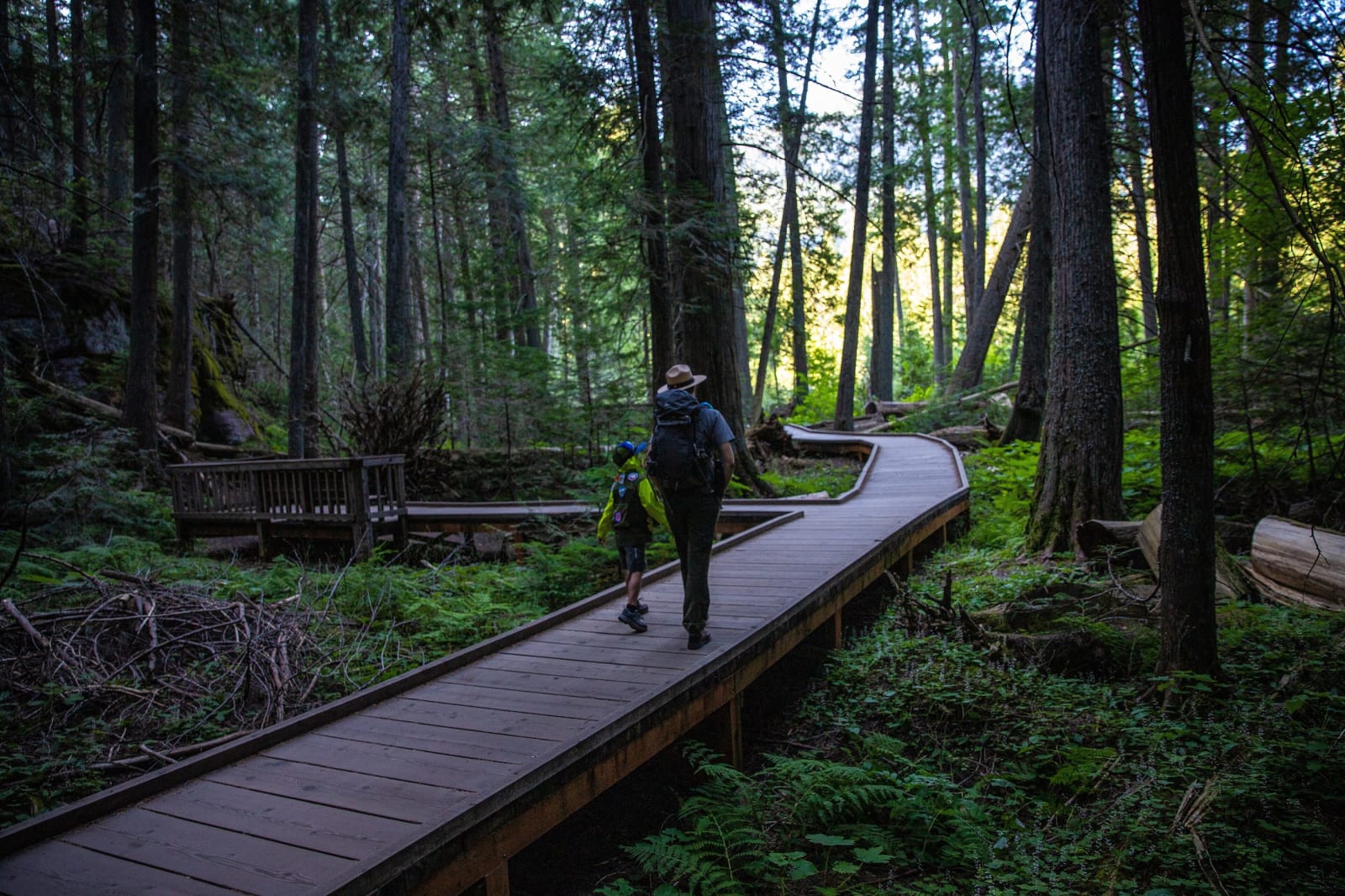
The Trail of the Cedars loops through a forest that belongs on the coast. Western redcedar and western hemlock need the mild, wet air that comes in off the Pacific, and a narrow finger of that maritime climate reaches inland as far as the Lake McDonald valley; here, on the west side of the Continental Divide, both trees reach the eastern edge of their range in the United States. Some of the trunks along Avalanche Creek took root around 1517 and are now about five hundred years old, with spiraling, stringy bark on the cedars and rows of woodpecker holes ringing the hemlocks.
The canopy is so complete that almost no direct sunlight reaches the ground, and only shade-tolerant trees of the same kinds can grow up beneath it, which is how the stand has held for centuries. It is also a remnant. Before the big fire of 1929, the forests along the park's west side held large stands of cedar and hemlock; their stumps still stand among the lodgepole pine that came back, and the park says plainly that it does not know whether a cedar forest would grow there again in today's climate.
The loop is short, level and wheelchair-accessible, its north side a raised boardwalk and its south side paved. Halfway round, a footbridge looks into Avalanche Gorge, where the creek has cut a narrow slot through red argillite, and the trail to Avalanche Lake leaves from just past the bridge. The trailhead is on Going-to-the-Sun Road at Avalanche Creek, about five miles beyond Lake McDonald Lodge, and its lot fills early on summer days.
Visitor Info
On the Map
Nearby
The closest stops worth working into your route