Home / North Carolina / Fayetteville, Pinehurst & the Sandhills / Town Creek Indian Mound State Historic Site
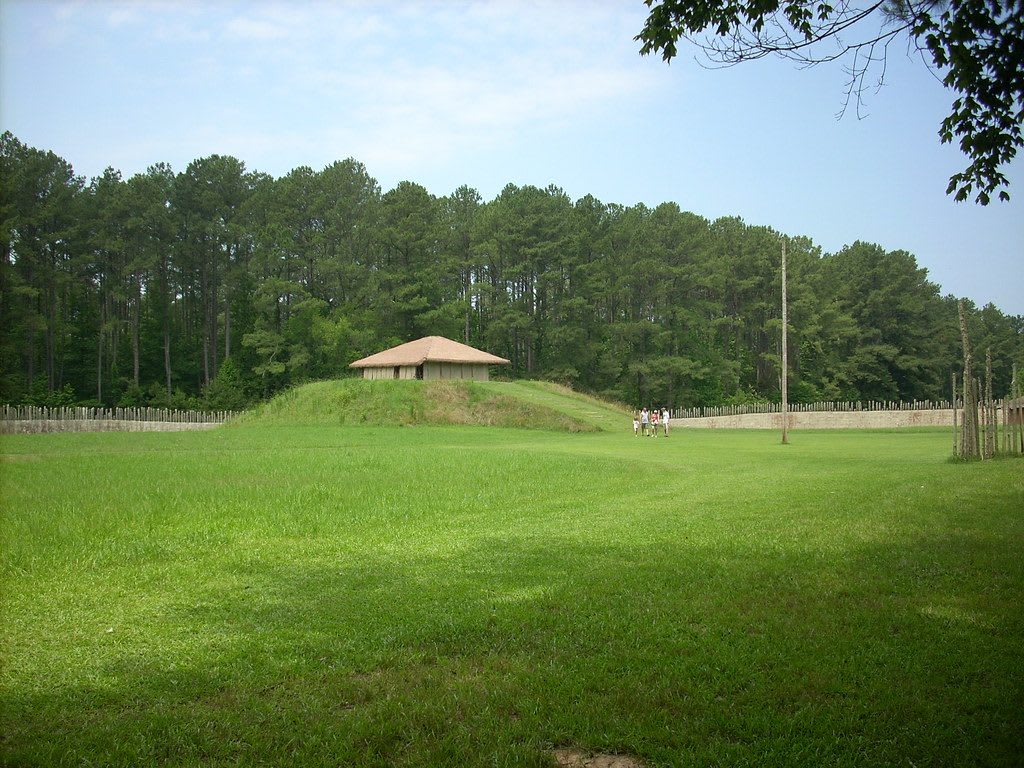
A grassy earthen mound with a small thatched temple on top, inside a log stockade under tall pines.Gerry Dincher / CC BY-SA 2.0 via Flickr
🏛️Historical

Town Creek Indian Mound State Historic Site

Part ofFayetteville, Pinehurst & the Sandhills

The ceremonial center Pee Dee people built above the Little River about a thousand years ago, with its earthen mound, plaza and stockade rebuilt by the state.

⏱
Duration
One to one and a half hours.
🎟
Admission
Free; guided tours $2 adults, $1 children 5-12 and seniors (NC Historic Sites, 2026).
📅
Best Season
Spring and fall. Grounds open Tuesday to Saturday 9 a.m. to 5 p.m. The visitor center and exhibits closed on July 28, 2026 for a full renovation, and the state said the whole site would close for construction later in the year; check before driving out (NC DNCR, 2026).

The Story

About the 11th century, the people archaeologists call the Pee Dee culture made a political and ceremonial center on a low bluff where Town Creek meets the Little River, a tributary of the Great Pee Dee. They were part of the wider South Appalachian Mississippian world that reached from Georgia and eastern Tennessee into the southern Piedmont: farmers who built earthen mounds for their spiritual and political leaders, traded widely and supported craft specialists. Clans from outlying villages gathered here for councils and for feasts that could last several days.

The most important of them was the busk, the new-year ceremony of the green corn. Houses were cleaned and the temple repaired, every fire was put out, debts and grievances were settled, and people purified themselves by bathing and fasting before eating the new corn. Going home, they carried embers from the sacred fire to relight their own hearths, which made them people of one fire. The mound itself grew over an earlier earth lodge; a temple on its summit burned and was rebuilt, and an east-facing ramp climbed to it from the plaza.

Excavation began in 1937 and ran for half a century, and the state made the site its only historic site given to American Indian heritage in 1955. The mound, two temples, the stockade and a burial house were rebuilt in the 1950s and 1960s. People of high rank lived, died and were buried here, and the burial house is a place to walk through quietly. A short trail follows the river bottom.

Visitor Info

⏱
Time Needed
One to one and a half hours.
🎟
Admission
Free; guided tours $2 adults, $1 children 5-12 and seniors (NC Historic Sites, 2026).
📅
Best Season
Spring and fall. Grounds open Tuesday to Saturday 9 a.m. to 5 p.m. The visitor center and exhibits closed on July 28, 2026 for a full renovation, and the state said the whole site would close for construction later in the year; check before driving out (NC DNCR, 2026).
🛣️
Highway
Town Creek Mound Road

On the Map

Nearby

The closest stops worth working into your route

natural15 mi away
Morrow Mountain State Park
An ancient volcanic peak of the Uwharries above the Yadkin-Pee Dee River and Lake Tillery, quarried for stone tools for thousands of years and built out by the CCC.
architectural26 mi away
Pinehurst Village
The resort village a Boston soda-fountain maker laid out in cutover longleaf country in 1895, with Olmsted's curving lanes, a village green and Donald Ross's No. 2.
cultural26 mi away
North Carolina Pottery Center
The statewide pottery museum in Seagrove, gateway to the family potteries along NC 705, where potters have worked local clay since before the Revolution.
cultural27 mi away
Jugtown Pottery
The 1921 pottery in the pines of northern Moore County where the Owens family still throws and fires pots, the cornerstone of the Seagrove pottery country.
historical31 mi away
Reed Gold Mine State Historic Site
The Cabarrus County farm where a boy found a 17-pound nugget in 1799, the first documented gold find in the United States, with restored tunnels to walk.
natural32 mi away
Weymouth Woods-Sandhills Nature Preserve
A remnant of the old longleaf pine forest at Southern Pines, saved by the novelist James Boyd's family, with trees centuries old and the scars of the turpentine trade.

Historical markers nearby

Roadside plaques and monuments within a short detour

Marker5.2 mi away
Colson's Supply Depot
Mount Gilead
Marker7.3 mi away
Edmund Deberry
Wadeville
Marker10 mi away
Fight at Colson's
Norwood
Marker11 mi away
Carolina Female College
Ansonville
Marker12 mi away
Ralf Freeman
Ansonville
Marker12 mi away
Randall's United Methodist Church
Norwood