Home / Missouri / Kansas City & the Western Border / Thomas Hart Benton Home and Studio State Historic Site
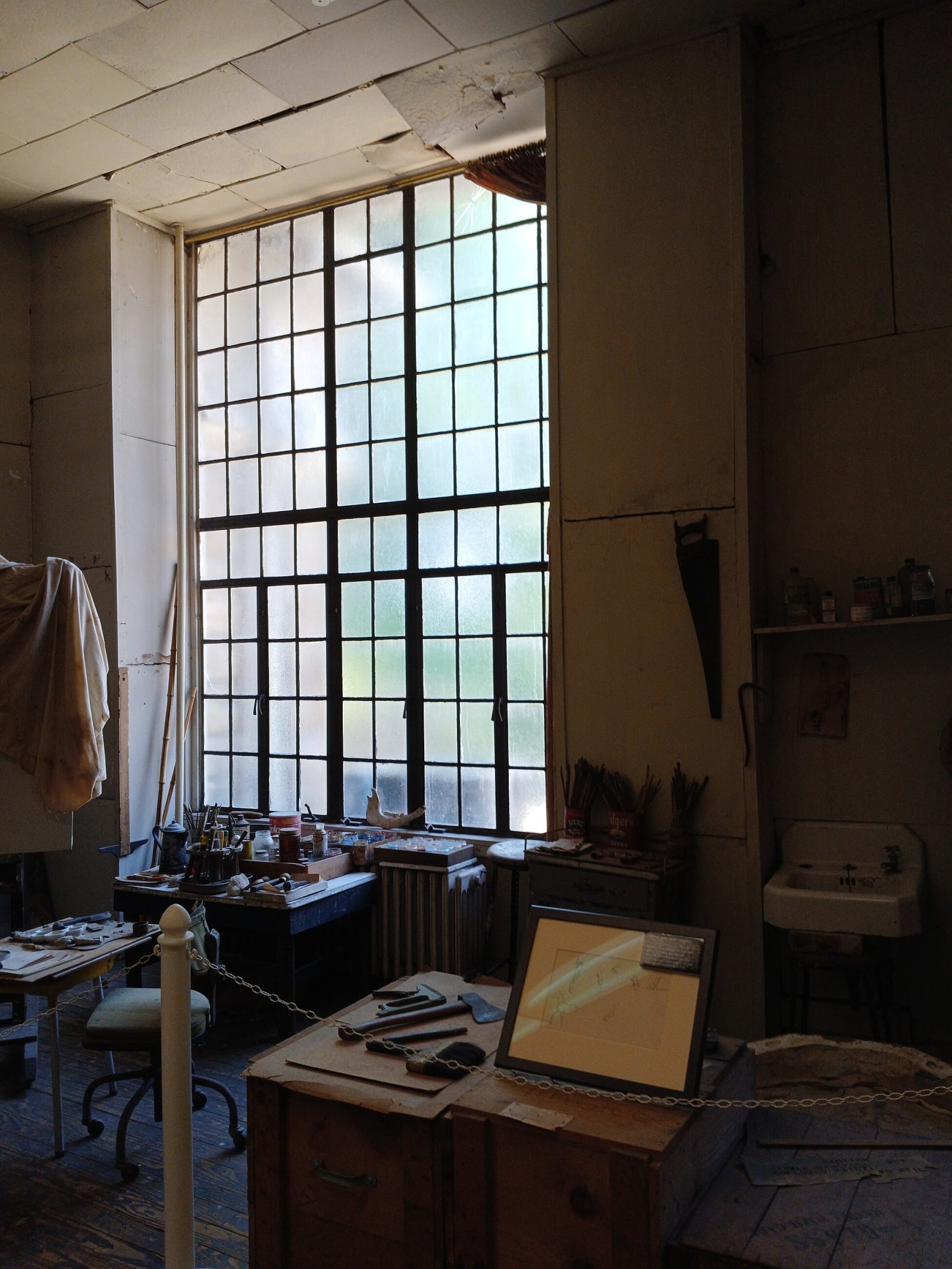
The tall multi-paned north window lighting the studio where Thomas Hart Benton worked, with his worktable and supplies below.Ser Amantio di Nicolao / CC BY-SA 4.0 via Wikimedia Commons
🎭Cultural

Thomas Hart Benton Home and Studio State Historic Site

Part ofKansas City & the Western Border

The limestone house where Thomas Hart Benton lived from 1939 to 1975 and the carriage-house studio where he died, left with his brushes in coffee cans.

⏱
Duration
About 45 minutes for the tour.
🎟
Admission
Guided tours only: adults $5, youth 6 to 17 $3.50, under 6 free. Tours can be reserved online or arranged on arrival; groups of 15 or more call ahead.
📅
Best Season
Year round: Monday and Thursday to Saturday 10 a.m. to 4 p.m., Sunday 11 a.m. to 4 p.m., closed Tuesday and Wednesday; no Monday tours from November through March.

The Story

Thomas Hart Benton was born in Neosho in 1889, the son of Congressman Maecenas E. Benton and a great-great-nephew of Missouri's first senator, whose name he carried. He studied in Chicago and Paris, served six months as a Navy draftsman in World War I, and in New York taught at the Art Students League, where Jackson Pollock was his student. Murals of American life made him the leader of the Regionalist painters of the 1930s. In 1935 he came home to paint the mural in the State Capitol and to teach at the Kansas City Art Institute.

From 1939 until his death he lived in this two-and-a-half-story house of quarried limestone in the Roanoke neighborhood. Its rooms hold his paintings and sculpture, some original and some reproduced, a baby grand piano, and pictures of his son playing the flute and his daughter the guitar. Benton played harmonica and even recorded an album. The second-floor library holds the books he read to get his details right, and he planned many paintings by first modeling the scene in clay.

In the early 1940s he turned half of the carriage house into a studio and put in an 8-by-12-foot window on the north side for steady light. He died there on January 19, 1975, just after finishing The Sources of Country Music for the Country Music Hall of Fame in Nashville. The studio holds nearly all of his own things, with brushes standing in coffee cans and a stretched canvas waiting.

Visitor Info

⏱
Time Needed
About 45 minutes for the tour.
🎟
Admission
Guided tours only: adults $5, youth 6 to 17 $3.50, under 6 free. Tours can be reserved online or arranged on arrival; groups of 15 or more call ahead.
📅
Best Season
Year round: Monday and Thursday to Saturday 10 a.m. to 4 p.m., Sunday 11 a.m. to 4 p.m., closed Tuesday and Wednesday; no Monday tours from November through March.
🛣️
Highway
US-56

On the Map

Nearby

The closest stops worth working into your route

architectural0.8 mi away
Harris-Kearney House
Westport's 1855 Greek Revival brick house, built by the hotelkeeper whose Harris House served the trail trade and the Union army, and moved and saved by a group of women in 1922.
historical1.4 mi away
National WWI Museum and Memorial
Kansas City's Liberty Memorial of 1926, paid for in ten days of giving, above a museum of the First World War entered across a glass bridge over 9,000 poppies.
cultural1.5 mi away
Nelson-Atkins Museum of Art
A free art museum of more than 45,000 works built from two Kansas City estates, opened in 1933, with four giant Shuttlecocks on the lawns of its sculpture park.
historical2.5 mi away
Shawnee Indian Mission State Historic Site
Three brick buildings in Fairway from the manual labor school the Methodist church ran for Shawnee and other Native children from 1839, which the Shawnee Tribe now calls by its plain name, a boarding school.
cultural2.8 mi away
American Jazz Museum
Kansas City's jazz museum at 18th & Vine, with Charlie Parker's Massey Hall saxophone, the 1912 Gem Theater across the street and the Blue Room, a working club inside the museum.
cultural2.8 mi away
Negro Leagues Baseball Museum
The national museum of Black professional baseball in Kansas City's 18th & Vine Jazz District, two blocks from the YMCA where the Negro National League was founded in 1920.

Historical markers nearby

Roadside plaques and monuments within a short detour

Marker2.7 mi away
Kansas City
Marker3.9 mi away
This Gateway to Kansas
Kansas
Marker6.3 mi away
Shawnee Friends Mission
Kansas
Marker8.7 mi away
Delaware Crossing and the Grinter Ferry
Kansas
Marker15 mi away
Kansas Indian Reservations
Kansas
Marker16 mi away
Liberty