Home / Missouri / Kansas City & the Western Border / American Jazz Museum
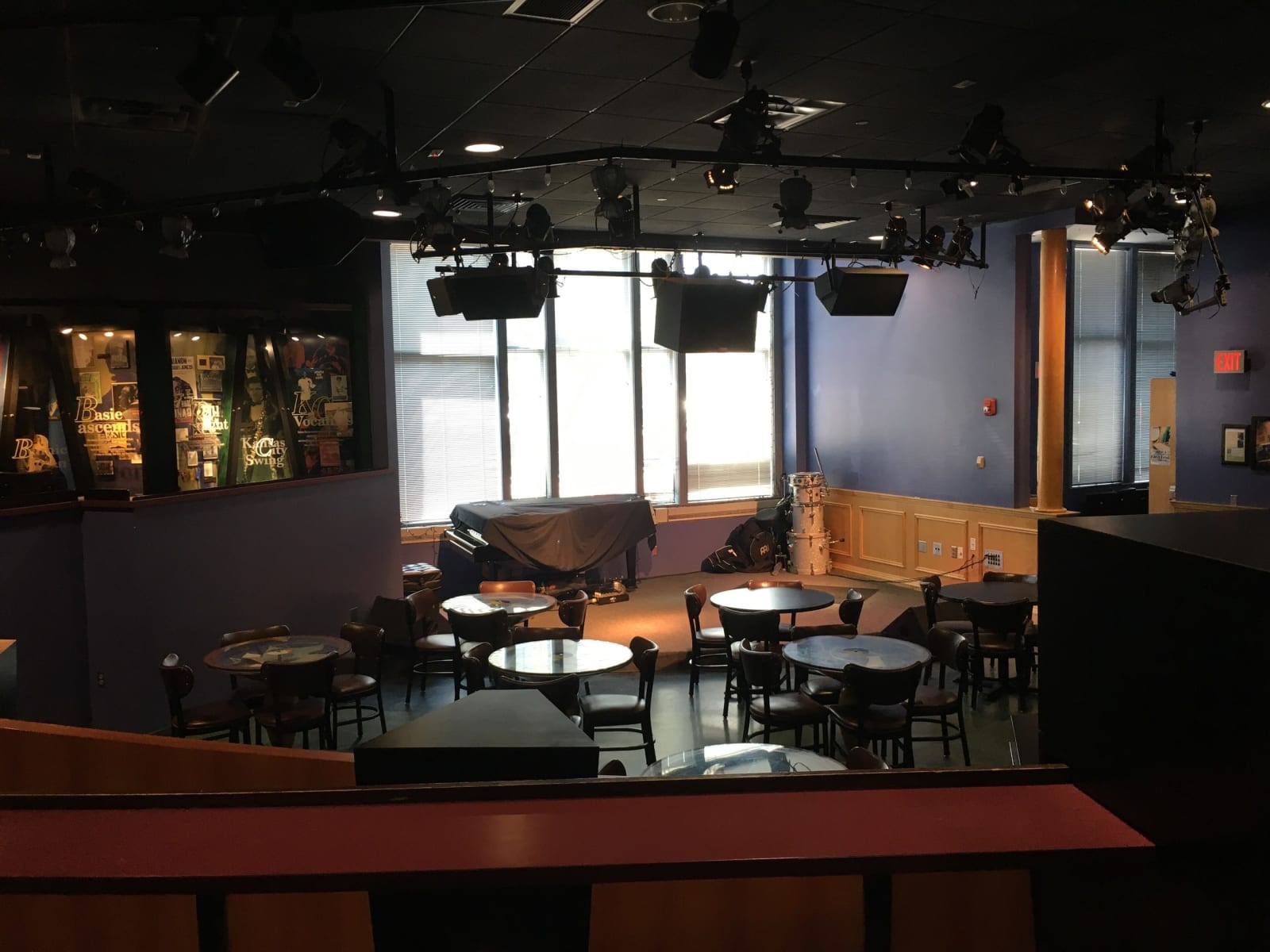
The Blue Room jazz club inside the American Jazz Museum, with its stage, bar and small tables.Jordano53 / CC BY-SA 4.0 via Wikimedia Commons
🎭Cultural

American Jazz Museum

Part ofKansas City & the Western Border

Kansas City's jazz museum at 18th & Vine, with Charlie Parker's Massey Hall saxophone, the 1912 Gem Theater across the street and the Blue Room, a working club inside the museum.

⏱
Duration
About ninety minutes, longer with the films or a Blue Room set.
🎟
Admission
Adults $15; seniors 65 and over $12; students and educators with ID $12; youth 6 to 18 $10; children 5 and under free. Blue Room shows are ticketed separately.
📅
Best Season
Year round. Tuesday to Saturday 10 a.m. to 5 p.m. and Sunday noon to 5 p.m.; closed Mondays from September 14, 2026 through May 31, 2027, with seven-day hours from June 1, 2027. Construction in the district may affect parking.

The Story

In the 1930s and 1940s the blocks around 18th and Vine were the center of Black Kansas City, its businesses and churches and the clubs where a Kansas City sound was worked out by bandleaders such as Bennie Moten and later by Charlie Parker, who grew up in Kansas City. The American Jazz Museum opened on September 5, 1997, as the Kansas City Jazz Museum, with a three-day celebration on a red-carpeted 18th Street, in the building it shares with the Negro Leagues Baseball Museum.

The permanent galleries follow four musicians, Louis Armstrong, Charlie Parker, Ella Fitzgerald and Duke Ellington, with artifacts, photographs and listening stations, and a studio where visitors try rhythm, harmony and improvisation by hand. The museum, a Smithsonian affiliate, holds the alto saxophone Parker played at the 1953 Massey Hall concert in Toronto with Dizzy Gillespie, Bud Powell, Charles Mingus and Max Roach. The visitor center's film, A People's Journey, narrated by Lucile Bluford, tells the district's history.

The Blue Room is named for the 1930s club in the Street Hotel and is both an exhibit and a club, with more than twenty shows a month. The Gem Theater across 18th Street opened in 1912 as the Star, a silent movie house for Black Kansas City, and took its present name in 1913. Parker's bronze statue stands behind the museum near Vine and 17th Terrace.

Visitor Info

⏱
Time Needed
About ninety minutes, longer with the films or a Blue Room set.
🎟
Admission
Adults $15; seniors 65 and over $12; students and educators with ID $12; youth 6 to 18 $10; children 5 and under free. Blue Room shows are ticketed separately.
📅
Best Season
Year round. Tuesday to Saturday 10 a.m. to 5 p.m. and Sunday noon to 5 p.m.; closed Mondays from September 14, 2026 through May 31, 2027, with seven-day hours from June 1, 2027. Construction in the district may affect parking.
🛣️
Highway
US-71

On the Map

Nearby

The closest stops worth working into your route

cultural0 mi away
Negro Leagues Baseball Museum
The national museum of Black professional baseball in Kansas City's 18th & Vine Jazz District, two blocks from the YMCA where the Negro National League was founded in 1920.
historical1.5 mi away
National WWI Museum and Memorial
Kansas City's Liberty Memorial of 1926, paid for in ten days of giving, above a museum of the First World War entered across a glass bridge over 9,000 poppies.
historical1.6 mi away
Arabia Steamboat Museum
The cargo of a sidewheeler that sank in 1856, dug out of a Kansas cornfield in 1988 and 1989 and shown in the River Market, from boots and buttons to jarred pickles.
cultural2.8 mi away
Thomas Hart Benton Home and Studio State Historic Site
The limestone house where Thomas Hart Benton lived from 1939 to 1975 and the carriage-house studio where he died, left with his brushes in coffee cans.
architectural2.9 mi away
Harris-Kearney House
Westport's 1855 Greek Revival brick house, built by the hotelkeeper whose Harris House served the trail trade and the Union army, and moved and saved by a group of women in 1922.
cultural3.4 mi away
Nelson-Atkins Museum of Art
A free art museum of more than 45,000 works built from two Kansas City estates, opened in 1933, with four giant Shuttlecocks on the lawns of its sculpture park.

Historical markers nearby

Roadside plaques and monuments within a short detour

Marker2.2 mi away
Kansas City
Marker3.5 mi away
This Gateway to Kansas
Kansas
Marker9 mi away
Shawnee Friends Mission
Kansas
Marker11 mi away
Delaware Crossing and the Grinter Ferry
Kansas
Marker13 mi away
Liberty
Marker16 mi away
Kansas Indian Reservations
Kansas