 Carol M. Highsmith / public domain via the Library of Congress
The Story
The Nelson-Atkins grew from two estates whose owners probably never met. Mary McAfee Atkins, a retired schoolteacher and real estate investor who had seen the art of Europe on her travels, died in 1911 and left about a third of her estate to buy land for a public art museum. William Rockhill Nelson, founder of The Kansas City Star and a real estate developer, died in 1915, and his will put most of his fortune into a trust to buy art. The two were combined, curators spent the Depression buying a collection, and the museum opened on December 11, 1933, to lines out to the street and a welcome, in the words spoken that day, to all groups, all races, all creeds. The east wing was the Atkins Museum of Fine Arts and the rest the William Rockhill Nelson Gallery of Art until the joint name was adopted in 1982.
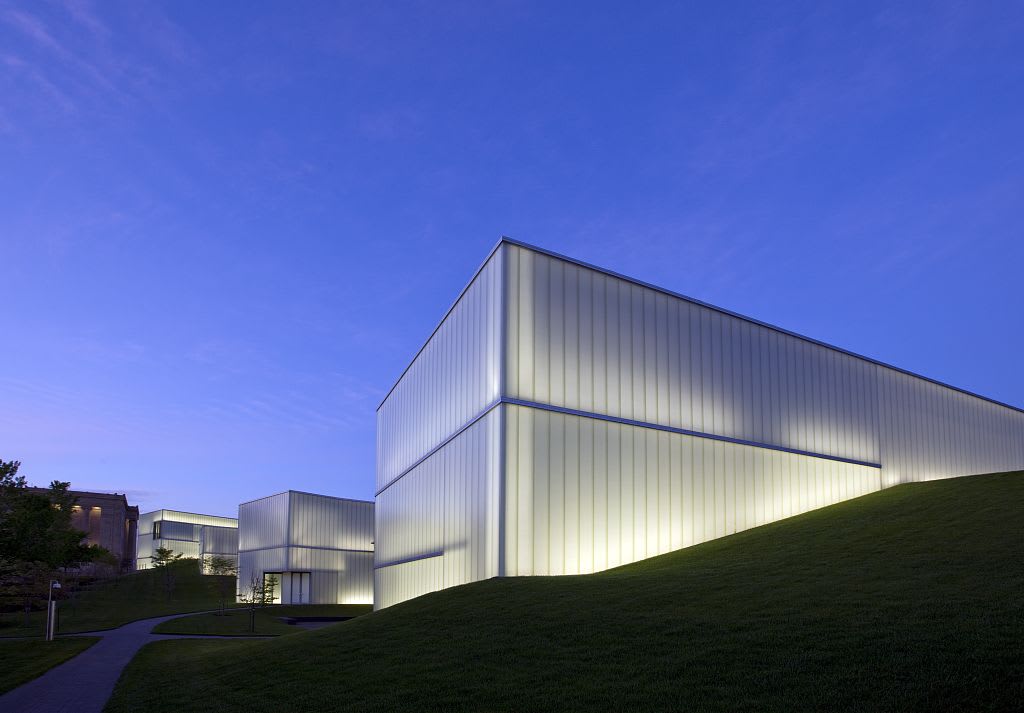
Admission has long been free and was made formal policy in the museum's 1998 strategic plan. The collection now runs past 45,000 works, in the original building and the Bloch Building, which opened in 2007.
The Donald J. Hall Sculpture Park outside began in 1986, when the Hall Family Foundation bought 57 works by Henry Moore for what was then the Henry Moore Sculpture Garden. Claes Oldenburg and Coosje van Bruggen's four Shuttlecocks, a gift of the Sosland family, were finished in 1994; each stands about 19 feet tall on the lawns. The park is free and open from sunrise to sundown.
Visitor Info
On the Map
Nearby
The closest stops worth working into your route
Historical markers nearby
Roadside plaques and monuments within a short detour