Home / Arkansas / Helena & the Lower Delta / Rohwer Relocation Center Memorial Cemetery
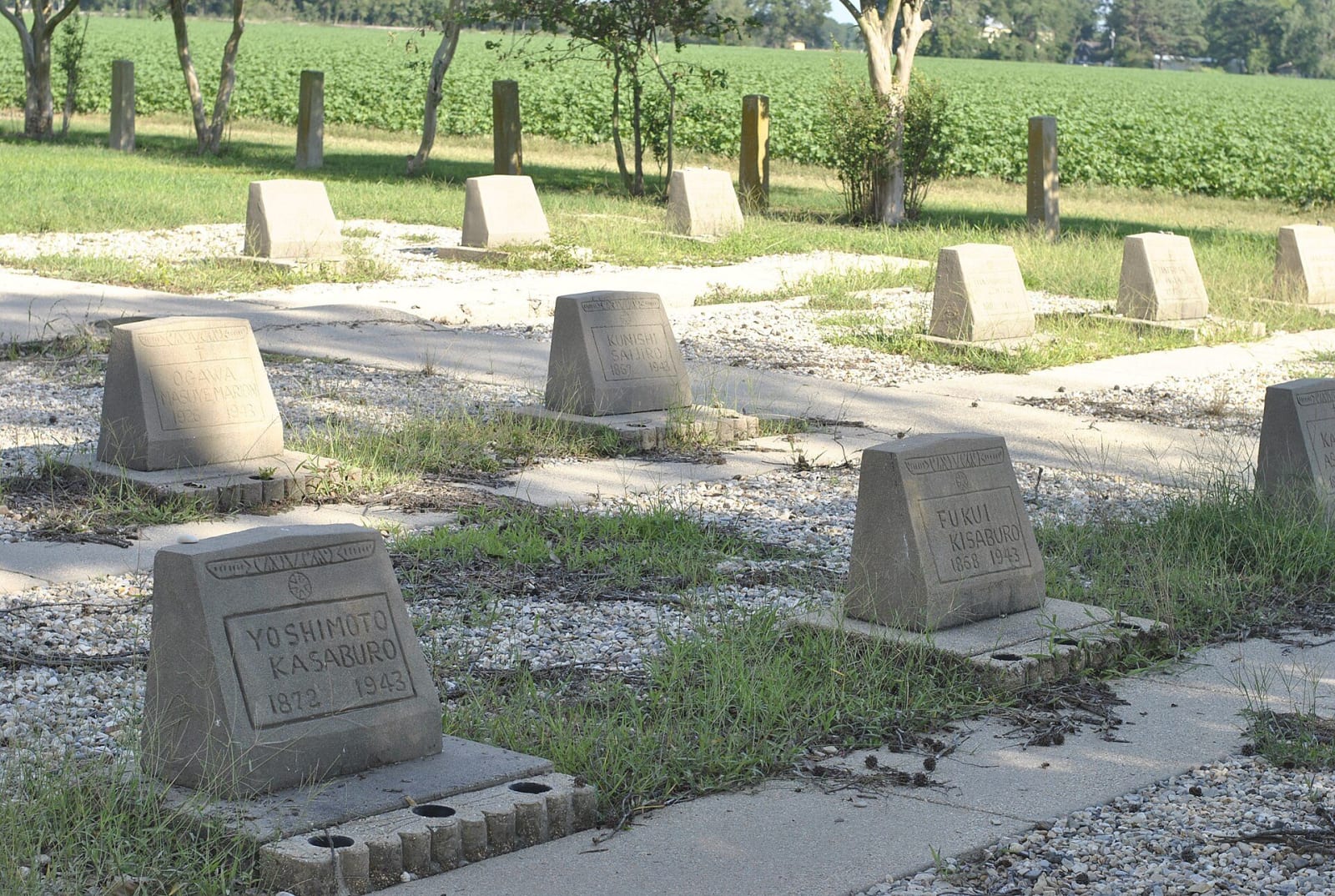
Low concrete headstones carved with Japanese-style borders and names, among them Yoshimoto Kasaburo 1872-1943, on gravel and walkways at Rohwer cemetery, with a green cotton field behind.Maekju / CC BY-SA 4.0 via Wikimedia Commons
🏛️Historical

Rohwer Relocation Center Memorial Cemetery

Part ofHelena & the Lower Delta

A National Historic Landmark cemetery built by Japanese Americans incarcerated at Rohwer from 1942 to 1945, with monuments they made and audio panels narrated by George Takei.

⏱
Duration
One hour.
🎟
Admission
Free; open in daylight hours, with no facilities on site.
📅
Best Season
Spring and fall; the site is open fields on a gravel road with little shade.

The Story

Rohwer Relocation Center Memorial Cemetery is the best preserved part of a World War II camp in Desha County where Japanese Americans were held. The camp opened on September 18, 1942, and closed on November 30, 1945. More than 10,000 people passed through, and over two thirds were American citizens. At its peak the camp held 8,475 people in about 500 acres of tar-papered barracks. The National Park Service says the cemetery is one of only three surviving Japanese American confinement site cemeteries in the United States.

The incarcerated people designed and built it in 1943 and 1944. A concrete obelisk dedicated on June 24, 1945, honors everyone who died at Rohwer, and carvings on it, including an egret and a peacock, bear Japanese and English inscriptions. A second monument, dedicated on November 4, 1945, carries the names of men from Rohwer killed in action with the 100th Infantry Battalion and the 442nd Regimental Combat Team, while their families were still incarcerated. Twenty-four low concrete headstones are marked with a flower for Buddhists or a cross for Christians. It became a National Historic Landmark in 1992.

The site is on a gravel road off Arkansas Highway 1, north of the community of Rohwer. A replica guard tower serves as a kiosk, and audio panels narrated by George Takei, who was held at Rohwer, mark a self-guided walk along the camp's southern edge. The Arkansas State University site suggests starting at the museum in McGehee.

Visitor Info

⏱
Time Needed
One hour.
🎟
Admission
Free; open in daylight hours, with no facilities on site.
📅
Best Season
Spring and fall; the site is open fields on a gravel road with little shade.
🛣️
Highway
AR-1

On the Map

Nearby

The closest stops worth working into your route

cultural12 mi away
Japanese American Internment Museum
A museum in the McGehee train depot on the two Arkansas camps, Rohwer and Jerome, where about 16,000 Japanese Americans were held from 1942 to 1945.
historical18 mi away
Arkansas Post National Memorial
The site of Arkansas's first European trading post, opened in 1686 beside the Quapaw town of Osotouy, later a territorial capital and the scene of a January 1863 Union victory.
recreational28 mi away
Lake Chicot State Park
A state park on the largest natural lake in Arkansas, a 20-mile oxbow of the Mississippi River that was cleaned up and reopened after decades of silt.
historical36 mi away
Lakeport Plantation
Arkansas's grandest surviving Greek Revival plantation house, built about 1858 by a planter who held 155 enslaved people in 1860, now an Arkansas State University museum.
historical62 mi away
Louisiana Purchase State Park
A National Historic Landmark in a headwater swamp where Phillips, Lee and Monroe counties meet, marking the initial point of every survey of the Louisiana Purchase lands.
historical65 mi away
Freedom Park
An outdoor Delta Cultural Center site on the ground of a Civil War contraband camp, where thousands of people who had escaped slavery sheltered and men enlisted.