Home / Arkansas / Little Rock & Central Arkansas / Arkansas Post National Memorial
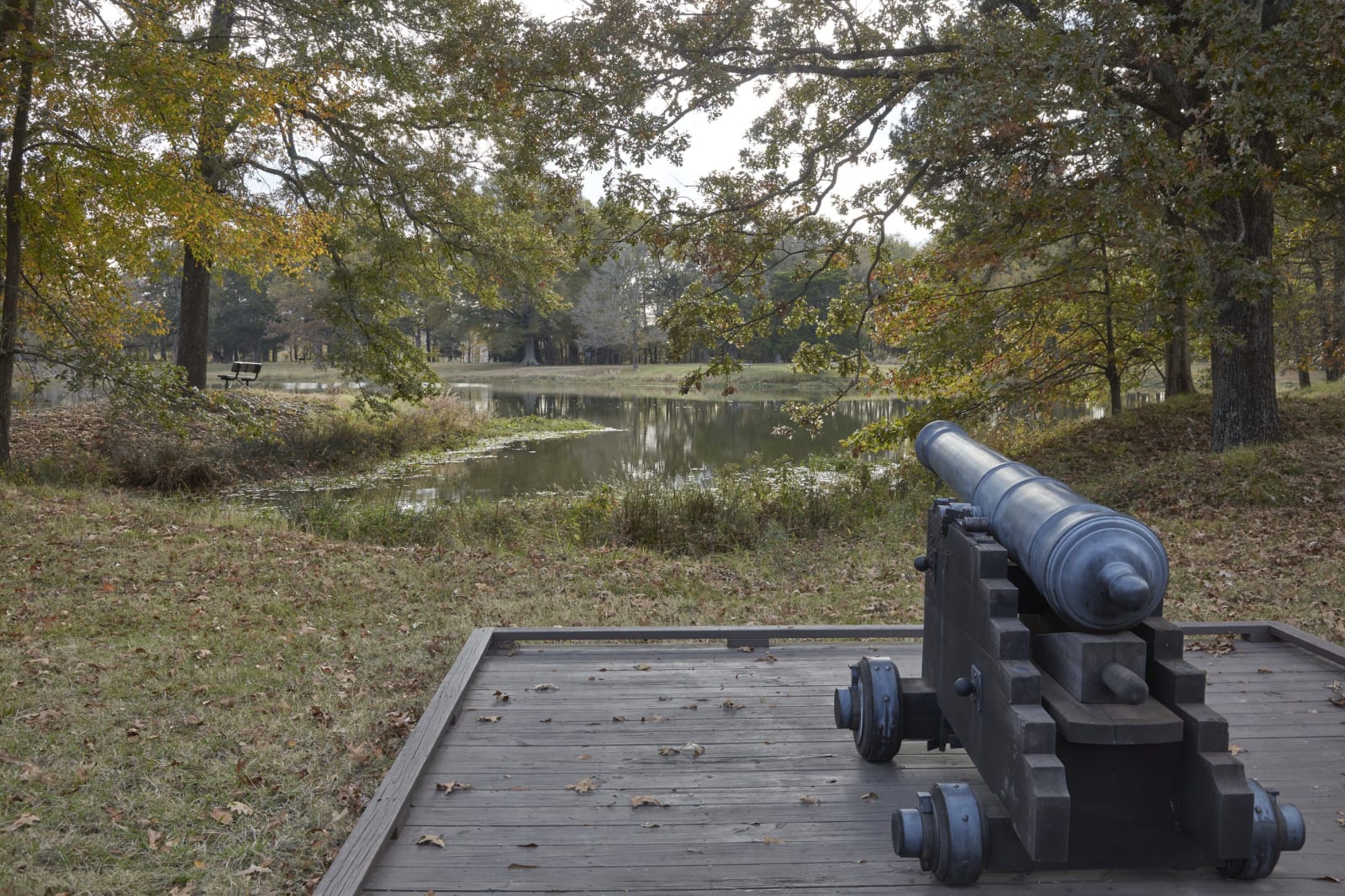
A cannon on a wooden platform above a pond at Arkansas Post National MemorialCarol M. Highsmith / Library of Congress, public domain
🏛️Historical

Arkansas Post National Memorial

Part ofLittle Rock & Central Arkansas

The site of Arkansas's first European trading post, opened in 1686 beside the Quapaw town of Osotouy, later a territorial capital and the scene of a January 1863 Union victory.

⏱
Duration
Two hours.
🎟
Admission
Free.
📅
Best Season
Year round; call 870-548-2207 for visitor center hours. The park film is shown on request daily from 8:30 a.m. with a last showing at 4:30 p.m. (NPS, 2023).

The Story

In the summer of 1686 Henri de Tonti arranged for Jean Couture, Jacques Cardinal and four other Frenchmen to open a trading post at the Quapaw town of Osotouy. Called aux Arcs, it could not have survived without Quapaw supplies and military help, according to the Encyclopedia of Arkansas. The National Park Service calls it the first semi-permanent French settlement in the lower Mississippi valley. The post moved along the Arkansas River several times, was garrisoned by France from 1731, passed to Spain after 1763 and was transferred to the United States in 1804.

Slavery was part of the post early. Nearly 100 enslaved people and indentured servants arrived in 1721 for John Law's company, and in 1817 Frederick Notrebe set up a cotton plantation worked by enslaved people. In 1819 the post became the capital of Arkansas Territory, until the capital moved to Little Rock in 1821. Confederates built Fort Hindman here in the fall of 1862, and on January 11, 1863 Union forces attacked; after heavy gunboat fire the Confederates surrendered, and the fort and the remaining French and Spanish houses were destroyed.

Osotouy is now associated with the Menard-Hodges site, about 25 miles away by road, which the Park Service owns and has left undeveloped. At the memorial, a museum covers more than 300 years of human history, a 20-minute film plays on request, and over three miles of paved and unpaved trails cross the town site and hardwood forest. The Spanish Fort Carlos III was partly reconstructed in 1964. Admission is free; call 870-548-2207 for current hours.

Visitor Info

⏱
Time Needed
Two hours.
🎟
Admission
Free.
📅
Best Season
Year round; call 870-548-2207 for visitor center hours. The park film is shown on request daily from 8:30 a.m. with a last showing at 4:30 p.m. (NPS, 2023).
🛣️
Highway
Arkansas 169

On the Map

Nearby

The closest stops worth working into your route

historical18 mi away
Rohwer Relocation Center Memorial Cemetery
A National Historic Landmark cemetery built by Japanese Americans incarcerated at Rohwer from 1942 to 1945, with monuments they made and audio panels narrated by George Takei.
cultural27 mi away
Japanese American Internment Museum
A museum in the McGehee train depot on the two Arkansas camps, Rohwer and Jerome, where about 16,000 Japanese Americans were held from 1942 to 1945.
recreational46 mi away
Lake Chicot State Park
A state park on the largest natural lake in Arkansas, a 20-mile oxbow of the Mississippi River that was cleaned up and reopened after decades of silt.
historical47 mi away
Louisiana Purchase State Park
A National Historic Landmark in a headwater swamp where Phillips, Lee and Monroe counties meet, marking the initial point of every survey of the Louisiana Purchase lands.
historical54 mi away
Lakeport Plantation
Arkansas's grandest surviving Greek Revival plantation house, built about 1858 by a planter who held 155 enslaved people in 1860, now an Arkansas State University museum.
historical55 mi away
Freedom Park
An outdoor Delta Cultural Center site on the ground of a Civil War contraband camp, where thousands of people who had escaped slavery sheltered and men enlisted.