Home / North Carolina / The Great Smokies & Cherokee Country / Qualla Arts and Crafts Mutual
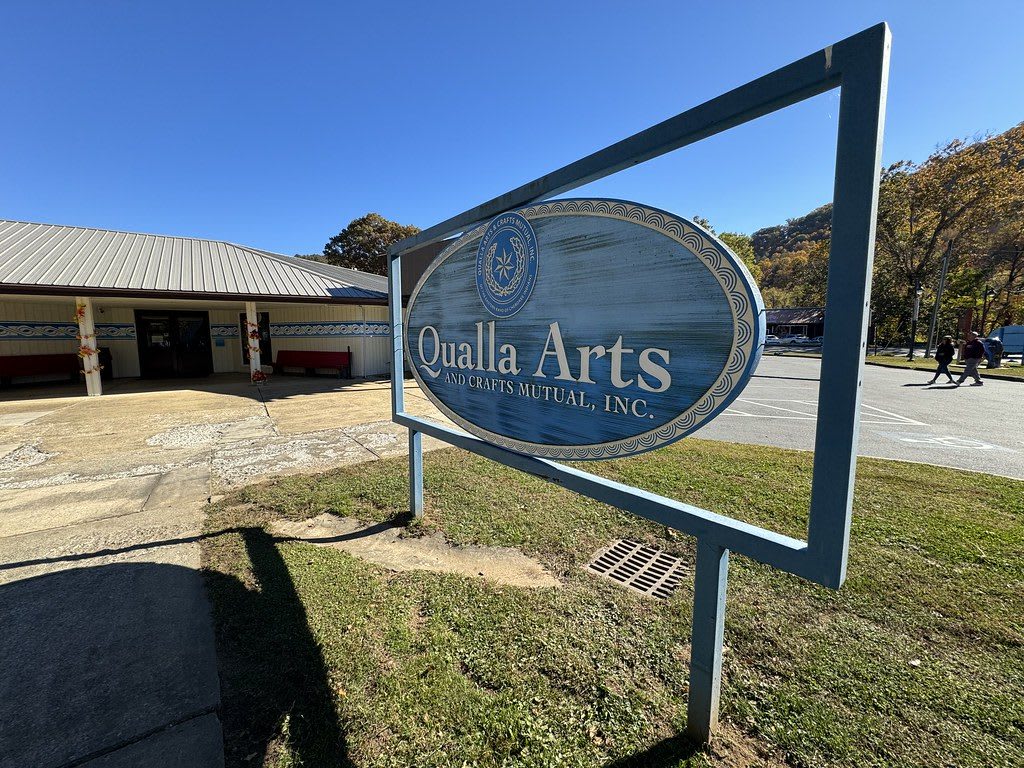
An oval blue sign reading Qualla Arts and Crafts Mutual in front of a low shop building under a clear autumn sky.Sarah Stierch / CC BY 2.0 via Flickr
🎭Cultural

Qualla Arts and Crafts Mutual

Part ofThe Great Smokies & Cherokee Country

The cooperative Cherokee craftspeople founded in 1946, selling baskets, carvings and pottery made by enrolled members of the Eastern Band.

⏱
Duration
Thirty minutes to an hour.
🎟
Admission
Free to browse.
📅
Best Season
Year round.

The Story

In the summer of 1946 about sixty Cherokee craftspeople, with help from Indian Service staff, formed a cooperative to give their work a year-round market. The Great Smoky Mountains National Park had opened in 1940 with an entrance through the Qualla Boundary, and the roads were filling with postwar travelers. The co-op was juried into the Southern Highland Handicraft Guild in 1949 and took the name Qualla Arts and Crafts Mutual in the mid-1950s. It calls itself the oldest Native American cooperative in the country.

It began in borrowed rooms, the Cherokee Indian Agency building among them, then rented shop space from the tribe in the Boundary Tree Motel complex. By 1960 sales were strong enough that the members planned a building of their own on Tsali Boulevard, a short walk from the Museum of the Cherokee People. A gallery followed in 1969, and a 1976 remodeling doubled the sales floor. Membership has passed 350 artists, all enrolled members of the Eastern Band, even as the rules for joining have tightened.

What is on the shelves is the point: river cane, white oak and honeysuckle baskets, the cane traditionally dyed with black walnut or bloodroot; masks of the kind carved for traditional dances; pottery, beadwork, finger weaving, quilts and stone carving, usually more than 3,000 pieces at once, each made by a member. A small museum inside the shop tells the story of the craftspeople who started it, and the work runs from small gifts to pieces by artists who have shown at the Smithsonian.

Visitor Info

⏱
Time Needed
Thirty minutes to an hour.
🎟
Admission
Free to browse.
📅
Best Season
Year round.
🛣️
Highway
US 441 (Tsali Boulevard)

On the Map

Nearby

The closest stops worth working into your route

cultural0.1 mi away
Museum of the Cherokee People
The Eastern Band's own museum on the Qualla Boundary, open since 1948 and now rethinking how it tells the Cherokee story in Cherokee voices.
cultural0.4 mi away
Oconaluftee Indian Village
A re-created eighteenth-century Cherokee town in Cherokee, opened in 1952, with craft and dance demonstrations, beside the outdoor drama Unto These Hills.
historical2 mi away
Mountain Farm Museum and Mingus Mill
Log farm buildings behind the Oconaluftee Visitor Center and an 1886 turbine gristmill, in the valley that was the Cherokee town of Egwanulti.
natural11 mi away
Newfound Gap
The lowest drivable pass through the Smokies, at 5,046 feet on the Tennessee and North Carolina line, where Roosevelt dedicated the park in 1940 and Kuwohi's Cherokee name was restored in 2024.
historical13 mi away
Lakeview Drive (the Road to Nowhere)
The park road promised in 1943 to replace a highway drowned by Fontana Lake, stopped at a tunnel in 1971 and settled for cash in 2010.
industrial27 mi away
Fontana Dam
TVA's wartime dam on the Little Tennessee, 480 feet tall, built in under three years for aluminum power at the cost of four drowned towns.

Historical markers nearby

Roadside plaques and monuments within a short detour

Marker0.2 mi away
Nimrod Jarrett Smith
Cherokee
Marker0.9 mi away
Thomas's Legion
Cherokee
Marker3.4 mi away
Cherokee Indian Reservation
Cherokee
Marker4.6 mi away
William H. Thomas
Whittier
Marker6.2 mi away
Yonaguska
Bryson City
Marker8.3 mi away
Tsali
Bryson City