Home / Arkansas / Texarkana, El Dorado & the Timberlands / Poison Spring Battleground State Park
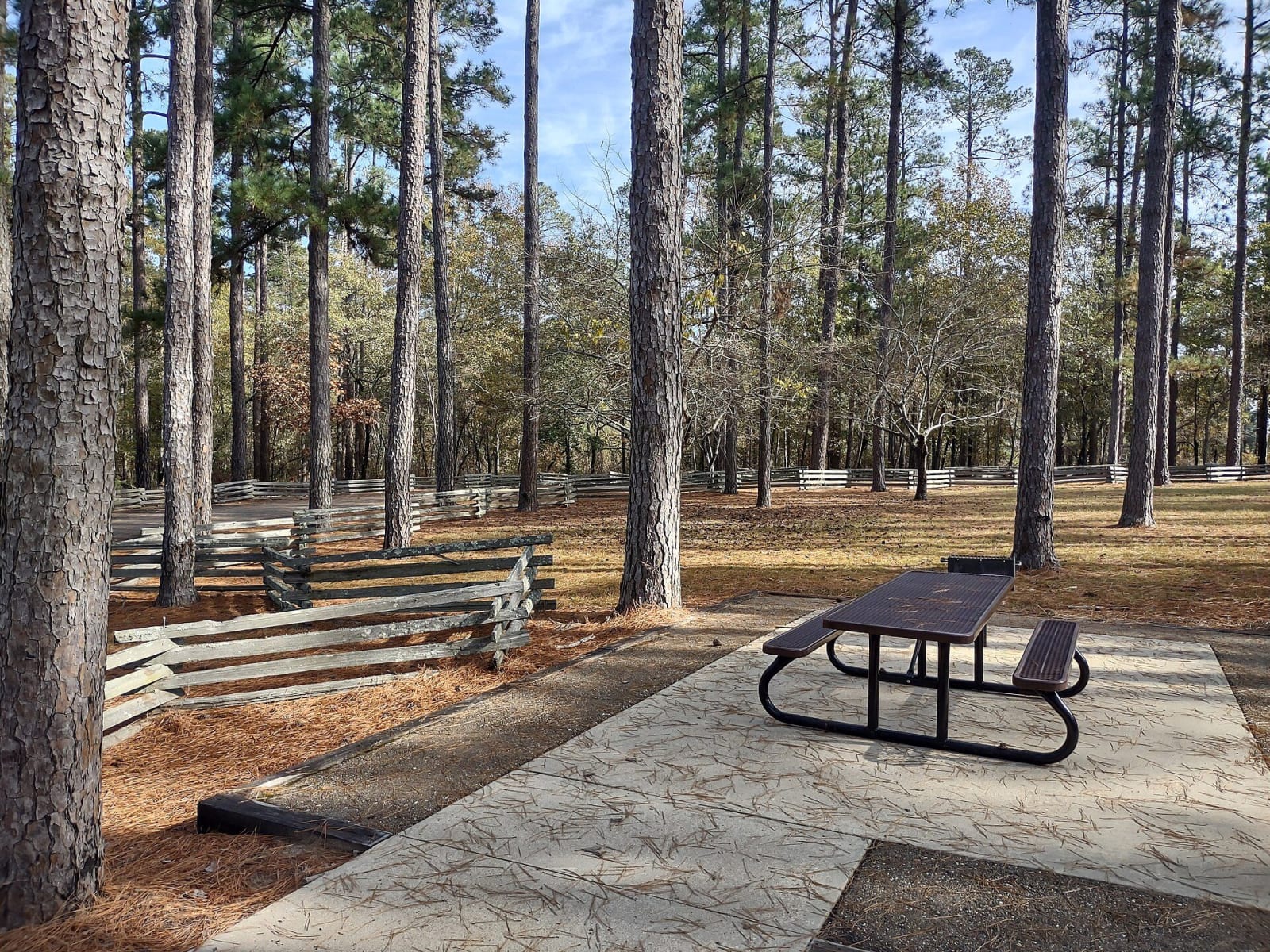
A split-rail fence and a picnic table among tall pines at Poison Spring Battleground State Park.Hog Farm / CC BY-SA 4.0 via Wikimedia Commons
🏛️Historical

Poison Spring Battleground State Park

Part ofTexarkana, El Dorado & the Timberlands

An 85-acre roadside battlefield west of Camden, where Confederates routed a Union foraging column on April 18, 1864, and many Black soldiers of the 1st Kansas Colored Infantry were killed after surrendering.

⏱
Duration
One hour.
🎟
Admission
No fee listed by the state parks page.
📅
Best Season
Open all year; the park closes at sunset (state parks page, November 2026). Cool months are best for the half-mile Poison Spring Nature Trail.

The Story

Union General Frederick Steele held Camden from April 15, 1864, and found it short of supplies. On April 17 he sent Colonel James M. Williams with over 600 men and 198 wagons to take corn from farms west of town. The column included the 1st Kansas Colored Infantry, a regiment recruited from formerly enslaved men from Arkansas and Missouri. On April 18, about 3,600 Confederate cavalry under Generals John Marmaduke and Samuel Maxey blocked the Camden-Washington road near Poison Spring. Colonel Tandy Walker's Choctaw Brigade from Indian Territory was among them. The 1st Kansas fought off two attacks, and a third by four brigades broke its line.

What followed is the reason this ground is remembered. The Encyclopedia of Arkansas says that both Union and Confederate accounts agree that many Black soldiers of the 1st Kansas were killed after the battle was over, among them wounded and captured men, and reports from the field say some were killed while trying to surrender. Williams lost 301 men killed, wounded and missing, 117 of the dead and sixty-five of the wounded from the 1st Kansas, against Confederate losses believed to be fewer than 145. The defeat, with a similar one at Marks' Mills a week later, led Steele to abandon Camden on the night of April 26.

The state created the park in 1961 to keep a small part of the field. Outdoor exhibits and picnic sites sit along Highway 76, ten miles west of Camden, with a short trail through the pines. The park is one of three Camden Expedition sites in a National Historic Landmark.

Visitor Info

⏱
Time Needed
One hour.
🎟
Admission
No fee listed by the state parks page.
📅
Best Season
Open all year; the park closes at sunset (state parks page, November 2026). Cool months are best for the half-mile Poison Spring Nature Trail.
🛣️
Highway
AR 76

On the Map

Nearby

The closest stops worth working into your route

recreational6.6 mi away
White Oak Lake State Park
A 725-acre park on the lower of two 1961 lakes, where white sand marks an ancient shoreline and the visitor center carries a Poison Spring display eight miles from the battlefield.
historical10 mi away
McCollum-Chidester House Museum
An 1847 Greek Revival house in Camden that served as a stagecoach headquarters and, in April 1864, as General Steele's headquarters, with bullet holes still visible upstairs.
natural23 mi away
Logoly State Park
Arkansas's first environmental education state park, built on the Magnesia Springs resort and a Boy Scout camp, with about 200 acres of mature forest kept as a natural area.
industrial27 mi away
Arkansas Museum of Natural Resources
A free state museum on the Smackover field, where a 112-foot derrick, a rebuilt 1920s boomtown street and working pumps tell how oil and bromine remade south Arkansas.
architectural29 mi away
Magnolia Square and the Columbia County Courthouse
The 1906 courthouse and square at the center of a town founded in 1853, where oil came in 1922, Southern Arkansas University grew from a farm school, and Jordan Jameson was burned to death in 1919.
historical34 mi away
President William Jefferson Clinton Birthplace Home National Historic Site
The two-story Hervey Street house in Hope where Bill Clinton lived his first four years with his widowed mother and her parents, now a National Park Service site with a ranger-led tour.