 StephenGA / CC0 via Flickr
The Story
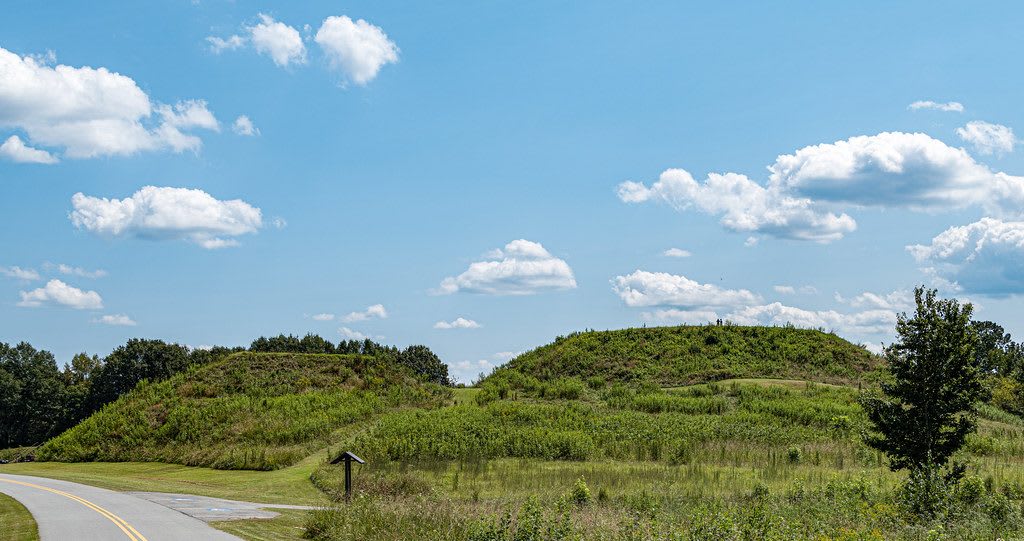
For the Muscogee (Creek) Nation this bluff above the Ocmulgee River is ancestral homeland, and Muscogee tradition remembers the mounds as the place where their ancestors first sat down at the end of a long migration from the west. People lived on the Macon Plateau for more than 12,000 years, but the great earthworks belong to an Early Mississippian town of about a thousand years ago, built by newcomers from the northwest. By hand, they raised flat-topped mounds, council houses and defensive ditches across a town a mile square, with the Great Temple Mound standing some 55 feet over the floodplain where they grew corn. At least one mound was a burial place.
Within a few centuries the town was empty, and what became of its people is still debated. Around 1690 Carolina traders built a post on the river here, beside a Hitchiti-speaking town called Ocmulgee; Muscogee warriors burned it in the Yamasee War of 1715. Early treaties took the land east of the river, all but these Old Fields, and the treaties of 1825 and 1826 pushed the Muscogee west of the Chattahoochee.
Relief workers dug here from 1933 to 1941 in the largest excavation the state has seen, and they found the clay floor of a council house dated to around 1050, with molded seats and a raised platform shaped like an eagle. The Earth Lodge, rebuilt over that floor, is open daily, and the visitor center museum holds about 2,000 artifacts. Eight miles of trails lead on to the Great Temple Mound, whose summit looks south across the river valley.
Visitor Info
On the Map
Nearby
The closest stops worth working into your route
Historical markers nearby
Roadside plaques and monuments within a short detour