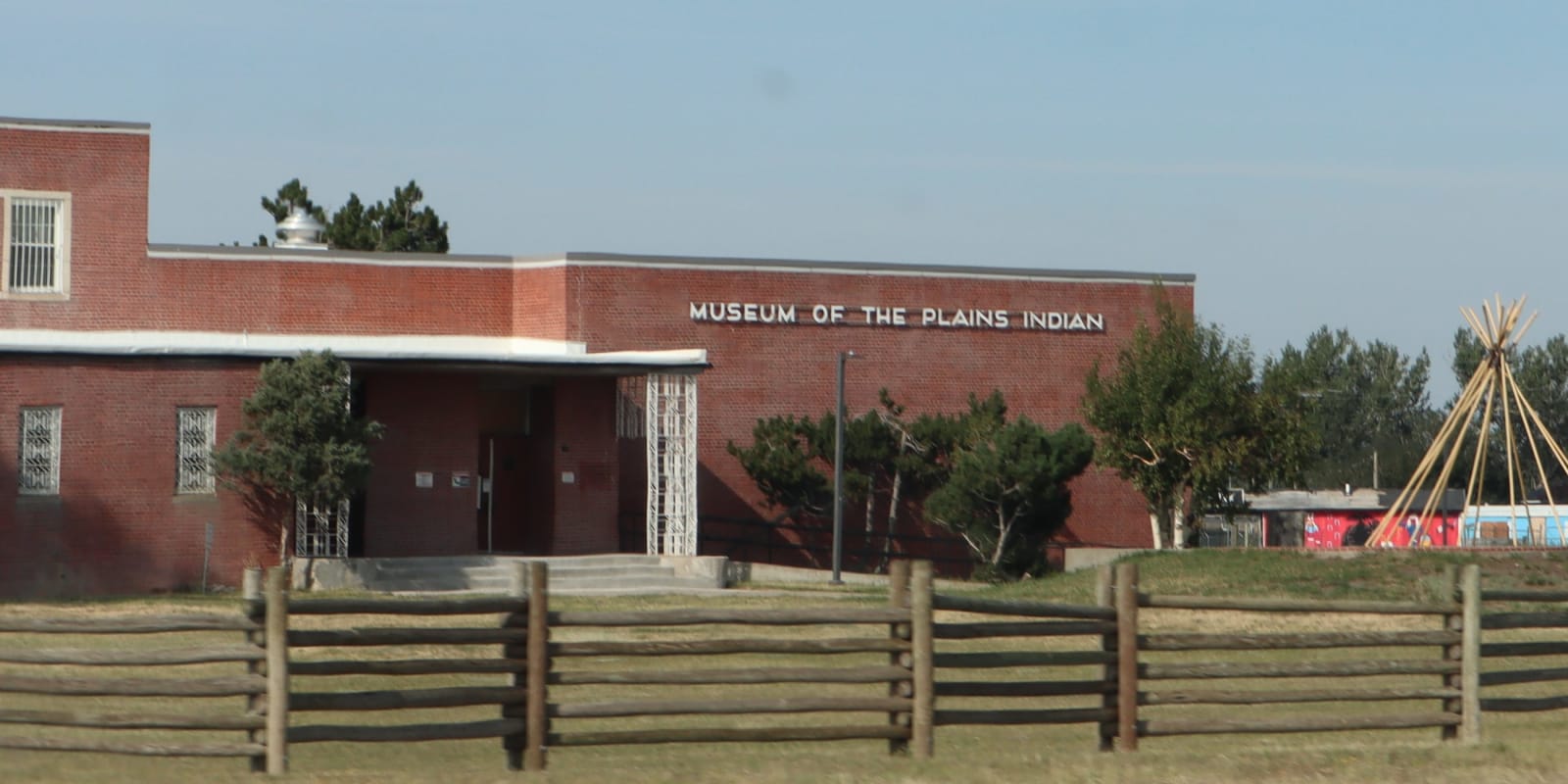
 Travellers & Tinkers / CC BY-SA 4.0 via Wikimedia Commons
The Story
The Museum of the Plains Indian belongs to the Indian Arts and Crafts Board, a federal agency set up in 1935 to protect Native artists' work and help them sell it. To lay out the exhibits the government hired John C. Ewers, a young ethnologist, in 1941. He was the museum's first curator and built its diorama of Plains life, and he went on to a long career at the Smithsonian and to books on Blackfeet history that are still read.
The building's murals are the work of Victor Pepion, a Blackfeet painter born on the reservation in 1908, who had studied under the German artist Winold Reiss and painted a series of them here in 1941; his watercolor poster for the new museum is now in the Smithsonian's National Museum of the American Indian. Carved wood panels by the Blackfeet sculptor John Clarke hang in the galleries, and half of the Plains art and craft gathered by the Great Northern's Louis W. Hill is here, the other half in St. Paul.
The museum still shows living artists. A summer showcase of contemporary Native work opens each year, and one exhibition was built around the stories of the reservation's painted tipis that Cecile Black Boy gathered for the Federal Writers' Project. The museum stands at the junction of US-2 and US-89 on the west side of Browning. It is open Tuesday through Friday only, closed on weekends and federal holidays. Admission is charged from June through September and free the rest of the year, always free to Blackfeet members, and national park passes are not accepted.
Visitor Info
On the Map
Nearby
The closest stops worth working into your route