 Roman Tokman / CC BY-SA 4.0 via Wikimedia Commons
The Story
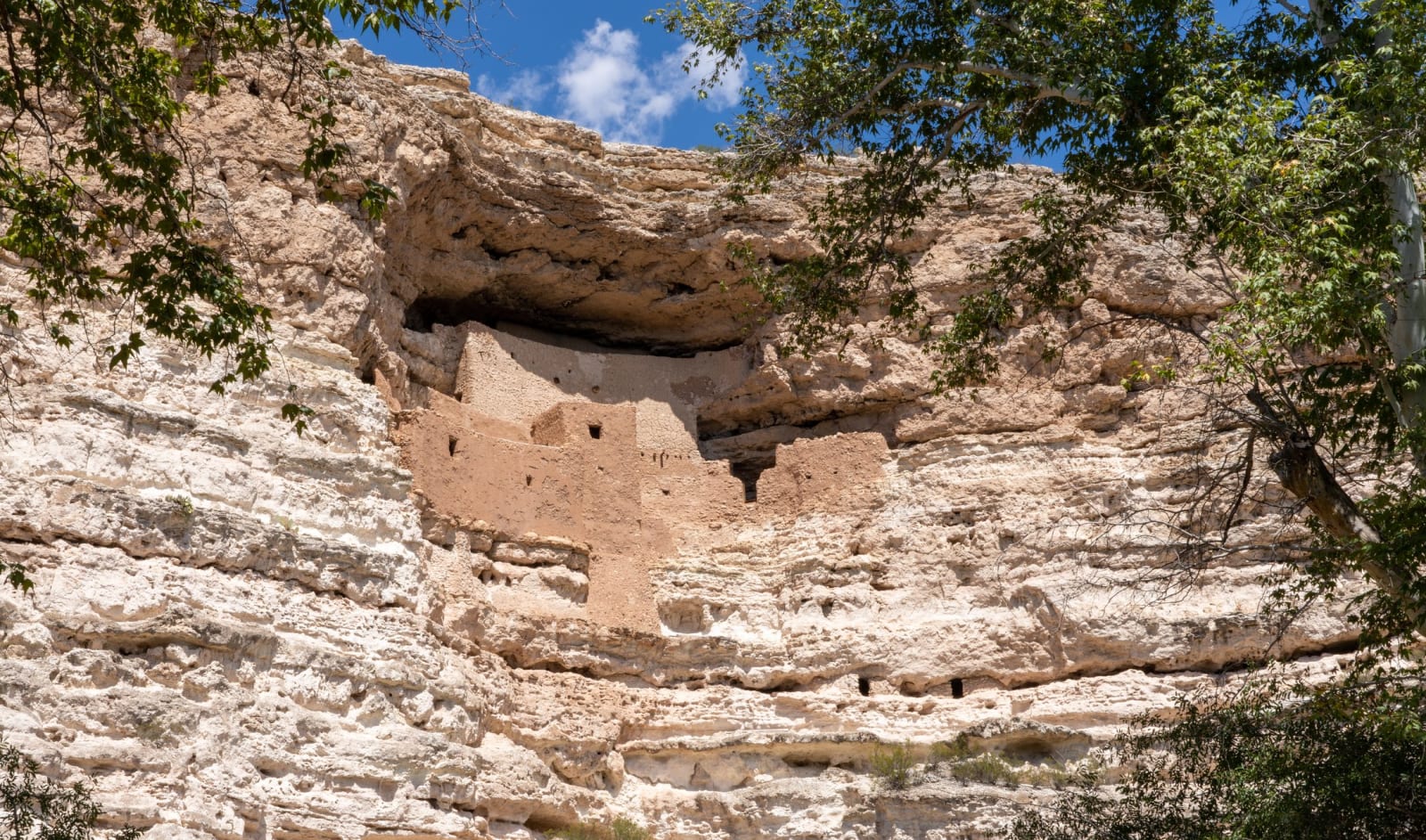
The name is wrong, and the National Park Service will tell you so before you reach the overlook. The five-story, twenty-room dwelling notched into the limestone cliff ninety feet above Beaver Creek was built and lived in by the Sinagua people between about 1100 and 1425 — a farming culture the archaeologists labeled with the Spanish for "without water," though along this creek they had plenty of it. The Sinagua left the place a full century before the Aztec ruler Montezuma was born. Settlers who came up the Verde in the 1860s simply assumed anything this impressive had to be Aztec, and the misnomer stuck to the map and never came off.
What they left is one of the best-preserved cliff dwellings in North America — limestone brick and mud mortar, viga-and-latilla ceilings, storage rooms and hearths, reached in its day only by ladders that could be pulled up behind you. Theodore Roosevelt made it one of the country's first national monuments in December 1906, under the brand-new Antiquities Act, specifically to stop the looting that had already begun. You can no longer climb into the rooms — that access was closed in the 1950s to preserve them — but the paved loop runs right along the base, close enough to read the construction.
A separate unit of the monument sits eleven miles northeast: Montezuma Well, a flooded limestone sinkhole fed by a spring that pushes out more than a million gallons a day, warm and carbonated and home to creatures found nowhere else on earth. The Sinagua ran irrigation ditches off it that are still traceable in the ground, and the Yavapai hold the Well as the place of their emergence, where the people came into this world.
The Sinagua are not a vanished people. The Hopi count them among their ancestors, and the Yavapai-Apache Nation's communities sit within a few miles of the cliff. The dwelling's sister site, the hilltop pueblo at Tuzigoot, tells the other half of the story; the red-rock country that first drew the Sinagua to this valley runs north to Sedona. The wrong name is worth holding in mind as you look — a small record of how easily the people who built this were written out of their own house.
Visitor Info
On the Map
A story featuring this place
Go deeper into the history and character of this stop
Nearby
The closest stops worth working into your route
Historical markers nearby
Roadside plaques and monuments within a short detour