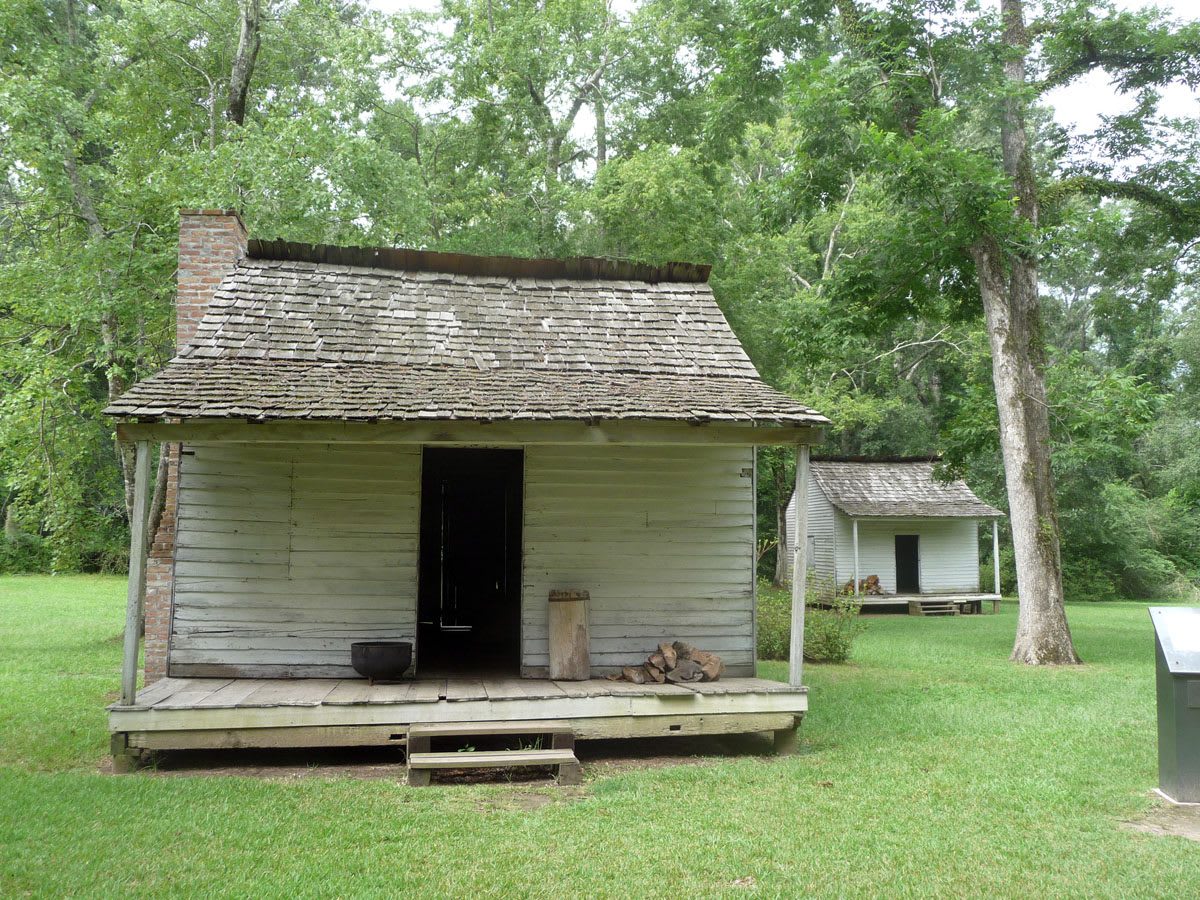
 Little Black Car / CC BY 2.0 via Wikimedia Commons
The Story
Two slave cabins stand a short way behind Oakley House, and they are the part of the site that connects it to most of the people who lived here. Laurie Wilkie's book Creating Freedom, published by LSU Press in 2000, follows four Black families who lived at Oakley between 1840 and 1950, using archaeology, oral interviews and documents. It traces how they endured slavery, Reconstruction and Jim Crow while keeping ties to their cultural past. The state site uses the cabins for programs on African Americans' part in building early America, and cooking demonstrations in the historic kitchen draw on African American traditions.
The house began in 1799, according to the National Register nomination, on a Spanish land grant that Ruffin Gray, a Natchez planter, held. Gray died before it was finished, and his widow Lucy completed it and later married James Pirrie of Scotland. Sources differ on the date: family tradition says 1799, records indicate 1806, and a 2005 survey cites 1815. In the spring of 1821 Lucy Pirrie hired John James Audubon as a tutor for her daughter Eliza. He arrived on June 18, was paid $60 a month plus room and board for himself and an assistant, and left on October 20, having painted 32 birds.
Louisiana acquired Oakley in 1947, restored it and opened it to the public. The site is at 11788 Highway 965, with a 100-acre forest of walking trails. Open daily 9 a.m. to 5 p.m.; admission is $6, as listed in 2026.
Visitor Info
On the Map
Nearby
The closest stops worth working into your route
Historical markers nearby
Roadside plaques and monuments within a short detour